As regular CFZ-watchers will know, for some time Corinna has been doing a column for Animals & Men and a regular segment on On The Track... particularly about out-of-place birds and rare vagrants. There seem to be more and more bird stories from all over the world hitting the news these days so, to make room for them all - and to give them all equal and worthy coverage - she has set up this new blog to cover all things feathery and Fortean.
Showing posts with label Europe. Show all posts

Wednesday, 22 May 2019

How to watch spring migration unfold across Europe


 10/04/2019

EuroBirdPortal LIVE – a free, web-based tool that provides a fascinating insight into the movements across Europe – has been launched this week. The portal allows the user to watch the northward migration of some 105 species, including Common Cuckoo and Swallow, via a live viewing programme. Animated maps are updated daily based on roughly 120,000 observations from birders across the region. 
Birders submitting their observations to BirdTrack will be contributing to this exciting project and, over the course of a year, around 45 million new observations are added, providing an unprecedented near real-time view of the movements of migrants as they arrive in Europe from further south and move north with the progression of spring. Gabriel Gargallo, EuroBirdPortal (EBP) project coordinator, said: "With the huge improvements in terms of coverage, data quality and connectivity accomplished during the last three years thanks to the EU LIFE grant, the EBP project has made a big step forward.
"Now we have better data, vital to properly understand the seasonal patterns of bird distribution in Europe and their changes over time, and it is readily available, providing unique opportunities to develop novel applications of conservation and management concern (for example, predicting wildfowl movements due to cold spells or improving the surveillance of avian-borne diseases).
"But all this would not be possible without the more than 120,000 volunteer birdwatchers regularly sharing their observations with the different online portals. The LIVE version of the EBP viewer recognises their vital role in the project and showcases how such individual and local contributions can be nicely summed up to help unravel the large-scale seasonal distributional patterns of our birds."
Scott Mayson, BirdTrack Organiser at BTO, added: "It is great to see the observations of birdwatchers contributing to this amazing project. I have always wanted to be able to follow a bird such as a Swallow as it migrates and now I can. This is citizen science at its very best."
You can follow developments at eurobirdportal.org.

Monday, 18 March 2019

Report reveals number of wild birds that were killed lawfully by hunters in Europe


Wednesday, March 06, 2019 - 01:34 PM
A report has found that more than 52 million wild birds are being killed lawfully by hunters in Europe each year.
The study provides data on 82 species of wild bird which may be legally hunted.
The research paper, which has been compiled by staff from the Committee Against Bird Slaughter (CABS) is a follow-up to a report which was first conducted back in 2005.
It makes official hunting statistics from 24 EU member states plus Switzerland and Norway available publicly for the first time.
The authors point out that despite a long-term decrease in the gross number of killings compared with older data, the bag figures for certain migratory species, such as Common Pochard, Northern Lapwing, Turtle Dove and Skylark, remain high in proportion to their declining populations Europe.
Against a backdrop of declining populations of many affected species, hunting pressures are undermining conservation efforts undertaken for these species in other countries.
"The hunting of birds with rapidly declining populations is not sustainable and therefore is a clear breach of the European Birds Directive", CABS Conservation Officer Geraldine Attard, who is one of the authors of the study, concluded.
Birds killed lawfully in Europe
1,607,964 Quails,
1,455,208 Turtle Doves,
973,414 Woodcocks,
898,958 Skylarks
522,253 Teal,
205,577 Snipe,
107,802 Lapwings,
The report is published this week in the journal British Birds.

Monday, 11 March 2019

Spring migration is now earlier in European and North American birds


Date:  February 25, 2019
Source:  University of Helsinki
Summary:
According to a new study, migratory birds in Europe and Canada have substantially advanced the timing of their spring migration due to climate change. The average migratory bird has advanced its spring migration by approximately one week in five decades, and the duration of the migration season has increased.
The greatest advances were found among short-distance migrants that winter in Europe or North America: about 1.5-2 days per decade. Long-distance migrants that winter in the tropics have also advanced the start of their migration, but only by approximately 0.6-1.2 days per decade.
"Based on changes in median migration dates, birds have on average advanced their spring migration by a little over a week since the late 1950s," says Aleksi Lehikoinen from the Finnish Museum of Natural History, University of Helsinki.
Some species show much greater advances. For instance, Whooper Swans now arrive in Finland about two weeks earlier than in the 1980s.
The advances in spring migration dates are not equal across the migration season. Early migrants of a given species have advanced their migration dates more than late migrants within the species' migration season. First migrants have the highest pressure to arrive at their breeding grounds as early as possible, whereas late migrants are typically non-breeders, which have no rush to move north. This asymmetry has led to an overall increase in the duration of migration.


Friday, 21 December 2018

Moun­tain birds de­clin­ing in Europe


Date:  December 13, 2018
Source:  University of Helsinki
Population data for European mountain birds have been for the first time combined in a recent study, with worrying results: the abundances of mountain-specialist birds has declined by as much as 10% in the 2000s.
Ecological communities in mountain areas include species not found in any other habitats. These species are also very susceptible to climate change, as global warming is reducing their liveable habitats. In principle, species may relocate further up the mountains, but closer to the top their habitat inevitably shrinks.
According to the new article, the abundance of European mountain birds has in fact declined in line with climate change projections.
The recently released study examined the population trends of 44 bird species in the 2000s in the mountain and fell regions of Fennoscandia, Great Britain, the Alps and the Iberian Peninsula. A decline was seen in 14 of the observed species, while eight of them saw significant increase.
"On average, population decline among the species studied was 7% over the 13-year research period, making the situation of mountain birds distinctly worse compared to, for example, European forest birds, whose numbers did not change during the same period," explains Aleksi Lehikoinen, an Academy of Finland research fellow at the Finnish Museum of Natural History Luomus (part of the University of Helsinki), who headed the study.


Friday, 30 November 2018

First European bird extinction for 170 years


14/11/2018
After nearly 40 years without a confirmed sighting, Common Buttonquail has become the first bird to be declared extinct in Europe since Great Auk.
Better known by European birders as Andalusian Hemipode, the species has been officially classified as Extinct by the Ecological Transition of the Spanish Government, with extensive searches in southern Spain during the last two decades failing to unearth any remnant populations of this elusive species. The last confirmed Spanish record was in 1981 near DoƱana National Park and while reliable observations – often of singing birds – were made into the 2000s, none was fully accepted.
Unlike Great Auk, Common Buttonquail is not globally extinct, and is in fact widely distributed in Africa and Asia. It maintains a flimsy foothold in the Western Palearctic, with a small and declining population of the nominate subspecies sylvaticus found in traditional farmland in parts of coastal Morocco. This population was undiscovered for decades, and only came to public light in 2011 following a paper published in Dutch Birding. In Europe however, Spain represented the last vestige for Common Buttonquail, with the only other populations in Sicily and Portugal likely becoming extinct in the 1920s and 1970s respectively.

Thursday, 25 October 2018

5 ways Important Bird & Biodiversity Areas have changed conservation


24 Oct 2018

40 years ago, we set out to identify the most important sites for birds in Europe. This idea has since spread across the world, informing conservation decisions and setting the model for wider initiatives to follow suit. We recount our top successes in that time.
Way back in 1979, when people had only just stopped wearing flared trousers and BirdLife was still called the ICBP (The International Council for Bird Preservation), we launched a bold new idea – one whose influence has gone far further than we could ever have hoped.
Important Bird and Biodiversity Areas had their origins in the European Union – which at the time was still the European Economic Community (EEC). In 1979, the EEC adopted the Birds Directive, which requires all member states to identify and protect areas that are important habitats for birds. However, it soon became clear that few understood where the most important sites for birds were. It was time for BirdLife to take the helm. So we came up with the criteria to identify these sites – and started to put them into action.
By 1994, IBAs had started expanding across the world. There are now over 13,000 IBAs, which cover 6.7% of the earth’s land surface and 4.2% of the oceans.
But what makes IBAs unique? Firstly, they are identified using the same set of criteria across the whole world, in all countries and in all ecosystems. And unlike landscape-scale approaches such as Biodiversity Hotspots, they pinpoint single sites that can be protected by conservation action to safeguard crucial habitats for one or more bird species. They also tend to be important for wider biodiversity, protecting a diverse range of plants and animals.
Here’s how IBAs have helped to conserve the environment over the past 40 years.

Sunday, 17 December 2017

Hawfinch invasion as rare birds flock to Britain in thousands after crop failures in Europe

Sarah Knapton, science editor 
1 DECEMBER 2017 • 12:01AM

Flocks of rare hawfinches have begun arriving in Britain in huge numbers following crop failures in Germany and Romania.

The little birds largely bypass the UK in the winter, staying in central Europe, but poor harvests on the continent has sent them further north looking for autumn fruits and nuts.

Nature experts are urging people to get outside this weekend to glimpse the elusive birds that are renowned for their parrot like bills, and which are flocking in groups of 100 or more, which is around 12 times the national average.

The National Trust has reported there hawfinches at Fyne Court, Somerset - where hawfinches have not been seen for seven years - as well Clumber Park, Nottinghamshire, Sizergh, in Cumbria and the Slindon Estate in West Sussex.

The birds have also been spotted at Sissinghurst in Kent, Felbrigg in Norfolk, Hatfield Forest in Essex, Basildon Park in Berks, Steps Hill at Ashridge in Bucks and Wimpole in Cambs.

Nature specialist Matthew Oates, says, “There has been an unprecedented influx of these shy and secretive birds to our shores.

“The keenest of birders may only spot a handful of hawfinches during years of birdwatching but right now, everyone has a chance.


Wednesday, 21 June 2017

Dire Straits - is Europe protecting its seabirds?


7 Jun 2017

By Gui-Xi Young

A new scientific paper, spearheaded by our Head of Conservation, IvĆ”n RamĆ­rez, has been published in the peer-reviewed journal ‘Marine Policy’. This study summarises the latest country-by-country and species-specific analyses of the EU’s marine SPA (Special Protection Areas) network and offers critical new insights into how well Europe is protecting its seabirds.

With oceans covering 71% of the Earth’s surface, it is small wonder that our little home in the solar system is often called the ‘Blue Planet’. Yet so much of our ocean environment remains a mystery. But indeed, isn’t that the romance of the big blue expanse that we are celebrating today, on ‘World Oceans Day’. A romance that has inspired explorers from Cook to Cousteau, storytellers from Homer to Hemmingway…and, of course, conservationists seeking to fathom the depths.

Sadly, on the flip side, the conservation of marine biodiversity is – in the words of Ivan Ramirez, Head of Conservation at BirdLife Europe & Central Asia – “a challenging enterprise”. To say the least. Many marine species are incredibly difficult to observe or track and there is an inherent lack of data and research resources in many countries, both here in Europe and globally.

The Desertas petrel…all at sea
Take the Desertas petrel, for example, a recently split species listed as Vulnerable because of its small population. RamĆ­rez and his colleagues have been tracking this species yearly since 2007, and have now accumulated one of the largest tracking datasets of any gadfly petrel in the world (available at seabirdtracking.org)! What the tiny loggers attached to the bird’s legs revealed to them was quite amazing: from its remote breeding grounds in Bugio Island (Madeira), the Desertas petrel performs a truly Atlantic “tour” with individuals wintering in as many as five different locations, identified in Cape Verde, Brazil, Argentina and Florida. RamĆ­rez has also found that these birds are very loyal to their winter grounds – that is, if a particular bird likes the Brazilian Coast, it will go there every single year.

Sunday, 7 May 2017

Birdwatchers flock to North Ronaldsay after rare bird sighting

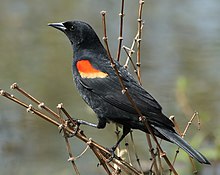
North Ronaldsay Bird Observatory (NRBO) has been inundated with visitors over the past two days, following the sighting of a Red-winged Blackbird.

Agelaius phoeniceus 0110 taxo.jpgThough very common in North America, this is the first recorded sighting of the species in Europe. Since it was first spotted last Saturday, April 28, over between 50 and 60 birdwatchers have arrived on the island each day, hoping to catch a glimpse.

NRBO’s Simon Davies explained that Red-winged blackbirds typically nest marsh areas. 

This specimen has been feeding in the middle of the Iris beds on North Ronaldsay, but no one is quite sure how it got there.

With the volume of birdwatchers increasing, NRBO made the decision yesterday to “flush” the bird out of its new residence and into a more suitable area. They hope that this will prevent any damage being done to the Iris beds, which already provide an important breeding ground for the island’s waterfowl.

“When a bird is flushed, it involves a lone member of the observatory staff going through the known feeding area to push the bird out towards another favourable area for the bird,” NRBO explained in a statement on Twitter.

“As you’ll appreciate, the bird is very rare and the volume of twitchers on the island is high. Without the use of this policing technique, groups of twitchers would simply arrive on the sit, fan out over the area and trample the irises that breeding birds find so important.”


NRBO staff also confirmed that they will be continuing to monitor the area, round-the-clock, in order to protect the both the bird and its habitat.

 sOURCE

Sunday, 16 October 2016

Saving two adult eagles per year to save the population of this endangered species


Date: September 29, 2016
Source: Universidad de Barcelona

Dying due to electrocution at the power lines is the most common death for Bonelli's eagle (Aquila fasciata), a threatened species in Europe. This is the case of a ringed bird in 2008 -- the baby bird 0M -- in Montserrat Mountain (Barcelona, Spain), that died due to electrocution in 2014 in a place with high density of power lines in a place in PenedĆØs where the baby lived. Electrocution was the same death cause for another ringed eagle -- baby bird CD -- in VallĆØs mountains in 2013 and found dead in 2015 at the bottom of an electric tower in EmpordĆ  (Girona, Spain).

These are only two examples of the 92 Bonelli's eagles that died due to electrocution in Catalonia from 1990 to 2014, a problem that has big effects on birds around the world. In other parts of the peninsula, this affects other species with great ecological value, such as the Spanish imperial eagle (Aquila adalberti), and another of the most threatened species around the world. In the United States, one of the most affected species is the American bald eagle (Haliaeetus leucocephalus), considered to be the national symbol of a country where there are around 12 and 64 million bird deaths due to power lines (around 11 million electrocutions).