As regular CFZ-watchers will know, for some time Corinna has been doing a column for Animals & Men and a regular segment on On The Track... particularly about out-of-place birds and rare vagrants. There seem to be more and more bird stories from all over the world hitting the news these days so, to make room for them all - and to give them all equal and worthy coverage - she has set up this new blog to cover all things feathery and Fortean.
Showing posts with label critically endangered species. Show all posts

Friday, 28 February 2020

Mass poisoning causes a heavy blow to the largest colony of Griffon Vultures in mainland Greece

We are devastated to report that eleven Griffon Vultures fell victim to poisoning in the area of Klisoura Gorge in Greece. Unfortunately, nine vultures died from the incident, and two are alive but currently in recovery.
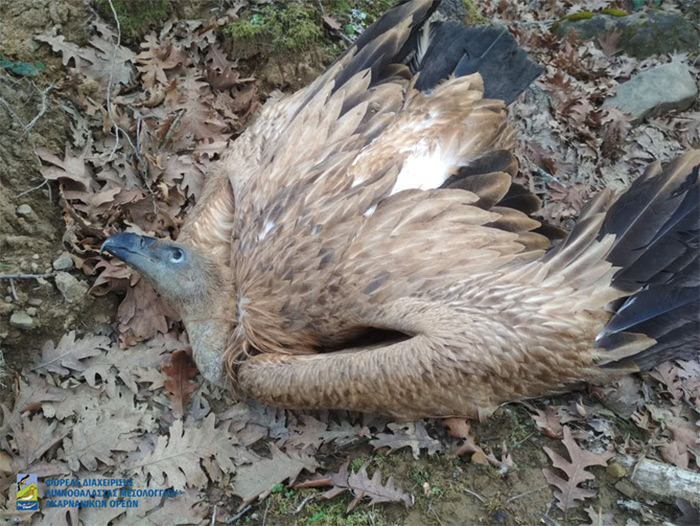
A total of eleven Griffon Vultures, a protected and critically endangered species in Greece, have been found poisoned in Klisoura Canyon in the Messolonghi-Etoliko Lagoon National Park a few days ago. This is the most severe poisoning case recorded in the country, after the one in the Strait of Nestos in 2012, and the largest confirmed case for Griffon Vultures.

The Messolonghi Management Body and HOS/BirdLife Greece discovered the carcasses of the nine Griffon Vultures. Executives from the Management Body of the Hunting Association of Messolonghi recovered the other two Griffon Vultures, which are currently alive and are being treated at ANIMA, gradually showing signs of recovery from poisoning. The dead vultures will be sent to the Athens Veterinary Foundations Centre for toxicological analysis, and to help avoid further poisoning.

Concerns about the fate of the rest of the vultures in the area are high and the danger of the local vulture population collapsing remains. The Griffon Vulture colony of Klisoura and Akarnania, are the only ones left in Western Greece and the largest remaining in the mainland.

Monday, 11 June 2018

A new home for Raso Lark


19/05/2018

In a bid to preserve its threatened population, the Critically Endangered Raso Lark has been reintroduced to an island from which it has been missing for centuries.

Raso Lark's range has been restricted to the small islet of Raso, Cape Verde, since humans arrived in the archipelago in the 15th century. Raso is largely a rock desert, with some sandy parts in the west, and the larks generally favour small vegetated areas along dry stream beds on level plains with volcanic soil. The tiny size of the island, plus its susceptibility to periods of drought, places Raso Lark in a precarious position. The species' population fluctuates greatly in response to climatic conditions; during wetter weather, when vegetation grows and food becomes plentiful, it can rapidly increase, with numbers in the low thousands, but drier periods have reduced its population to just a few hundred mature individuals in the space of a few years.

Prior to human colonisation, Raso Lark was believed to be more widespread, frequenting both Branco and São Vicente Islands. Evidence from subfossil bone deposits reveal that it once also existed on the islands of Santa Luzia, São Vicente and Santo Antão. There are also one or two recent records of vagrants from São Nicolau, including one at Ponta do Barril in March 2009.

With this in mind, a new project, Cape Verde conservation charity Biosfera 1, in association with the Portuguese Society for the Study of Birds (SPEA) and other organisations, has launched an ambitious reintroduction programme on Santa Luzia.

Since 15 April, a total of 37 Raso Larks were translocated from Raso to Santa Luiza, where they have been successfully released. Each individual lark has been fitted with a small radio tag so that it can be tracked, allowing researchers to establish which area of the island they favour and whether the birds stick together and behave naturally.


Sunday, 19 November 2017

Critically Endangered hawks thrive following translocation


Species translocation - capturing animals in one place and releasing them in another—is a widely used conservation method for establishing or reestablishing populations of threatened species. However, translocation projects often fail when the transplanted animals fail to thrive in their new home. A new study from The Condor: Ornithological Applications demonstrates how close monitoring of the animals being released into a new area is helping wildlife managers gauge the success of their effort to save the Ridgway’s Hawk of Hispaniola.

Ridgway’s Hawk is a critically endangered raptor endemic to the Caribbean island of Hispaniola. Since 2009, the Peregrine Fund has translocated 104 nestlings from the species’ stronghold in a national park to a protected resort area called Punta Cana 130 kilometers away. They monitored the birds after their release, tracking their survival and breeding success, as well as collecting the same data on 36–110 breeding pairs per year in the original national park population. Survival rates were high in both locations, and more young hawks began breeding on the resort property, probably because more territories were available due to the birds’ low numbers.

Continued  

Friday, 17 November 2017

Captive-reared Critically Endangered vultures soon to be released in Nepal

8 Nov 2017

Conservationists are making great progress in removing vulture-killing drug diclofenac from Nepal, with vulture populations stabilising as a result. Now, in this safer environment, it’s almost time for six captive-reared White-rumped Vultures to venture out into the wild.

South Asian vultures have famously suffered devastating population declines in recent decades. For example, 99.9% of White-rumped Vultures Gyps bengalensis were wiped out between 1992 and 2007. This was due to the use of diclofenac: an anti-inflammatory drug given to reduce pain in livestock, but deadly to vultures that subsequently feed on their carcasses. A ban on veterinary diclofenac in India, Nepal and Pakistan in 2006 and Bangladesh in 2010 has allowed vulture populations to stabilise and possibly start to recover in some areas.

However, five of South Asia’s nine vulture species remain Endangered or Critically Endangered; the misuse of human diclofenac to treat livestock, as well as the use of other vulture-toxic veterinary drugs, continues to threaten some South Asian vulture populations with extinction. BirdLife Partners are changing that, through a combination of advocacy, legislation and education.

Monday, 9 October 2017

Alala released into Hawaii Island native forest


Published September 27, 2017 - 10:58am

HILO — Six young Alala — critically endangered Hawaiian crows — were released Wednesday into Puu Makaala Natural Area Reserve on the Big Island.

The first group of birds: two females and four males took some time to emerge from the aviary where they had been temporarily housed and they appeared to show a natural curiosity for their surroundings. Plans are to release a second group of five birds: two females and three males in mid-October from the same release aviary.

Previously, in December, a reintroduction attempt was halted after challenges posed by winter storms and predation on Alala by Io, (Hawaiian hawk). The concerted reintroduction efforts, funded by the state Department of Land and Natural Resources, San Diego Zoo Global, and U.S. Fish and Wildlife Service have addressed those challenges by changing the timing of release to avoid winter storms, changing the release site location, releasing a social group of both males and females, and enhancing the “antipredator training program” to teach the released birds how to better respond to predators like Io.

A high mortality rate is associated with releasing species into the wild. This is especially true for species like Alala that have been in captivity for longer periods of time. A successful conservation breeding program gives managers the flexibility to adapt their management techniques to improve successful transition to the wild. Conservation breeding programs are key tools for recovering threatened and endangered species.


Monday, 26 June 2017

Can we bring back the pheasant that was wiped out by the war in Vietnam?

16 Jun 2017

The Edwards’s Pheasant, a Vietnam endemic, has been all but wiped out in the wild in the aftermath of the war that once ravaged the land. But a prospering caged community brings hope that it could once again come home to roost

Framed by mounds of white tuft, the ruddy faces of the Red-shanked Douc monkeys peer out from the forest canopies. In the distance, calls of White-cheeked Gibbons echo through the early morning stillness. Underneath, browsing in the shadows of the forest floor are myriad species of deer; among them forages one of the world’s rarest large mammals – the Saola, a bovine that lives in forests so wild and remote, that they were unknown to humans until researchers happened upon the remains of one during an expedition in 1992.

That is a measure of how deep into the wilderness we’ve had to come to get here. We’re in Khe Nuoc Trong, an evergreen-broadleaf forest situated in the Annamese lowlands, Vietnam. It feels like you couldn’t stretch your arms out to yawn without knocking three or four endangered species off their perch. The area is a jewel of biodiversity, but something’s missing. A very important part of the forest’s heritage, in fact. You could spend all morning listening out into the stillness without ever once hearing a guttural “uk-uk-uk-uk-uk” call, which once rang loud and clear through the canopies. A call that belongs, or perhaps once belonged, to the Edwards’s Pheasant Lophura edwardsi (Critically Endangered) – an endemic species that has not been seen in the wild since 2000.

This beautiful bird, whose males are iridescent blue with a flash of red on the face and a white crest, was little known in the wild even prior to its disapperance; it was said to love the dark shadows of ever-wet lowland forests. It was discovered in 1896 and was recorded by French ornithologists during the early 20th Century, but then went unrecorded for almost 60 years. Suddenly, in 1996, it was rediscovered, but almost as soon as it was found, it vanished again. Extensive surveying of its favoured haunts has found no trace of it since.

Friday, 24 March 2017

Kenyan wind farm could wipe out critically endangered vultures


BirdLife International, Nature Kenya, Kenya Bird of Prey Trust and The Peregrine Fund have collectively expressed concern over a proposal to develop the Kipeto Wind Energy Project, in Kajiado County, Kenya. This is due to the fact that the proposed wind farm will be in close proximity to the nesting sites of two species of Critically Endangered vultures and also close to an important flyway for a vast numbers of migratory birds. 

Just 14 km from Kwenia cliffs – the third largest nesting site of Rüppell’s Vultures in Kenya – and 10 km from the White-backed Vulture colony, these wind turbine blades could severely impact these species, both on the edge of extinction. Recent surveys commissioned by the project developers show that collectively these two colonies regularly hold more than 80 pairs of nesting vultures and that both species frequently fly over and occasionally forage at the proposed wind farm site and would be at risk of colliding with wind turbines. 

The area has already seen the extinction of Endangered Egyptian Vultures, yet it still holds an impressive number of cliff-dwelling large falcons and Verreaux’s Eagles. The project location lies along the north-south ridge of the Rift Valley Escarpment, which is a prime location for migratory species including globally endangered Steppe Eagles as well as Amur Falcons, Eurasian Hobbys, Lesser Kestrels and White Storks. The site is unique for its density of raptors, and deserving of special protection status, particularly in recognition that African Vultures are vitally important “cleaners of the environment” that help prevent the spread of diseases. 

Friday, 20 January 2017

Biologist reveals important role cities play in conservation of threatened species


Hong Kong home to critically endangered yellow-crested cockatoo 
Date: January 5, 2017
Source: The University of Hong Kong

The exhaustive international trade of wildlife has pushed many species to the brink of extinction. Coincidentally, many of the same species have been introduced to urban centres or wilderness areas outside their natural ranges. In a recent study published in Frontiers in Ecology and the Environment, authors from Hong Kong and Australia find that these introduced populations may provide hope for these threatened species.

"Across the planet, poachers have reached into the last remote habitats to harvest wildlife populations used for clothing, eaten, or kept as pets in faraway cities," said Dr. Luke Gibson from the School of Biological Sciences of the University of Hong Kong, who led the study.

"In some cases, the traded organisms have escaped and are now thriving in their introduced habitats," he added.

In total, the authors identified 49 globally threatened species -- those listed by the International Union for the Conservation of Nature as Vulnerable, Endangered, or Critically Endangered -- which have established introduced populations outside their native distribution. These include amphibians, reptiles, mammals, and birds, as well as insects and plants, with introduced populations found on all continents except Antarctica.

Continued

Thursday, 12 January 2017

The Poor Bustard! Court Order Protecting Endangered Bird Flouted

Manon Verchot
Yesterday, 12:27 pm

Two new windmills have popped up near Desert National Park despite a court order for construction to stop.

The turbines, built not far from Jaisalmer, are in the flight path of the Great Indian Bustard, a critically endangered species with around 200 individuals left. Construction was supposed to be halted until an Eco-Sensitive Zone was demarcated.

The Great Indian Bustard was almost poached to extinction over the past four decades. Though the birds are still hunted for sport in Pakistan, a hunting ban in India has managed to protect 140 bustards in Rajasthan.

The government set up a Rs 12 crore project to save the bustard, which they launched in 2015. Late last year, 11 chicks successfully hatched in Dessert National Park, bringing the number up to 151.

But the new windmills threaten to undo this progress. Conservation activists say the bustards could be killed by the windmill blades, and that the noise made by these mills disturbs the birds. 
 

Friday, 7 October 2016

The Tiny Threat That’s Killing North America’s Largest Bird


Some critically endangered California condors carry genes that are causing fatal dwarfism in their offspring. Scientists are working on a genetic test to help save the species.
 
Every egg matters when you’re trying to save a critically endangered bird from extinction.
That’s especially true for California condors, North America’s largest birds with a 10-foot wingspan. Condors nearly went extinct in the 1980s as a result of hunting, lead contamination, DDT poisoning, and other factors. The last 22 California condors were brought into captivity in 1987 in a last-ditch effort to breed them in safety and save the species from disappearing.

That desperate move was a success. Today, the California condor population has risen to more than 435—all descended from just 14 breeding individuals—and the birds have returned to the skies above California, Arizona, Utah, and Baja, Mexico.

That number would be much higher, however, if every California condor egg hatched a healthy young chick. That isn’t always the case. Eggs fail in captivity and in the wild for a number of reasons, but one of the most worrying is a rare genetic condition called chondrodystrophy, a lethal form of dwarfism.

 “The chicks born with this disease show very short extremities,” said Cynthia Steiner, acting associate director of genetics at San Diego Zoo Global, who is studying the disease. “It produces late embryonic mortality. The chicks die right before or right after hatching.”

Chondrodystrophy first showed up in five California condor eggs in the late 1990s, a period when the population was just starting to climb again. “It was a big alarm for the managers of the captive population,” Steiner said. Since then the problem has shown up several other times, although exactly how often is unclear because not every failed egg is fully examined to determine why it did not hatch successfully. Steiner said the data researchers do have suggests that some form of malformation and embryonic death affected about 120 fertile eggs over the past 22 years.