As regular CFZ-watchers will know, for some time Corinna has been doing a column for Animals & Men and a regular segment on On The Track... particularly about out-of-place birds and rare vagrants. There seem to be more and more bird stories from all over the world hitting the news these days so, to make room for them all - and to give them all equal and worthy coverage - she has set up this new blog to cover all things feathery and Fortean.
Showing posts with label ostrich. Show all posts

Friday, 29 November 2019

Ostrich eggshell beads reveal 10,000 years of cultural interaction across Africa

Date: November 27, 2019
Source: Max Planck Institute for the Science of Human History

Ostrich eggshell beads are some of the oldest ornaments made by humankind, and they can be found dating back at least 50,000 years in Africa. Previous research in southern Africa has shown that the beads increase in size about 2,000 years ago, when herding populations first enter the region. In the current study, researchers Jennifer Miller and Elizabeth Sawchuk investigate this idea using increased data and evaluate the hypothesis in a new region where it has never before been tested.

Review of old ideas, analysis of old collections

To conduct their study, the researchers recorded the diameters of 1,200 ostrich eggshell beads unearthed from 30 sites in Africa dating to the last 10,000 years. Many of these bead measurements were taken from decades-old unstudied collections, and so are being reported here for the first time. This new data increases the published bead diameter measurements from less than 100 to over 1,000, and reveals new trends that oppose longstanding beliefs.

The ostrich eggshell beads reflect different responses to the introduction of herding between eastern and southern Africa. In southern Africa, new bead styles appear alongside signs of herding, but do not replace the existing forager bead traditions. On the other hand, beads from the eastern Africa sites showed no change in style with the introduction of herding. Although eastern African bead sizes are consistently larger than those from southern Africa, the larger southern African herder beads fall within the eastern African forager size range, hinting at contact between these regions as herding spread. "These beads are symbols that were made by hunter-gatherers from both regions for more than 40,000 years," says lead author Jennifer Miller, "so changes -- or lack thereof -- in these symbols tells us how these communities responded to cultural contact and economic change."

Wednesday, 13 September 2017

Why the ostrich is the only living animal with four kneecaps


1 September 2017

Zoologger is our weekly column highlighting extraordinary animals – and occasionally other organisms – from around the world

By Michael Marshall
Species: Struthio camelus
Habitat: most of Africa, especially the reasonably flat bits

Some people just achieve too much. For instance, Iron Maiden singer Bruce Dickinson is also a qualified airline pilot, a skilled fencer and a published novelist – which is frankly galling.

Ostriches are the Bruce Dickinsons of the bird world. Not only are they the largest living bird species, they also lay the largest eggs of any bird alive and hold a Guinness World Record to that effect. And they can run faster.

However, what you may not know is that they are quite possibly the only animal to have two kneecaps in each leg. This we’ve known since at least 1864, but why it should be so has remained a mystery ever since.

Funny bones
To find out, Sophie Regnault and her colleagues at the Royal Veterinary College in London, examined a single dead ostrich donated to the college. They alternately bent and straightened the ostrich’s knees, and used an imaging technique called biplanar fluoroscopy to track how the bones moved. Then they built a simple model to understand how the kneecaps affected the leverage of the muscles controlling the knee.

“The upper kneecap looks similar to the single bone in ourselves and other animals,” says Regnault. However, “the lower one is very closely attached to the lower leg bone… a bit like the point of your elbow.”

Typically, kneecaps improve the leverage of the knee extensor muscles, so they don’t need to produce as much force to straighten the knee. “It’s a bit like putting the door handle further from the hinge,” says Regnault. “It requires less force to open the door.”

Wednesday, 6 July 2016

Fossil Shows Ostrich Relatives Lived in North America 50 Million Years Ago

5th July 2016


AUSTIN, Texas — Exceedingly well-preserved bird fossil specimens dating back 50 million years represent a species of a previously unknown relative of the modern-day ostrich, according to new research from Virginia Tech and The University of Texas at Austin published June 30 in theBulletin of the American Museum of Natural History.

“This spectacular specimen could be a ‘keystone’ that helps interpret much of the sparse fossil (record) of birds that once lived in North America millions of years ago,” said lead author Sterling Nesbitt of Virginia Tech’s Department of Geosciences and the Global Change Center.

The bird fossils were found more than a decade ago, completely intact with bones, feathers and soft tissues in a former lake bed in Wyoming. The new species has been named Calciavis grandei – with “calci” meaning “hard/stone,” “avis” from the Latin for bird, and “grandei” in honor of famed paleontologist Lance Grande.

Nesbitt called the fossils a once-in-a-lifetime discovery for paleontologists.

“This is among one of the earliest well represented bird species after the age of large dinosaurs,” he said.

Some of the fossils are now on display as part of the exhibit “Dinosaurs Among Us” at New York’s American Museum of Natural History. Other specimens used in the study are from the Field Museum of Natural History in Chicago and the Wyoming Geological Survey.

Nesbitt began studying the fossil in 2009 as a postdoctoral researcher at The University of Texas at Austin’s Jackson School of Geosciences, under Professor Julia Clarke in the Department of Geological Sciences. Clarke is a co-author on the research.

Two fossils of Calciavis grandei dating from the Eocene epoch – roughly between 56 million and 30 million years ago – were found by fossil diggers within the Green River Formation in Wyoming, a hot bed for extinct fish.

Tuesday, 15 March 2016

Ostrich chases after cyclists in South Africa


Headcam footage shows an ostrich running after a group of cyclists travelling towards the Cape of Good Hope in South Africa


By Charlotte Krol, video source ViralHog / YouTube / Oleksiy Mishchenko
7:32PM GMT 06 Mar 2016

Is it is a bird, is it a plane? Well, yes, it is a bird: a huge ostrich chasing after a group of cyclists in South Africa.

Headcam footage taken by Oleksiy Mishchenko on Saturday shows the bizarre moment the ostrich appears out of nowhere and follows his training group along a road.

Some may find such an experience terrifying but Mr Mishchenko clearly thinks otherwise, laughing heartily off-camera as the bird runs after his friends.

He said: "The road through the national park is quite and a little deserted. Suddenly I heard a noise on my left and saw a big ostrich in the bush.


Saturday, 27 December 2014

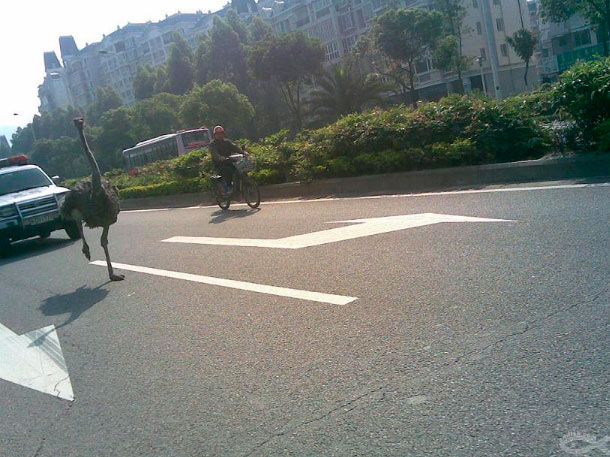
Runaway ostrich races onto highway in Zhejiang

CCTV.com

12-26-2014 05:36 BJT


An over-two-meter high, 75 kilogram ostrich accidentally crashed into the fast lane in eastern China’s Zhejiang province Monday. An ostrich ran onto an expressway in eastern China’s Zhejiang province Monday. 
Surveillance footage captured the run-away ostrich, over 2 meters tall and weighing 75 kilograms, bursting through a toll gate. The bird then ran on the side of the road and raced with passing cars.

Police officers eventually caught up with the bird and accompanied it until it was willing to walk off the expressway.

Wednesday, 3 September 2014

Phuket: Big Bird on loose in Bangkok: VIDEO


Phuket: Big Bird on loose in Bangkok: VIDEO

PHUKET: Nobody knows where it’s from. Nobody knows how it got there. This is simply an inexplicable video of a single ostrich chasing the fast pace of humanity.

Monday 1 September 2014, 04:35PM

PHUKET: Nobody knows where it’s from. Nobody knows how it got there. This is simply an inexplicable video of a single ostrich chasing the fast pace of humanity. - See more at: http://www.thephuketnews.com/big-bird-on-loose-in-bangkok-video-48505.php#sthash.lPiLxGc1.dpuf

Facebook user Sukchi Kas posted a short clip of the bizarre event he encountered on the Teparak road on Wednesday (August 27). It’s just that, an ostrich on the loose in Samut Prakan’s Bang Phli district.

The user added he was on his way to a business meeting and was quite confused about what was happening.

Read orginial story here.


- See more at: http://www.thephuketnews.com/big-bird-on-loose-in-bangkok-video-48505.php#sthash.lPiLxGc1.dpuf

Sunday, 29 June 2014

Zookeeper who battered ostrich to death with shovel blames killing on innocent pony


By Alex Wellman

Colleagues of the zookeeper saw him beating the giant bird and told their supervisors who confronted the man only for him to blame a pony

A bungling French zookeeper who beat an ostrich to death with a shovel blamed the killing on an innocent pony.

The unnamed zookeeper falsely accused the pony after shocked colleagues at a zoo in La Teste-de-Buch, southwest France, discovered the giant bird had died.

The ostrich shared a pen with an elderly pony and despite a number of co-workers seeing the man beat the animal over the head with a shovel, he claimed he had nothing to do with it.

According to the New York Daily News, the man claimed the bird had been killed by a savage kick from its equine roommate.

However, closer inspection showed that the bird had died from a blow to the head from a shovel.

The man was sentenced to jail for six months, four of which were suspended, and ordered to pay a fine of 5,000 Euros as well as being fired from his job of 15 years.

Sunday, 26 January 2014

Ostrich causes chaos in Tunbridge Wells as it races traffic at 40mph Motorists slammed on the brakes after spotting the flightless bird speeding up and down the busy main road

By News agencies

The escaped bird was spotted running along more than 20 cars on the main road between the villages of Rusthall and Speldhurst in Tunbridge10:51AM GMT 14 Jan 2014

An ostrich caused traffic chaos in Tunbridge Wells after running beside cars at more than 40mph.
The escaped bird was spotted running past 20 cars on the main road between the villages of Rusthall and Speldhurst in Tunbridge Wells, Kent.

Adult ostriches can run up to 60mph and grow to more than 9ft-tall, but this youngster is just over 2ft-tall, but can still run at more than 40mph, according to locals.

Thursday, 6 June 2013

China: ostrich on the loose in rush hour traffic – video

CCTV footage of an ostrich running wild on the streets of Zhangzhou city, southern China. The big bird is hit twice by cars on its frantic mission among rush-hour traffic, as amazed residents look on and take photos. The ostrich was injured and is recovering from a wing injury


Monday, 19 November 2012

Ostrich trial ‘was life risk’


FLAPPY Helen Flanagan could have been KILLED by an ostrich during a Bushtucker Trial, animal charities claimed yesterday.

RSPCA official Michael Beatty slammed programme chiefs for shutting the 7ft bird in a hotel room during Cruelty Towers.

He said: “The ostrich could have easily got distressed and lashed out.

“It would have used its feet like claws to tear into Helen, ripping her stomach open. She could have been seriously injured or killed.”

RSPCA inspectors are investigating the trial.

Read more: http://www.thesun.co.uk/sol/homepage/showbiz/tv/im_a__celebrity/4650430/ostrich-could-have-killed-helen-flanagan.html#ixzz2CZon1mTB