As regular CFZ-watchers will know, for some time Corinna has been doing a column for Animals & Men and a regular segment on On The Track... particularly about out-of-place birds and rare vagrants. There seem to be more and more bird stories from all over the world hitting the news these days so, to make room for them all - and to give them all equal and worthy coverage - she has set up this new blog to cover all things feathery and Fortean.
Showing posts with label brink of extinction. Show all posts

Friday, 9 August 2019

Nature’s cleaners on the brink of extinction


BHUBANESWAR: Vultures, once part of popular Odia culture, have become almost extinct from the face of the capital city and even from the state. Not really known for their aesthetics or hunting skills, vultures are knows as nature’s best scavengers. However, these birds along with a few other species, have gradually been pushed from the category of endangered to extinct due to rapid urbanization and loss of green habitat.

“There are three species of vultures found in India, Odisha has two of them. The first is black or king vulture, this specie is almost extinct everywhere in the country. The second is white-backed Bengal vulture which is known ‘Gidha’ or ‘Saguna’ in Odia. About 50 years ago these were found aplenty in Odisha, especially in rural areas. The third one is White Scavenger, also known as Pariah Kite. Unlike other vultures, this particular type feeds on other smaller birds and rodents,” explained Rabindra Samal, an ornithologist, here.

A report by Bird Life International a decade ago stated that about 14 out of 52 near threatened bird species listed for India are in Odisha. Among the critically endangered types, Oriental White-backed Vulture and Long-Billed Vulture topped the list. The data was recorded on their presence in Bhitarkanika Wildlife Sanctuary, Sambalpur, North and South of Mahanadi and in Simlipal National Park.

Monday, 21 January 2019

New Zealand’s rarest bird on the brink of extinction: 'This is a crisis year'


David Williams of Newsroom.co.nz08:55, Jan 16 2019
Concerns over the fairy tern have prompted the Department of Conservation to re-establish a specific recovery group.
This story was originally published on Newsroom.co.nz and is republished with permission.
A disastrous breeding season has plunged one of the world's rarest birds even deeper into crisis.
The critically endangered fairy tern/tara iti, the country's rarest native bird species with fewer than 40 individuals, has had only three chicks hatch this season.
New Zealand Fairy Tern Charitable Trust convenor Heather Rogan says one chick has gone missing, which could make this the worst breeding season in at least 27 years.
The Department of Conservation maintained on Monday that all three chicks were alive and well. If that's the case and they all fledge, this would still be the worst season since 1996-7, the last time three chicks fledged.
More worrying than the lack of chicks, Rogan says, is that breeding pairs have been decimated. She estimates there are only five pairs left across breeding sites on beaches north of Auckland – when over the last decade there have been between eight and 10 pairs.
She describes the season as "disastrous". "I would say that this is a crisis year."
Melanie Scott, who lives near Mangawhai and is a member of the group Save Te Arai, says: "We're on the verge of losing this bird."

Thursday, 28 December 2017

Rare fairy tern chick hatches in New Zealand


‘Critically endangered’ bird has been on the brink of extinction since the 1970s

PUBLISHED : Thursday, 07 December, 2017, 2:22pm
UPDATED : Thursday, 07 December, 2017, 2:24pm

Conservationists are celebrating the birth of one of New Zealand’s rarest birds at Mangawhai.

The number of one of the country’s rarest birds, the New Zealand fairy tern/tara-iti, has been boosted by a chick successfully hatching at Mangawhai, in late November.

With a total population of around just 40 birds, the NZ fairy tern is critically endangered, and has teetered on the brink of extinction since the 1970s.

Department of Conservation Mangawhai Fairy Tern Ranger Keven Drew hopes the new chick will help boost fairy tern numbers.

“Although it is early days for the chick and the risks are high, we are hopeful he or she will continue to do well and fledge later in summer,” Mr Drew said.

Fairy terns nest on shell and sand banks just above high tide, which makes them vulnerable to rats, stoats and other predators, disturbance by people, 4WD vehicles and dogs. They are also at risk from stormy weather and very high tides.

“The birds cannot be transported to predator-free offshore islands because they are very particular about where they nest, and the chicks are not raised in captivity as they have to be looked after by their parents while they learn how to fish successfully” he said.

Sunday, 17 December 2017

'Worrying alarm call' for world's birds on brink of extinction


By Helen Briggs
BBC News
12 December 2017

Overfishing and changing sea temperatures are pushing seabirds to the brink of extinction, according to new data on the world's birds.

Birds that are now globally threatened include the kittiwake and the Atlantic puffin, which breed on UK sea cliffs.

Meanwhile, on land, the Snowy Owl is struggling to find prey as ice melts in the North American Arctic, say conservation groups.

The iconic bird is listed as vulnerable to extinction for the first time.

"Birds are well-studied and great indicators of the health of the wider environment,'' said Dr Ian Burfield, global science coordinator at BirdLife International, the IUCN Red List authority on birds.

''A species at higher risk of extinction is a worrying alarm call that action needs to be taken now. ''

He added that success in kiwi and pelican conservation had shown that, when well-resourced and supported, conservation efforts do pay off.

Worldwide, over a quarter of more than 200 bird species reassessed by the International Union for the Conservation of Nature have been moved to higher threat categories while a similar number have been downgraded.


Monday, 2 October 2017

Poaching pushes waterfowl species to brink of extinction

Wed, Sep 13 2017 12:16:24 PM
By Vishal Gulati

New Delhi, Sep 13 (IANS): Crossing national and international boundaries, millions of migratory birds descend on India to avoid the extreme winter chill in their native habitats. Many of them never return to their breeding grounds, say ornithologists.
The reason: They are exposed, largely in non-protected wetlands, to illegal killing and trade.
Scientists, mainly from Mysuru's Nature Conservation Foundation, during their fieldwork in 27 wetlands in Tamil Nadu's Kanchipuram district, estimate that at least 1,700 waterbirds, mainly large- and medium-sized, are hunted every year in each wetland. They say hunting is widespread from December to April, the peak season of winter migrants.

Wednesday, 28 June 2017

Hen harriers are on the brink of extinction in England after researchers find there are only four breeding pairs left in the country

Number of breeding pairs in England fell from 12 in 2010 to just four in 2016
Hen harriers are the most threatened birds of prey in the UK due to illegal killings
The number of breeding pairs in Wales also fell to 35 from 57

By Press Association and Phoebe Weston For Mailonline

Published: 07:50, 28 June 2017 | Updated: 11:19, 28 June 2017

Hen harriers are on the brink of extinction in England after the number of breeding pairs fell to four last year, according to worrying new figures.

The fifth national hen harrier survey showed the number of breeding pairs of the bird of prey in England fell from 12 in 2010 to just four in 2016.

Scotland – which is home to 80 per cent of the UK population of hen harriers – saw its number of breeding pairs drop to 460 in 2016 from 505 six years previously.

Hen harriers mainly live in open areas with low vegetation, normally in the moorlands of Wales, Northern England, Northern Ireland, Scotland and the Isle of Man.

In winter they move to lowland farmland and river valleys.

They mainly feed on small birds and mammals and used to hunt free-range fowl which is how they got their name.

Males are pale grey while females are brown with a white rump and long tail.

The number of breeding pairs in Wales fell to 35 from 57 while Northern Ireland also experienced a drop from 59 to 46.

Hen harriers are the most threatened birds of prey in the UK due to illegal killings and destruction of heather moorland and forestry, their natural habitat.

Read more: 

Monday, 5 December 2016

Some of Ireland's favourite birds are on brink of extinction - report


Large parts of Ireland's environment is in a worse state today than 20 years ago, a major report from the Environmental Protection Agency (EPA) says. 
 
Bird species, including the corncrake and the curlew, are almost extinct. There has been a "dramatic reduction" in the number of pristine rivers with high water quality, and traffic is causing serious air pollution.

The 'Ireland's Environment: An Assessment 2016' report also shows the average household now produces 20pc more waste than two decades ago, and says there is a need for "decisive leadership". While the overall state of the environment is "good", there are "serious underlying signals of concern".

Report co-editor Dr Jonathan Dernham said there was a need for integrated policies to protect the environment.


"We have not done well on nature protection, and we have lost some of our highest quality waters while at the same time reducing the number of seriously polluted waters," he said.

"If it was a school report card, it would be 'could do better'. We're winning and losing at the same time. The real challenge for the State is we're seeing that improvement is inconsistent and sporadic, as the joined-up policies are not there."


Continued

Sunday, 14 August 2016

How this majestic British bird was saved from the brink of extinction

Here are five of Europe's most impressive natural wonders

6 AUGUST 2016 • 6:00AM

It is approaching 3pm at Gigrin Farm, and feeding time. For a few hours now, red kites have been steadily streaming in from their perches across the sparse, steep valleys of Powys. The birds scythe overhead in holding patterns, tawny plumage fluttering and amber eyes staring with intent. A scarlet tractor trundles into view and the sky clouds further.

The driver parks in the  middle of a field and begins shovelling 90lb of gristle-grey meat on to the grass. He is still unloading when the birds begin to dive, their 5ft wings hooked into a corkscrew to accelerate the descent. They feed on the wing, fanning their tail feathers at the very last moment and snatching the food in their talons before wheeling away screeching.

As the frenzy reaches  its peak the kites number 300 at the very least, a single swirling vortex from earth to sky. Only after 30 minutes or so, when most of the kites have soared off into the afternoon, does a column of crows feel sufficiently emboldened to mob over from the branches of a dead chestnut tree, fighting for the few morsels left behind.


Monday, 27 October 2014

National bird on verge of extinction

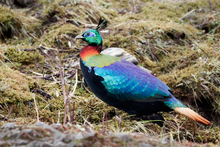
ACHHAM: The national bird of Nepal Danphe (Lophophorus) is on the verge of extinction in Achham district.

Lack of preservation and the conservation of Ramaroshan, the one and only place in the district that houses this national bird, has been attributed for it.
Himalayan Monal Adult Male East Sikkim Sikkim India 11.05.2014.png
Casting light to the situation, Kali Bahadur Budha, a local said that unlike in the past, the villagers do not see the bird of this species in bulk. 

"The concerned authority is not making any effort to conserve the bird as well its habitat, Ramaroshan," he complained. 

A local social worker Govinda Saud added that if the government continues to turn blind eye towards it, Ramaroshan will soon lose its existence apart from its habitats such as birds like Danphe and other wild animals.

People should work united at local level to address this issue, opined Chandra Prasad Dhungana, chairman of the Federation of Nepalese Chambers of Commerce and Industry (FNCCI), Achham.

Assistant District Forest Officer in Accham, Bhaktaraj Giri, stated that since it is the responsibility of the Department of National Park to conserve wild animals, the District Forest Office so far has not run any programme as such. - 


Monday, 15 September 2014

Birds on the brink: Saving the malleefowl


Saturday, 13 September 2014 14:10
Written by Natalie Holmes


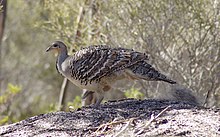
They’re shy, they’re unique and they’re iconic to the region. But as we discovered, the malleefowl is also, sadly, on the brink of extinction.
Leipoa ocellata -Ongerup, Western Australia, Australia-8.jpgIsolated and independent, the malleefowl is a creature both shy and solitary. An iconic native bird and one of only two megapodes (big-footed mound builder) residing in Australia, the malleefowl also has another fairly alarming defining feature – it’s nearly extinct.

According to the Federal Department of the Environment, the total population of this indistinct-looking species is estimated at 100,000 breeding birds scattered across 100 subpopulations, although this information is considered to be of low reliability. Once widespread across southern Australia, the birds can now be found only in small pockets in four states: NSW, Victoria, Western and South Australia.

Their numbers have been degraded by a range of pressures on habitat mainly caused by an increasing human population in the past century and the problems associated with that: fire threats, predation, disease, agricultural practices, mining and to a lesser extent these days, hunting.

Tuesday, 5 August 2014

SREL, DOE bring wood stork back from brink of extinction


4TH aUGUST 2014
1 hour ago by Vicky L. Sutton-Jackson

Thanks to the hard work of conservationists across the United States, the once imperiled American wood stork has been down-listed from endangered to threatened by the U.S. Fish and Wildlife Service. Among the many organizations responsible for bringing the large wading bird back from the brink of extinction are the University of Georgia's Savannah River Ecology Laboratory and the U.S. Department of Energy.

SREL's efforts began in 1983 with an extensive study of the wood stork's biology on the Savannah River Site and their nesting colony in Jenkins County, Georgia. The studies documenting their nocturnal feeding patterns, genetics, uptake of mercury and regional movements were the first of their kind in the bird's northern range.

Access to the stork's nourishing wetlands was reduced in 1985 when the Savannah River Site resumed operation of L-reactor, one of its nuclear reactors. Use of the reactor ended in 1988. SREL and DOE expanded efforts to protect the stork's habitat through collaboration with the National Audubon Society.


Monday, 27 January 2014

Endangered Philippine eagle killed by falling branch

MANILA, Philippines—A rare Philippine eagle, whose species is on the brink of extinction, was killed inside a conservation group’s breeding center when a branch fell on its cage, the center said Saturday.
The 15-year-old male bird, named ‘Arakan’, was one of about 250 adult Philippine eagles remaining according to the Swiss-based International Union for the Conservation of Nature, which lists the species as “critically endangered”.

Days of non-stop rain caused the huge branch of a tree to fall on Arakan’s cage at the Philippine Eagle Foundation’s center in the southern island of Mindanao, crushing the raptor on January 18, the foundation said.

Numerous large trees are planted inside the center because the conservation group is “trying to simulate the natural environment of the eagles,” said the foundation’s communications officer Beauxy Auxtero.


Wednesday, 15 January 2014

Bird's Rescue from Extinction Nearly Backfired

By Douglas Main, LiveScience Contributor | January 13, 2014 03:54pm 

In the 1980s, the black robin was on the brink of extinction, having been reduced to just a single breeding pair by predation from cats and rats introduced to the islands where they live, southeast of New Zealand. To save the species, scientists encouraged the pair and their offspring to mate as much as possible, and even lent a hand to move eggs laid on the edges of nests, where they wouldn't hatch, into the middle of the nest, where they would.

Thursday, 15 August 2013

Rare songbird fights back from brink of extinction and found to be thriving in habitat used by Navy for bomb practice


  • Numbers of the rare San Clemente Island loggerhead shrike thriving
  • The endangered songbird had been threatened with extinction
  • But a US Navy investment programme has helped it bounce back


PUBLISHED: 09:50, 12 August 2013 | UPDATED: 09:58, 12 August 2013

One of North America's rarest birds has fought back from the brink of extinction and is enjoying a renaissance - on a rocky outcrop used by the US Navy as a firing range.

The San Clemente Island loggerhead shrike is thriving on the rocky outcrop off the Californian coast, known as the 'boom box'.

In the 90s its numbers had dwindled to just seven breeding pairs, but now there are believed to be 70 on the island.

It is a remarkable success story given the black, grey and white songbird shares its home with an area that is regularly bombed by US Navy battleships.


The Navy itself has claimed credit for the shrikes survival after it launched a $3-million-a-year captive breeding programme to protect the threatened species, according to a report in the Telegraph.


Tuesday, 11 December 2012

Research shows rare hen harrier 'Bowland Betty' was gunned down over Yorkshire Dales


A HUNT has been launched for the killer of 'Bowland Betty', a rare bird of prey which conservationists had tracked across the north of Britain.

The Royal Society for the Protection of Birds is offering a £1,000 reward for details leading to the conviction of those responsible for the hen harrier’s death in Colsterdale, south of Leyburn, in the Yorkshire Dales.

A spokesman for the charity said with hen harriers on the brink of extinction as a breeding species in England, Betty’s death was a significant blow to the species’ future.

Betty was raised in Bowland, Lancashire, last year before being fitted with a satellite tag by Natural England as part of their Hen Harrier Recovery Project, which tracked Betty’s movements from Caithness, in Scotland, to North Yorkshire in May.

She ranged around the moors in the Nidderdale and Colsterdale areas for a few weeks, but in late June the satellite data indicated Betty had become stationary, raising fears for her safety.

With the cooperation of the Swinton Estate, Stephen Murphy of the Natural England Hen Harrier Recovery Project found Betty dead in July.

Betty’s body was sent to the Zoological Society of London for a post-mortem examination, which revealed that she had a fractured left leg, leading to her death.

Read on:  

Thursday, 11 October 2012

Golden opportunity to crack bird of prey persecution in Lancashire, before it's too late!


As the hen harrier teeters on the brink of extinction as a breeding bird in England, Coalition and Welsh Government Ministers have a once in a lifetime opportunity to tackle the illegal killing of birds of prey in England and Wales, and must not waste it.

That’s the message from the RSPB as it publishes its annual wildlife crime figures showing yet another shameful year of poisoning, shooting and trapping for red kites, golden eagles, peregrine falcons, goshawks and other persecuted species. Just one pair of hen harriers bred in England in 2012, with Government’s own studies suggesting that illegal killing is the major factor in their decline.

In Lancashire in 2011 the RSPB received 36 reports of incidents relating to birds of prey.
Too little has been done over the years to stop these sickening attacks on birds, but this could change with proposed reforms of wildlife law and policing. The RSPB believes a review of wildlife protection legislation by the Law Commission - currently being consulted on - provides a golden opportunity to address ongoing persecution of bird of prey in England and Wales.

This month will also see the publication of the House of Commons Environmental Audit Committee’s inquiry into wildlife crime while the imminent reorganisation of the police service and the creation of National Crime Agency will provide further opportunities to prioritise wildlife crime.

RSPB Conservation director Martin Harper said: “This is a once in a lifetime opportunity to tackle the illegal shooting and poisoning of some of our most magnificent birds.