As regular CFZ-watchers will know, for some time Corinna has been doing a column for Animals & Men and a regular segment on On The Track... particularly about out-of-place birds and rare vagrants. There seem to be more and more bird stories from all over the world hitting the news these days so, to make room for them all - and to give them all equal and worthy coverage - she has set up this new blog to cover all things feathery and Fortean.
Showing posts with label Hertfordshire. Show all posts

Tuesday, 3 January 2017

Buzzards found in Herefordshire with lead shot in their bodies

A WILDLIFE rescue worker has raised concerns about the number of birds of prey which have been shot with lead pellets.

Sasha Norris, of Herefordshire Wildlife Rescue, has seen three buzzards within the past four months which have had lead pellets in their bodies.

As it is against the law to shoot any bird of prey, Herefordshire Wildlife Rescue is now working with the Royal Society for the Protection of Birds (RSPB), the police and Herefordshire Wildlife Trust to investigate the illegal shooting of birds of prey in Herefordshire.

The three birds were all found in different parts of the county- Mordiford, Honeymoor Common, and near Leominster.

Dr Norris said: "My view is that those who feel birds of prey threaten their livelihood need to take a look at the figures.

"There are around 40,000 pairs of buzzard in the UK. There are 70million people.

"The truth is that people are winning the game of life and it's the intelligent and compassionate thing to do obey the law and take care of wild animals."

The last buzzard she collected was sat in a strange posture, so she asked for an x-ray to be carried out, which revealed the bird had been shot and had a broken back. Sadly the buzzard had to be euthanised.

Dr Norris said: "We have seen numerous suspect and some proven incidents with wild birds of prey which have been shot or possibly poisoned."

continued

Monday, 29 February 2016

Staggering £275k reward to find 'evil goose killer' who gunned down bird in 'drive-by shooting'

19:24, 26 FEB 2016
UPDATED 19:41, 26 FEB 2016
BY RACHEL MCDERMOTT

The bird, who features on the village welcome sign in Sandon, Hertfordshire, died on Sunday amid reports he was shot in the head

Villagers have been left sickened after a much-loved goose was killed in a drive-by shooting.
The bird, known fondly as 'Goose' died on Sunday, amid reports from villagers that he was shot in the head with an air rifle by a man leaning out of a 4x4 vehicle.

His death has sparked a national outcry among animal lovers who heard he became part of the community in Sandon, Herts., where he even features on the village welcome sign.
And now there is even a staggering reward of £275,000 being offered to those who can find the culprits behind the animal's death.

Two members of the public contacted the BBC 's Jeremy Vine Show today to offer rewards - £250,000 from Peter Hunt in Eastbourne, Sussex, and £25,000 from John Barker in Cambridge.

Texting into the show, Mr Hunt said: "I would like to offer £250,000 to whoever catches the vile killers of the goose so long as it leads to a conviction.

"This incident makes me feel sick."

And after calling in to the Radio 2 lunchtime programme, Mr Barker said: "I am very upset about the whole situation.

"They are utterly scumbags and toerags.

"If the people responsible hand themselves in I will write them a cheque and hand it to them personally.

"They have taken the law into their own hands."


Sunday, 22 March 2015

An uncommon kerfuffle over a rare Hitchin bird which could rewrite the record books if the experts agree

A stuffed bird from Victorian times gathering dust in a museum stockroom is causing a flutter in learned circles as experts decide whether it can be confirmed as the first specimen of its type recorded in the UK.

Mike Ilett from the Herts bird club with the north Herts museum service specimen he identified as a Least Bittern

The Least Bittern – Ixobrychus exilis in Latin – is normally found in North America.

It breeds in reed beds and can be difficult to observe due to its shy and secretive nature – and until now has never been recorded in the UK.

All that could be about to change, but Mark Ilett – who chairs the Herts Rare Birds Panel and is co-author of Birds of Hertfordshire, isn’t getting his hopes up just yet.

The bird in question is part of the collection held at Hitchin Museum, and at the moment it’s held in storage while the heritage base transfers from its former home next to the town library to the revamped Hitchin Town Hall site, which is due to open its doors later this year.

Wednesday, 4 June 2014

Delight as rare birds spotted on outskirts of Hatfield

Alex LewisSaturday, May 31, 2014 
12:00 PM

Birdwatchers rushed to a lake on the outskirts of Hatfield last week to see two Temminck’s stints, tiny wading birds very scarce in Hertfordshire.

Temmincks Stint.jpgBirdwatcher Steve Blake found the stints, barely bigger than sparrows, at Tyttenhanger gravel pits, near Colney Heath, on Tuesday morning, prompting a steady flow of enthusiasts to enjoy them, often at very close range.
Chairman of the Herts Bird Club Ken Smith, who lives in WGC, told the WHT: “Imagine Steve’s excitement when he found these birds and realised they were Temminck’s stints.

“This species was last seen in Hertfordshire in 2002, with only a smattering of records before that.

“I think most Herts birders have managed to get good views of the birds before they head off to their tundra breeding grounds in Norway and further north.

“Amazingly the last Temminck’s stints seen in Hertfordshire in 2002 were also at Tyttenhanger.”

The species is named after Dutch zoologist Coenraad Jacob Temminck (1778-1858)

Monday, 12 May 2014

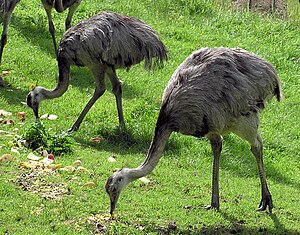
Runaway Rhea 'Shot Dead By Gamekeeper'

The ostrich-like animal called Chris became a common sight at a golf course after escaping from her enclosure.
5:29am UK, Saturday 10 May 2014


A runaway rhea called Chris who has been wandering around the countryside for more than a month has been shot dead, it has been reported.

The ostrich-like animal had become a common sight in the area surrounding Barkway Park Golf Club near Royston in Hertfordshire.

The female, who came from South America, escaped from the home of owner Joanna Clark, who gave up hope of getting her back.

Members of the public were warned not to approach the giant-clawed animal, which can reach speeds of 40mph.

The 6ft-tall bird met its end at the hands of a local gamekeeper, the Daily Telegraph reports.

Inspector Paul David of Hertfordshire Police told the paper he was "amazed" Chris had survived for so long.

"It would have been a real problem if it had wandered into the road and posed a traffic hazard," he said.

"We will have to notify the owner that the bird has been killed."

A Hertfordshire Police spokeswoman has told Sky News the force is aware of the reports and is investigating.

Friday, 18 April 2014

BIRD ESCAPES: Large rhea bird on the loose around east Hertfordshire


- last updated Mon 14 Apr 2014

A village in east Hertfordshire is on the lookout after a large bird similar to an emu was seen wandering in the fields.
The rhea went missing from its owner four weeks ago in Brent Pelham - it is around four feet tall and has been spotted several times, but, with it being able to hit speeds of 40 miles per hour, so far no-one has been able to catch it.

Ray Murdoch caught sight of the bird on a bike ride through Nuthampstead. He managed to take a few photos before it ran off.

Tuesday, 6 November 2012

Crossbills: Rare Birds Visit Hatfield


This afternoon a flock of 30 crossbills were seen feeding upon tree top pine cones in Hatfield Park.

An early Scandinavian cold snap may have triggered the birds south to over-winter in the area. 

Crossbills, are a type of finch and, as their name suggests, they have a crossed beak which they use to prise apart cones to get at the pine nuts inside. They are reddy / brown in colour and a bit larger than a sparrow.

Sightings of other interesting birds can be viewed on the Herts Bird Club website.