As regular CFZ-watchers will know, for some time Corinna has been doing a column for Animals & Men and a regular segment on On The Track... particularly about out-of-place birds and rare vagrants. There seem to be more and more bird stories from all over the world hitting the news these days so, to make room for them all - and to give them all equal and worthy coverage - she has set up this new blog to cover all things feathery and Fortean.
Showing posts with label pelicans. Show all posts

Wednesday, 11 December 2019

Israeli fish farmers give peckish pelicans free lunch

DECEMBER 8, 2019

by Jonah Mandel
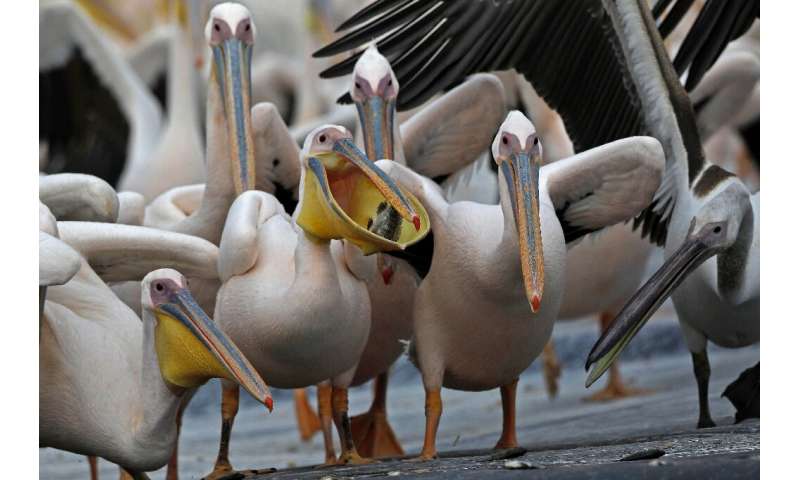
Great white pelicans eat fish provided by Israeli farmers at a water reservoir in the Emek Hefer valley north of Tel Aviv

Migratory pelicans have long raided Israeli fish farms, which try to deter them with loudspeakers, laser beams and by firing blank rounds from rifles.

In their desperation, they have come up with another way: offering the birds a free lunch.

An estimated 50,000 pelicans stop off in Israel during their annual migration from the Balkans to Africa, where they enjoy a mild winter before returning to Europe.

They rest and feed in the Middle Eastern country for weeks, causing chaos for fish farmers, whose outdoor commercial pools and reservoirs provide rich pickings.

Before the pelicans reach Israel, "they have nowhere to stop and eat", said Eli Sharir, general manager of the Israel Fish Breeders Association.

The impact on the fish farms is enormous.

"We're talking millions of shekels a year," he said.

So six years ago Israeli fisherman came up with a solution—providing alternative feed with unmarketable fish to try to keep pelicans away from the commercial pools.

One recent day on a reservoir in northern Israel, hundreds of great white pelicans swooped down to position themselves in the shallow waters, eyeing a truck backing up to the water's edge.

Then the truck dropped its cargo of thousands of small, live, flapping fish into the water, where they were almost instantly scooped up by the pelicans' nimble beaks.

Sunday, 12 May 2019

Salton Sea pelican population declining at startling rate


Bird populations threatened.
By: 
Posted: Apr 25, 2019 04:04 PM PDT
Updated: Apr 25, 2019 05:09 PM PDT

SALTON SEA, Calif.- - A new report paints a grim future for birds that rely on the Salton Sea habitat. Audubon California-released report uses bird-monitoring data from several different sources to show just how the destruction of the Salton Sea ecological habitat has decimated the populations of both pelicans and cormorants endemic to the area.
As the Salton Sea recedes, the body of water's salinity increases, which kills off its tilapia population. Without tilapia, the birds starve. 
According to surveys, there were approximately 20,000 American White Pelicans in 2008. According to Aerial surveys conducted by the California Department of Fish and Wildlife, that number now sits at 100. Audubon's own research backs up this decline. 

Monday, 24 December 2018

More dead pelicans, seagulls wash up in North Myrtle Beach and officials don’t know why


DECEMBER 16, 2018 01:44 PM,
UPDATED DECEMBER 17, 2018 03:40 PM
More dead birds were found on the beach in North Myrtle Beach on Sunday, and local and state officials are still trying to determine the cause.
There’s also a discrepancy over just how many dead birds were found Saturday, when estimates ranged from several to “dozens” or even “hundreds.”
“The bottom line is that birds perished and were found on our beach, and as of this writing we do not know why,” North Myrtle Beach officials said via email Sunday morning.
A day after North Myrtle Beach officials refuted social media postings indicating there were “dozens” or even “hundreds” of dead birds found on the beach, the city said the South Carolina Department of Natural Resources reported finding 30 on Saturday. North Myrtle Beach also noted that its beach patrol had found 10 more birds Sunday — a pelican that was barely alive and seagulls that had died.


Monday, 12 January 2015

Officials: Pelicans being hurt along coastline

Author: Chris Robbins, Evening newscast producer, crobbins@wjxt.com
Published On: Jan 11 2015 11:19:50 PM EST Updated On: Jan 12 2015 12:56:26 AM EST

Pelicans injured at beaches

JACKSONVILLE BEACH, Fla. -

Wildlife officials said they believe someone is intentionally hurting pelicans along the coast. They've seen injured birds in Jacksonville Beach and as far south as St. Augustine.

Ohad Paris is one of many volunteers with BEAKS Sanctuary. He said he's devastated to learn someone may be hurting pelicans on purpose. So far, he said he knows of at least a dozen.

"It's something in the teens -- 15, 16 -- so somebody is doing this," Paris said. "We really don't know who, or why, or where. It just feels like you're looking at an injured child."

Paris said BEAKS, or the Bird Emergency Aid and Kare Sanctuary, has gotten calls from people in both Jacksonville Beach and all along the coast, going as far down as St. Augustine.

Friday, 18 July 2014

Pelicans most at risk from fishing tackle injuries

1 hour ago

South Australia's recreational fishermen are more likely to snag pelicans than any other marine birds, who are often the victim of fishing line and hook entanglements, according to new research.

Fishermen are being warned to be more aware of the risks to seabirds and to report any injuries as soon as possible.

A study of 113 seabirds treated over a six-year period for 132 fishing-related injuries has been conducted by researchers from the University of Adelaide's School of Medical Sciences and the Australian Marine Wildlife Research and Rescue Organisation (AMWRRO).

They've found that, contrary to public belief, "live" tackle being used by fishermen is resulting in the bird injuries, not tackle that's been thrown away.

The results of the study are now published in the International Journal of Veterinary Health Science & Research.


Sunday, 25 May 2014

Monofilament fishing line perilous for pelicans

Special to The News-Press12:06 a.m. EDT May 22, 2014

Fishing is an important part of the Florida lifestyle as well as its economy. In spite of the obvious benefits, this leisure-time activity, on occasion, can lead to problems for birds and other wildlife such as sea turtles and manatees.

According to the Florida Fish and Wildlife Conservation Commission biologists, monofilament fishing line and fishing hooks can entangle these animals, leading to injury and even death.

The brown pelican is one species that is especially affected by monofilament line. These birds frequently spend time looking for an easy meal at piers and other fishing hot spots, where they are often hooked accidentally when trying to grab bait off an angler's line. In addition, discarded monofilament line hanging from trees, piers and other structures can ensnare these birds. Once entangled, pelicans can have a difficult time flying and feeding.

"It is not uncommon to find dead pelicans entangled with fishing line and hooks," said FWC biologist Ricardo Zambrano. "If they are not rescued, these birds may suffer for days before succumbing to injury or starvation."

Here are some simple things people can do to help protect brown pelicans and other wildlife:

Wednesday, 29 May 2013

Pelicans used as target practice in WA

WILDLIFE officers believe pelicans are being used as target practice, after two birds were found shot with arrows in separate incidents in Western Australia.

WA's Department of Environment and Conservation (DEC) is appealing for information from the public following the shocking attacks on the pelicans over the past week near Mandurah.

Last Monday, an adult pelican was found at Soldiers Cove, near the Mandurah estuary bridge, with a target arrow through its chest.

A volunteer retrieved the bird, which had to be put down because of severe internal injuries.

Less than a week later, an adult pelican was shot through both wings with a hunting arrow at nearby Samphire Cove. Another volunteer retrieved this bird, which is being rehabilitated.

DEC wildlife officer Cameron Craigie said the attacks were being investigated by DEC, WA Police and RSPCA.

"Using animals like pelicans for target practice or hunting is something that is not only illegal, it is inhumane and cruel," Mr Craigie said.

"The pelican shot on Sunday is extremely lucky to have survived as the arrow has not caused significant damage to any bones or vital organs."

A maximum penalty of $4,000 applies for injuring or killing pelicans in WA.

Anyone with information about the attacks can contact DEC's Wildcare Helpline on 9474 9055 or Crime Stoppers on 1800 333 000.

Wednesday, 9 January 2013

Bird rescue center's tracking program shows how rehabilitated pelicans fare


By the hundreds they've been treated and cared for at specialty rehabilitation centers.

But what happens to the sick or injured California brown pelicans once they're set free again? What are their chances for surviving back out in the wild?

Researchers are hoping an ongoing survey of the pelicans treated at California's bird rehabilitation centers will provide them with a better glimpse into how the birds fare - and where they go - once they are released.

"We've put a lot of time and money into these birds," said Jay Holcomb, director of the nonprofit International Bird Rescue that operates a facility in San Pedro. "We wanted to know if they're surviving."

Some of the California brown pelicans head north for the winter - not south like most other birds. Many have been found as far north as British Columbia, according to study results.

It was known that many of them fed along the Oregon and Washington coasts but that the young pelicans flew so far north so quickly after they were released was a surprise, Holcomb said.

Thursday, 6 December 2012

Birds in La Jolla Create Stench and Pollution, But They're Not the Only Ones


By Morgan Justice-Black 
As a handful of groups work quickly toward the best solution to eradicating the odor without irritating the wildlife, I Love A Clean San Diego provides other important facts on the pollution front.

Yes, the bird stench at La Jolla Cove is a big problem for businesses, tourists and residents there. While a number of experts and stakeholders are working hard to find the right solution, I Love A Clean San Diego has some additional information on animal pollution that we should all pay attention to.

Just to recap, it seems that the stench stems from more than a few big birds (pelicans and cormorants to be exact) that have found a permanent hangout at the cove safe from human interruption. The odor from their droppings is attracting most of the attention, and some have begun to raise questions about their poop triggering both a “public health disaster” and an environmental contamination issue.

The bad news is it may take some time for the best solution to be developed and agreed upon. In the meantime, with our rainy season rapidly approaching, the bird waste will wash into the water and may create a short-term water quality issue for swimmers and scuba divers, even before any human intervention takes place.

Tuesday, 13 November 2012

From carrier pigeons to text-messaging pelicans


Many Israelis rarely leave home without a cellphone. Starting this month several pelicans headed abroad will also be equipped with SIM cards in an unusual attempt to track the movements of the migrating birds.

The pelicans, which are making their way to Africa, will start transmitting SMS messages from devices attached to their bodies, in a joint project of the Israel Nature and Parks Authority, Small World telecommunications company, the Hebrew University of Jerusalem and the Society for the Protection of Nature in Israel.

One of the goals of the project is to monitor the birds, some of which arrive in Israel malnourished, and determine how to meet their nutritional needs without harming the livelihood of commercial fish breeders.