As regular CFZ-watchers will know, for some time Corinna has been doing a column for Animals & Men and a regular segment on On The Track... particularly about out-of-place birds and rare vagrants. There seem to be more and more bird stories from all over the world hitting the news these days so, to make room for them all - and to give them all equal and worthy coverage - she has set up this new blog to cover all things feathery and Fortean.
Showing posts with label Wiltshire. Show all posts

Wednesday, 13 March 2019

Hen Harrier 'disappears' near proposed reintroduction site in Wiltshire


A young male Hen Harrier from Northumberland has disappeared in suspicious circumstances in Wiltshire, south west England.
The harrier, named Vulcan, was one of 11 chicks to fledge from nests in Northumberland last summer, which were being protected by the Northumberland Hen Harrier Protection Partnership. He was fitted with a satellite tag as part of the RSPB’s EU-funded Hen Harrier LIFE project, which enabled the nature conservation charity to track his movements.
Vulcan is the second satellite-tagged Hen Harrier from Northumberland to disappear since last summer. In August 2018, female Hen Harrier Athena vanished in suspicious circumstances in Inverness-shire.
Vulcan was tracked by the RSPB moving from Northumberland down to the Peak District where he remained throughout September. He then continued to head further south through Hampshire and Dorset. On 16 January 2019, Vulcan’s tag sent out its final transmission, from a location south of the village of Calstone Wellington, in Wiltshire.
RSPB Investigations staff searched the area, which is farmland and heavily managed for pheasant and partridge shooting, but there was no sign of Vulcan or his tag. He has not been heard from since and the matter was reported to Wiltshire Police.
Satellite tagging technology is commonly used to follow the movements of birds. Tags continue to transmit regularly, even when the bird dies, and until the tag reaches the end of its lifespan. Vulcan’s tag was providing regular updates on the bird’s location, so the sudden and unexpected ending of transmission is suspicious and could suggest criminal interference. Vulcan is the 11th satellite-tagged Hen Harrier to disappear since last summer.
Hen Harriers are one of the UK’s rarest birds of prey with only nine successful nests recorded in England in 2018 despite sufficient habitat for over 300 pairs. An overwhelming body of scientific evidence suggests that the main reason for their low numbers is illegal killing associated with driven grouse shooting.
1st March


Thursday, 31 January 2019

Woman fined for feeding birds


05/01/2019
A Wiltshire resident will have to pay more than £2,000 for putting out too much food for birds. Maureen Francis, of Trowbridge, has been fined £500 with £1,600 costs after she breached a community protection notice which ordered her not to put out so much food for the local gulls and Feral Rock Doves.
She was convicted at Salisbury Magistrates Court after failing to attend. The court was told that flocks of gulls and pigeons apparently brought noise, mess and nuisance to residents after she allegedly fed the birds excessively over a two-year period.

Following complaints from neighbours, Mrs Francis was issued with a community protection notice and an order to stop leaving out such amounts of food. She was asked to put out just a single bird feeder, but she ignored the notice, and consequently was prosecuted by Wiltshire Council.
Cllr Jerry Wickham, Wiltshire Council's cabinet member for public protection, said: "Our officers made numerous attempts to engage with Mrs Francis to try and resolve this problem. We were reluctant to take legal action but for the sake of the neighbours, prosecution was the only option."

Wednesday, 1 July 2015

Town smashes more than 600 birds' eggs in bid to wipe out hordes of seagulls which are causing mayhem

Devizes in Wiltshire takes strong stance to combat the seabird problem
Clothes on washing lines, cars and buildings affected by the birds' waste
Seagulls attracted inland by the mountains of rubbish and waste left out 


PUBLISHED: 10:55, 1 July 2015 | UPDATED: 11:22, 1 July 2015

A town popular with tourists has taken to smashing birds' eggs in a bid to quell the numbers of seagulls causing misery to locals and visitors.

Officials in Devizes in Wiltshire have devised a three-year plan to address the number of complaints from people about the seabird.

More than 600 eggs have already been smashed after the council called in an expert to help with the problem.

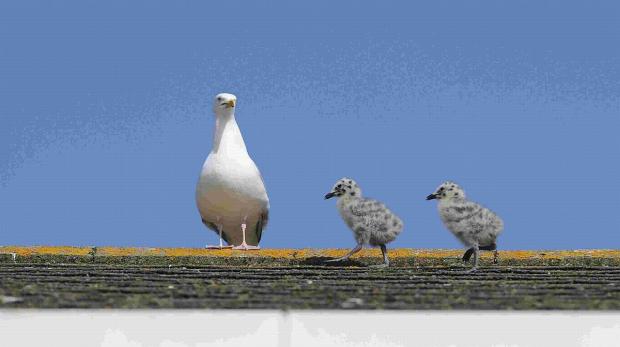
Seagulls have become such a problem in Devizes officials have began an 'egg smashing campaign

The fact that gulls return to where they were born and bred led officials to decide that smashing the eggs was the first step. 

Families say huge flocks of gulls nest on their rooftops even though it's nearly 50 miles from the sea. The gulls' droppings spatter down on people's heads, leave dirt on their washing hung out to dry and put damaging stains on the gleaming bodywork of parked cars. 

And the birds are playing havoc with tourists visiting the beautiful market town in the heart of Wiltshire. Devizes has 500 listed buildings and is situated around an old Norman castle.

In the last few weeks 140 nests on the Garden estate - the gulls' favourite roosting spot - have been removed and over 400 eggs have been destroyed. 

Wednesday, 4 February 2015

Bird of prey to scare off Devizes gulls

1:00pm Saturday 31st January 2015 in News

An action plan to reduce gull numbers in Devizes and the surrounding areas was announced at Devizes Area Board on Monday night.

The board agreed to contribute £3,200 towards the £10,000-a-year project, which will use a bird of prey to scare the gulls along with replacing eggs with fake ones.

The bird of prey, which is being supplied by Harris Hawks and Falcons, would fly three hours daily for 10 days and then 26 more flights through the year to maintain a presence in the area.

On four occasions there will also be an egg and nest removal program for roof areas during April, May and June, with access arranged by Wiltshire Council.

Thursday, 19 September 2013

Wedding delayed as ring-bearing owl goes for a sleep

A wedding service was delayed when an owl bearing rings fell asleep in the church roof.

Darcy the barn owl was meant to fly down the aisle at Holy Cross Church in Sherston, Wiltshire, and deliver rings to Sonia Cadman and Andrew Matley.

Instead the one-year-old owl flew into the church roof to roost. It took about an hour to get her down.

The Reverend Christopher Bryan said: "We tried all we could to get it down but it just wouldn't budge."

He said the owl seemed "very happy" in the roof and could not be tempted down with a treat.

"It must have been an hour before they got a ladder to rescue it," he said.

'Absolute stitches'
The specially-trained owl had been hired by Ms Cadman for the wedding, which took place at the weekend.

Saturday, 10 August 2013

Rare Curlew bird found wandering around an Aldi SUPERMARKET

One of Britain’s rarest birds stunned shoppers after it was found wandering around – an Aldi SUPERMARKET.
The stone curlew was discovered “dazed and confused” in the shop many miles from the nearest habitat.
Stone curlews are a ground-nesting bird that were once common in upland areas of the West, but nearly died out because of modern farming methods.
There are believed to be less than 350 nesting pairs of stone curlews left in Britain, and the RSPB have been campaigning to save the little brown and white birds.
The young stone curlew – also known as a dikkop – was spotted at the budget supermarket chain in Devizes, Wilts..
It was taken to a local vet by a member of the public, and passed on to the Wiltshire Wildlife Hospital at Newton Toney, near Salisbury.
Volunteer Marilyn Korkis said: “I couldn’t believe it when I saw it. It is such an unusual bird and a privilege to see it close up.”
RSPB stone curlew officer Nick Tomalin said: “We knew an ideal site to release the bird where the landowner has created some excellent stone-curlew habitat.”

Friday, 21 December 2012

Bird poo study to help Great Bustards thrive


December 17, 2012 The LIFE+ Great Bustard Reintroduction Project aims to create a sustainable colony of the birds on Salisbury Plain, Wiltshire Move over Gillan McKeith – scientists at the University of Bath are studying the droppings of Great Bustards to help understand their diet and nutrition with the aim of boosting their survival in a conservation project to reintroduce the birds to the UK.

Great Bustards, the world's largest flying birds and the county mascot for Wiltshire, became extinct in the UK in 1832. The LIFE+ Great Bustard Reintroduction Project is a partnership between the Great Bustard Group, RSPB, Natural England and the University of Bath, which has been working together to establish a self-sustaining population of Great Bustards in southern England. The reintroduction project has been regularly rearing chicks imported from Saratov, Russia and releasing them once they are fully fledged at a secret location on Salisbury Plain. For the first time this year, they have also successfully hatched chicks from eggs brought over from Russia. As part of the conservation project, Scott Gooch and Dr Kate Ashbrook from the University of Bath LIFE+ project monitoring team have been collecting droppings of the released birds to monitor what they prefer eating and how their diet changes through the year. 

Scott Gooch explained: "Relatively little is known about the diets of Great Bustards living in the UK. Watching bustards in the wild can give you information on where they prefer to feed and how much of their time they devote to feeding, but by examining their droppings under a microscope we can discover the quantities of different insects and plants in their diet and how this changes across the year."

Read more at: http://phys.org/news/2012-12-bird-poo-great-bustards.html#jCp