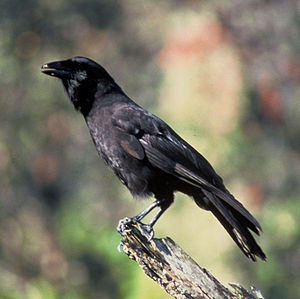
As regular CFZ-watchers will know, for some time Corinna has been doing a column for Animals & Men and a regular segment on On The Track... particularly about out-of-place birds and rare vagrants. There seem to be more and more bird stories from all over the world hitting the news these days so, to make room for them all - and to give them all equal and worthy coverage - she has set up this new blog to cover all things feathery and Fortean.
Showing posts with label Hawaiian crows. Show all posts

Monday, 10 September 2018

ʻAlalā Doing Just Fine After Hurricane Lane Drenching


By Big Island Now
August 28, 2018, 1:49 PM HST (Updated August 28, 2018, 1:49 PM)
On the Big Island, in their forest home in the Pu‘u Maka‘ala Natural Area Reserve on Hawai‘i Island, eleven ʻAlalā  (native Hawaiian crows) appear to have little difficulty following several days of heavy rains generated by Hurricane Lane. The critically endangered birds, the first to have been successfully released into the wild from conservation breeding facilities last fall, are among the creatures who experienced more than 30 inches of rain during the storm.
As soon as it was safe, staff from the San Diego Zoo Global’s Hawai‘i Endangered Bird Conservation Program, a partner in The ʻAlalā Project, went into the field to check on the bird’s welfare. Dr. Alison Greggor, a post-doctoral research associate commented, “The Hawaiian forest is very resilient and, in that way, the ʻAlalā are also very resilient. Our team got out here as soon as it was safe, and they saw no ill effects on the birds. They weathered the storm very well.”  Department of Land and Natural Resources staff also accessed the site as soon as it was safe, to assess any damage to roads, infrastructure, and check the status of management actions. “Decades of intensive habitat management have made the reserve a unique ecosystem, home to some of the island’s rarest birds and plants”, said DLNR Division of Forestry and Wildlife (DOFAW) Biologist, Jackie Gaudioso-Levita.
The reintroduction team describes the eleven birds as being quite hardy.  They’ve lived in the forest for almost a year, including through one entire winter.
“They survive very well in wet conditions and they’re able to fend for themselves.” said Dr. Greggor. “We’ve seen over time that the birds have gotten much better seeking shelter in the forest and finding natural nooks and crevices where they can hide from the rain.” She explained that for forest bird species, individuals that get really wet from prolonged rain can see ill effects when their body temperatures drop. ʻAlalā are known to be highly intelligent but the field team was thrilled that in spite of nearly three feet of rain over just four days, the birds remained unharmed.  This is encouraging news, among known impacts on wild and establishing populations in low numbers, where a single storm can prove to be decimating.

Sunday, 2 October 2016

New generation of ‘alala: Captive breeding program staff optimistic about November release


Published September 18, 2016 - 12:05am
By IVY ASHE Hawaii Tribune-Herald 

Imagine pre-dawn, when the sky turns pale after a long night.

Imagine a call breaking the silence and carrying through the trees, a “cracked caw,” as one ornithologist put it years ago: a crow’s call.

Then another call. And another, as the ‘alala in the forest wake up and remind their neighbors they are still there, yes, and please don’t come near this tree, it’s mine.

You have to imagine these things because it’s been nearly 25 years since they actually happened.

Today, the only Hawaiian crows calling from trees live in conservation centers on the Big Island and Maui, not the wild.

Like so many other island birds, their numbers have been decimated from all sides: avian malaria, toxoplasmosis, introduced predators, native predators, loss of forest habitat.

There are 131 birds — 112 adults and 19 fledglings — left in the world, the result of a decades-long breeding effort that begins a new chapter in November, when a first group of young ‘alala moves into an outdoor aviary at Pu‘u Maka‘ala Natural Area Reserve.

If all goes well, those birds will be the foundation of a new wild population.

“Everyone’s extremely excited,” said Bryce Masuda, program manager at the Keauhou Bird Conservation Center, a 140-acre campus on Kamehameha Schools land in Volcano. “It’s been a long time coming.”

At first, people didn’t think the ‘alala needed to be saved.

Thursday, 14 August 2014

`Alalā Breeding Season a Success

Created on Friday, 08 August 2014 18:07
Written by San Diego Zoo Global

Corvus hawaiiensis FWS.jpgSan Diego, California - Partially feathered and squawking for meals, `alalā chicks at San Diego Zoo Global's Keauhou Bird Conservation Center keep animal care staff busy. With nine new chicks being hand-reared this year, the rare bird's population now numbers 115 at the Center. 

`Alalā (also known as Hawaiian crows) are extinct in the wild, the remaining population is managed through a collaborative effort by the Hawai`i Endangered Bird Conservation Program (HEBCP) on the big island of Hawaii. The chicks are fed and cared for by animal care staff they never see to ensure they do not imprint on humans.

"`Alalā are very intelligent birds and very susceptible to imprinting," said Byce Masuda, program manager for San Diego Zoo Global. "We use puppets to hand-rear and feed the birds when they are young to keep them from imprinting onto us so they will act naturally as adults."

The last `alalā were recorded in their Hawaiian forest natural habitat in 2002 where they were threatened by habitat destruction, introduced predators and avian disease. The HEBCP has been working with the species in managed care since 1993, bringing the population from a low of only 20 individuals to 115. 

Sunday, 30 June 2013

Parent-Raised Rare Birds are First in this Century

Created on Friday, 28 June 2013 16:33 Written by IVN

San Diego, California - Two `alalā (also known as Hawaiian crows) at the San Diego Zoo Global's Keauhou Bird Conservation Center represent the first chicks of this critically endangered species to be successfully raised by a parent in more than 25 years. 

Hatched on 30th April and 1st May 2013 on the Big Island of Hawai`i, the chicks have passed an important survival marker - fledging. Newly feathered and beginning to fly, the birds represent a species that is extinct in the wild and is being managed through a collaborative effort as the Hawai`i Endangered Bird Conservation Program (HEBCP).

For just over six weeks, the chicks were cared for by their mother, enabling them to rapidly develop from small, naked, blind nestlings into fully-feathered youngsters, almost the size of an adult. On 13th June 2013, both chicks took the bold step of jumping out of their nest.

"It has been nerve-racking watching these chicks on camera. We had no idea whether Po Mahina would be a good mother. Fortunately her maternal instincts kicked in straight away and we are absolutely delighted that the chicks have successfully fledged," said Rosanna Leighton, Research Coordinator at KBCC. "We also have another female raising a chick a few weeks younger, still in the nest."

The last `alala were recorded in their Hawaiian forest natural habitat in 2002 where they were threatened by habitat destruction, introduced predators and avian disease. The HEBCP has been working with the species in captivity since 1993, bringing the population from a low of only 20 individuals to more than 110. Until this year artificial incubation and hand-rearing were used as a strategy to maximize breeding success.