As regular CFZ-watchers will know, for some time Corinna has been doing a column for Animals & Men and a regular segment on On The Track... particularly about out-of-place birds and rare vagrants. There seem to be more and more bird stories from all over the world hitting the news these days so, to make room for them all - and to give them all equal and worthy coverage - she has set up this new blog to cover all things feathery and Fortean.
Showing posts with label Nottinghamshire. Show all posts

Monday, 30 September 2019

'Extremely rare' bird seen at Nottinghamshire nature reserve after 45 years


The black-winged stilt was spotted at the Idle Valley reserve in Retford
By
Gurjeet Nanrah Community Reporter
11:04, 4 SEP 2019
An 'extremely rare' bird was spotted this weekend at a nature reserve in north Nottinghamshire.
The black-winged stilt was seen at Idle Valley nature reserve in Retford over the weekend - marking its first sighting in Nottinghamshire for 45 years.
It is a long-legged wader bird that is also rarely seen elsewhere in the UK.
Members of Nottinghamshire Wildlife Trust, the charity that looks after the nature reserve along the River Idle, believe the sighting shows how the wetland reserve has great potential as a location for wildlife watching.
The trust’s head of communications Erin McDaid said: “The bird has caused real excitement. It arrived over the weekend and was still on site this Monday so a number of people have been able to see and photograph it.
"It’s a very rare visitor for Nottinghamshire, the last one was recorded in 1974 and they are still quite a rarity across the UK.”
The sighting comes ahead of the first Explore North Notts weekend on September 14 and 15 - which is part of the Heritage Open Days Festival - and is aimed at celebrating the county's historic buildings, country parks and open spaces.
September is considered a good time to visit the reserve as many birds begin their autumn migration, meaning birds that could be seen include flycatchers, garganeys, wheaters and whinchats.
A guided bird walk will take place on Sunday, September 15 from 9.30am to 11.30am, so visitors can explore the reserve and children aged 8-12 can take part in the Wildlife Watch Group’s ‘In the Swim’ event the day before which focuses on fishes and other animals that live in water.


Sunday, 27 January 2019

Rare Firecrest, the joint smallest bird in Europe visits Attenborough


By
Thursday, January 17, 2019 5:42 pm
Over the past couple of weeks there have been many people with binoculars and cameras gathered around the lane into Nottinghamshire Wildlife Trust’s Attenborough Nature Reserve.
But what have a few bushes got that the 145 hectares of nature reserve hasn’t?
Weighing around the same as a 10p coin, the Firecrest holds joint position with its relative the Goldcrest for the smallest bird in Europe. To the untrained eye they may look similar, but there are a few distinguishing features that set them apart. The black eye stripe and white markings above the eye are only present in the Firecrest, but the most notable difference is their bright orange crown.
They rarely stay still, so look out for the flash of orange that can be seen darting through branches whilst they catch insects and spiders to eat.
Firecrests are undeniably a charming bird to watch but why is this one in Nottinghamshire attracting so much attention?
Firecrests are much rarer than the Goldcrest and don’t often visit this area of the country, with only 15 records at Attenborough Nature Reserve since 1974.
In the past Firecrests were simply passage migrants, meaning they would only stop in the UK during their spring and autumn migration, a sort of pit stop if you like, on their way to the warmth of Southern Europe and North-west Africa.
This bird travels from Eastern Europe and despite its small size crosses the blustery North Sea before taking a well-earned break in the UK. However, in 1962 the first record of them breeding in the UK was made in the south of the country. Although they haven’t stayed in Nottinghamshire to breed, chances are this fiery visitor could well be spending the winter with us. The last Firecrest at the reserve was in 2016 and is thought to have stayed in the area throughout the colder months.
It seems that this particular Firecrest has chosen the bushes along Barton Lane for its winter stay, if you want to catch a glimpse yourself, head to Attenborough Nature Reserve and keep an eye out along Barton Lane, just before the level crossing.
If the bird is nearby there are likely to be at least a few people waiting to see it too, but as any birdwatcher will tell you – prepare to be patient and it’ll be well worth the wait.

For more information about the Firecrests and Nottinghamshire Wildlife Trust’s nature reserves visit www.nottinghamshirewildlife.org.

Friday, 25 January 2019

Police pick up penguins stolen from Nottingham zoo


Two missing Humboldts were found this week in Strelley Village after a tipoff
Press Association
Fri 18 Jan 2019 13.01 GMTLast modified on Fri 18 Jan 2019 16.20 GMT
Two penguins have been found by police officers two months after they were stolen.
The pair of Humboldt penguins were taken in November last year from a zoo in Nottinghamshire.
Police officers rescued them on Wednesday afternoon in Strelley Village, west Nottingham, after a tipoff, and returned them to the undisclosed zoo.
A 23-year-old-man was arrested on suspicion of burglary and theft. He has since been released under investigation.
Sgt Andrew Browning and PC Paul Toon of Nottinghamshire police worked together during the investigation.

Thursday, 29 June 2017

‘Incredibly rare’ group of exotic birds spotted in Nottinghamshire – for first time in 40 years


By Jamie Barlow -
Jun 27, 2017

‘Incredibly rare’ exotic birds have been spotted in Nottinghamshire for the first time in around 40 years.

Two bee-eaters were spotted by bird watchers at CEMEX’s East Leake Quarry on Sunday and a group of 10 were spotted by staff yesterday (June 26).

Janice Bradley, head of conservation at Nottinghamshire Wildlife Trust, which works with the quarry, said the birds are showing signs of ‘mating behaviour’.

She said: “They were starting to show signs of mating behaviour which is really, really exciting.

“We don’t know if they’re going to breed but it’s interesting that they are not just passing through for 24 hours before moving on. They seem to be staying here and there’s a little group of them.”

Janice said staff at the quarry are making sure the birds are not disturbed and have set up a ‘viewing location’ for people to watch them with telescopes.


Continued

Thursday, 25 June 2015

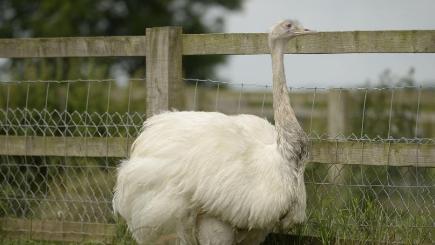
Rustler fear over missing rhea

The owner of an "aggressive" ostrich-like bird which has been hunted by armed police since it was reported missing two days ago fears he has been stolen.

Last updated: 25 June 2015, 14:30 BST

The owner of an "aggressive" ostrich-like bird which has been hunted by armed police since it was reported missing two days ago fears he has been stolen.

People living near Carlton-in-Lindrick, in north Nottinghamshire, have been warned to stay clear of the 6ft tall male rhea and told to call 999 immediately with any sightings.

But owner Alex Macdonald said that despite police officers turning out earlier this week with shotguns and rifles to look for the unnamed bird, he thinks it must have been stolen.

Mr Macdonald said that even though the missing rhea is a male, he is sitting on eggs at the moment and it is unlikely he would stray far.

Today, the bird's female partner was pacing the field they share looking for her mate.

"They used to play a lot running around the fields and stuff and she's not doing that at the minute. She's just getting over the fact she's on her own now," Mr Macdonald said.

"It's speculation but I think it's been taken. Nobody's reported it and it's something you would report if you saw it."


Sunday, 16 February 2014

Save the starling: Bird-watcher plea to Nottinghamshire people

BIRD-WATCHERS are urging people in Notts to put up bird boxes and plant bushes to help dwindling starling numbers.

The plea follows the RSPB's 35th Big Garden Birdwatch at the weekend.

Last year the survey revealed starling numbers had plummeted by 16 per cent – with less than three sightings per garden – an all-time low.

Notts Birdwatchers fear the trend could continue this year unless people help their feathered friends.

Chairman of the Notts Birdwatchers and RSPB conservation officer Carl Cornish said: "Starlings are a native British bird who love to nest in cavities, so they love a badly insulated house. But because we are more environmentally conscious now they are struggling to find places to nest.


Friday, 13 September 2013

White-winged black tern at Attenborough Nature Reserve

A rare bird usually found in Central Asia and Africa has been discovered at a nature reserve in Nottinghamshire.

The white-winged black tern has attracted more than 800 birdwatchers to Attenborough since it was first spotted on Thursday.

Experts said the bird could have been blown off its migration course as it would normally spend winter in the southern hemisphere.

Centre manager Tim Sexton said the bird's visit had been amazing.

'Swallow-like'
White-winged black terns' scientific name is Chlidonias Leucopterus which means swallow-like with bright white wings

The birds have a white rump, pale grey upper wings and a broad white collar
They are known as marsh terns and have shorter tails than sea terns like the common and little species

Mr Sexton said: "It first appeared on Thursday but news didn't get to us until late so it was too dark to go out looking for it.

"An anxious night followed and at first light on Friday I arrived at the reserve and within minutes, had relocated the white-winged black tern.

"It's so rare in the UK because it breeds in the far east of Europe, Central Asia and East Africa.

"It over-winters in southern Africa, South Asia and as far away as Australia."

Sunday, 30 September 2012

Rare bird spotted at nature reserve

A RARE bird has been spotted at Attenborough Nature Reserve.

Notts Wildlife Trust staff, who manage the reserve, spotted the bittern – a rare species of heron – amongst the reeds on Wednesday.

Speaking about the appearance, Tim Sexton from the reserve, said: "These birds are very few in number – with only 87 males recorded in the UK last year. Here at Attenborough we are usually very fortunate: our specially-created reedbed habitat often attracts bitterns during the cold winter weather.

"Over the last couple of years, bird enthusiasts from around the country have travelled to Attenborough to catch a glimpse of this elusive bird, with five recorded last winter.

"I can only assume that this year, the recent harsh wet and windy conditions on the east coast have moved them inland to their over-winter grounds early."
Continued: http://www.thisisnottingham.co.uk/Rare-bird-spotted-nature-reserve/story-17009720-detail/story.html

More information on the bittern (Botaurus stellaris):