As regular CFZ-watchers will know, for some time Corinna has been doing a column for Animals & Men and a regular segment on On The Track... particularly about out-of-place birds and rare vagrants. There seem to be more and more bird stories from all over the world hitting the news these days so, to make room for them all - and to give them all equal and worthy coverage - she has set up this new blog to cover all things feathery and Fortean.
Showing posts with label Taranaki. Show all posts

Friday, 1 March 2019

London scientists come to the rescue of rare native bird in Taranaki


Mike Watson13:49, Feb 10 2019
A Taranaki native bird sanctuary has made a conservation breakthrough in recording the calls of one of New Zealand's rarest birds without disturbing their natural behaviour.
Rotokare Scenic Reserve Trust (RSRT), with the help of scientists from the Zoological  Society London (ZSL), used remote recorders to listen in on the bird call of the hihi, or stitchbird.
The recording method is being touted as a breakthrough for conservation.
Endangered juvenile hihi from Tiritiri Matangi Island were released in Rotokare Scenic Reserve in 2017.
Rotokare Scenic Reserve Trust sanctuary manager Simon Collins said hihi, meaning 'first ray of sunshine', was associated with health in Maori culture.
"Essentially, they're an age-old indicator of a healthy forest. Not only are they important to protect but have proved to be a unique and ideal model to study the effectiveness of this new technique, which has huge potential for reintroduction programmes for other species," he said.


Wednesday, 25 April 2018

Taranaki's kōkako population continues to grow


Taranaki's kōkako population is slowing climbing, with four more of the endangered birds making the region home over the past week.

Released into the Parininihi Forest, near Urenui, the new residents are a part of a catch and release operation in which 20 kōkako will be taken from the Rangitoto Ranges, on the northern edge of Pureora Forest Park, King Country, and relocated to the area this month.

Leading the efforts, Tiaki te Mauri o Parininihi Trust, responsible for bringing the rare bird back to rural Taranaki after a near 20-year absence, hopes to one day have 500 kōkako living at Parininihi.

And according to trust chair Davis McClutchie, they are well on their way.

Eighteen years after the last kokako, named Tamanui, was moved from Parininihi to a captive breeding programme run by the Department of Conservation (DOC), 12 of his descendants were brought to the national forest in May last year.

Davis said the additional 20 kōkako marked an important milestone for the Ngāti Tama-led trust and are critical in building a genetically healthy and robust kōkako population.

But he said the programme was bigger than just Parininihi.

 "As we strengthen and expand our pest control work and increase native populations, biodiversity corridors can be created connecting our work to other projects", Davis said.
Volunteer Phil Andrews, of Shell Taranaki, will be on the ground helping with the catching this week. 

Continued 

Wednesday, 13 December 2017

Rare North Island robin chicks on Mt Taranaki after 112 years

North Island robin are breeding again in Taranaki

An rare native bird species had showed encouraging signs of re-establishing in Taranaki after last being sighted in the region 112 years ago.

The North Island robin, or toutouwai, was presumed extinct in the region after 1905.
But after the release of 50 birds in April, conservationists have found evidence of them breeding on Mt Taranaki.

North Island robin are nesting after being released on Mt Taranaki in April 2017.

Three pairs of toutouwai with chicks have been discovered nesting,Taranaki Mounga project manager Sean Zieltjes​ said.

The robins, relocated from Pureora Forest Park, are the first species to be re-introduced to the area by the environmental project, a $24 million scheme aimed at eradicating pests and restoring wildlife.

"We are ecstatic the robins have stayed and are breeding," Zieltjes said.

"It's a testament to the exceptional work of the team and it's great to get this early win and we will keep cracking on with our goal to build large and resilient bird populations."

Conservation biologist Nic Gorman said the pairs had established a cluster which would encourage more robins to the protected block.

"My gut feeling is now these birds are there, it will be an anchor so if there are more translocations the birds will stick," he said.


Monday, 9 June 2014

Sanctuaries unite for birds' release

8:41 AM Thursday Jun 5, 2014
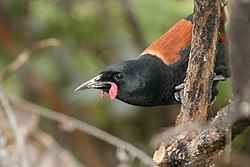
It's been 150 years but last weekend 40 saddleback birds were back in Taranaki - the result of two sanctuaries working together.

Saddleback tiritiri.jpg
The birds had been bred at Wanganui's Bushy Park reserve and on Saturday about 250 people gathered at Lake Rotokare east of Eltham to celebrate the release of the red and black tieke.

Bushy Park Trust member Allan Anderson was at the release and said it was a "very big day" for the Wanganui trust and the Rotokare Scenic Reserve Trust. The birds are descendants of the original 40 tieke moved to Bushy Park eight years ago.

Today there are an estimated 350 birds at the sanctuary north of Kai Iwi.

Mr Anderson said a key to the birds' survival is the predator-proof fences around the perimeter of both reserves.

"Without it they just wouldn't make it." he said.