As regular CFZ-watchers will know, for some time Corinna has been doing a column for Animals & Men and a regular segment on On The Track... particularly about out-of-place birds and rare vagrants. There seem to be more and more bird stories from all over the world hitting the news these days so, to make room for them all - and to give them all equal and worthy coverage - she has set up this new blog to cover all things feathery and Fortean.
Showing posts with label balloons. Show all posts

Friday, 22 March 2019

Balloons are the deadliest plastic to seabirds


15/03/2019
A new study has found that balloons are the highest-risk plastic debris item for seabirds, being 32 times more likely to kill them than ingesting hard plastics.
Researchers from the Institute for Marine and Antarctic Studies (IMAS), Commonwealth Scientific and Industrial Research Organisation (CSIRO) and Antarctic Climate & Ecosystems Cooperative Research Centre (ACE CRC) looked at the cause of death of 1,733 seabirds from 51 species and found that one in three of the birds had ingested marine debris. The data showed that a seabird ingesting a single piece of plastic had a 20 per cent chance of mortality, rising to 50 per cent for nine items and 100 per cent for 93 items.
Led by former IMAS-CSIRO PhD student Dr Lauren Roman and published in the journal Scientific Reports, the study found that although hard plastic accounts for the vast majority of debris ingested, it is far less likely to kill than soft plastics such as balloons.
Dr Roman commented: "Marine debris ingestion is now a globally recognised threat. However, the relationship between the amount or type of debris that a seabird ingests and mortality remains poorly understood. Among the birds we studied the leading cause of death was blockage of the gastrointestinal tract, followed by infections or other complications caused by gastrointestinal obstructions.
"Although soft plastics accounted for just 5 per cent of the items ingested, they were responsible for more than 40 per cent of the mortalities. Balloons or balloon fragments were the marine debris most likely to cause mortality, and they killed almost one in five of the seabirds that ingested them.
"As similar research into plastic ingestion by sea turtles has found, it appears that while hard plastic fragments may pass quickly through the gut, soft plastics are more likely to become compacted and cause fatal obstructions."

Friday, 28 December 2018

Gull dies after becoming tangled in balloon


06/12/2018

The severe danger that balloons pose to wildlife has once again been highlighted following the death of a European Herring Gull in Derbyshire.
After a member of the public spotted the struggling and distressed bird hanging from a telephone wire on Thornbrook Road in Chapel-en-le-Frith, the RSPCA were swiftly on the scene. However, despite an officer managing to free the gull, which was thought to have been hanging there for several hours, it sustained very serious injuries and had to be put down.
Adam Grogan, Head of Wildlife at the RSPCA, said: "It's very sad to see that this poor bird suffered like this because of a single balloon and, although balloons released into the sky make an impressive sight, this case really highlights why they are a problem.
"Deflated or fragments of balloons can be eaten by accident or mistaken for food. Ingesting balloons can cause a slow death to wild birds and mammals as well as farm animals, horses and marine life, by blocking the digestive or respiratory tracts, and the attached strings can strangle or cause animals to get tangled, as happened in this case."
Lee Stewart, manager at Stapeley Grange, added: "Our vets tried everything they could for the gull but sadly its injuries were too severe. Frustratingly, as with all cases we see involving litter, this could have easily been avoided."

Tuesday, 27 January 2015

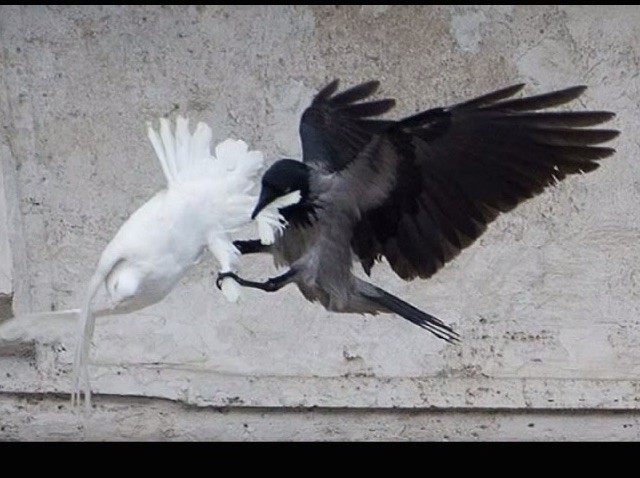
AFTER KILLER BIRD ATTACK, POPE LAUNCHES BALLOONS INSTEAD OF DOVES


papal dove attackA papal tradition has come to a bizarre end. For years, popes have sent out white doves as a symbol of peace after an annual meeting with young people from the youth movement called Catholic Action.

The anticipated avian emissaries were replaced this year by a bunch of colored balloons, set afloat from the balcony of the papal apartments.

Last Sunday, Pope Francis approached the window of the Apostolic Palace accompanied by a boy and a girl belonging to two different Roman parishes, but when the moment came for the traditional launch of the doves, balloons were released instead of the birds.

The reason? Last January 27 was witness to a macabre incident. In an episode worthy of Alfred Hitchcock, as the Pope’s entourage released two white doves, they were violently set upon by a black crow and a seagull, to the horror of onlookers.