As regular CFZ-watchers will know, for some time Corinna has been doing a column for Animals & Men and a regular segment on On The Track... particularly about out-of-place birds and rare vagrants. There seem to be more and more bird stories from all over the world hitting the news these days so, to make room for them all - and to give them all equal and worthy coverage - she has set up this new blog to cover all things feathery and Fortean.
Showing posts with label spoon-billed sandpipers. Show all posts

Sunday, 7 August 2016

Farmers choose solar farm over our endangered spoon-billed sandpipers


Phuket Gazette - July 29, 2016 | 11:57 AM

SAMUT SAKHON: Given a choice between renewable energy and wildlife conservation, the people of Samut Sakhon have opted for a solar farm.

Tractors and trucks loaded with soil were seen busily working in a field yesterday to fill a salt basin in Ban Khok Kham, where a three-megawatt solar farm project, costing about 180 million baht, is set to start pumping out power in December.

Conservationists have protested that the site chosen for the solar farm is an important wetland, and that its destruction would threaten the very existence of the endangered spoon-billed sandpiper.

The owner of the 42 rai, Wai Rodtayoi, said farmers like him are not worried about the impact on the birds because leasing the land to the solar farm operator is more profitable than conservation.

"We don't get anything from the birds. They just come here to catch fish and we don't earn anything from that,” Mr Wai said. “We cannot hunt them because it is against the law and they also eat the fish from our ponds. We prefer the solar farm over the birds because we will receive a substantial amount of cash from it.”

According to Sunseap Energy Co Ltd, the land owner will receive over 1 million baht (approx US$ 28,000) per year for the 25-year lease.

Mr Wai said that the traditional occupation of producing salt in the area was no longer sustainable as the price of salt is now only about 1,000 baht per 1.5 tonnes.

“We are all too old to continue panning for salt and the new generation is not interested in that work either,” Mr Wai said. “I think it would be better to use this land for producing solar power because it is clean, instead of us selling the land for farming or for building factories, as that would cause more ecological damage," he said.

However, prominent bird watcher and Mahidol University lecturer Philip Round said the salt basin in Ban Khok Kham is an essential wetland for migratory birds, and one of the last two habitats in the Bay of Bangkok area for the critically endangered spoon-billed sandpiper.

“This basin is a critical area for the birds,” Mr Round said. “It is one of only two areas in Thailand that are declared as a reserve site for shore birds under the East Asian-Australian Flyway Partnership, of which the Thai government is also a signatory.”

Read on … 

Wednesday, 6 July 2016

Efforts to breed rare spoon-billed sandpipers fail after chicks die

Conservationists are devastated after the first two chicks born in captivity to one of the world’s rarest birds die at a wildfowl centre in Gloucestershire

Press Association

Wednesday 6 July 201610.15 BSTLast modified on Wednesday 6 July 201610.40 BST

An attempt to breed one of the world’s rarest birds in captivity has failed after the only two chicks which hatched died, conservationists said.

Efforts to breed critically endangered spoon-billed sandpipers, named after their unusual beak, from the world’s only captive population seemed to have yielded results, with seven eggs laid and two chicks hatching.

One of the tiny birds, which were little bigger than a bumblebee, died soon after it hatched at the Wildfowl and Wetlands Trust (WWT) headquarters at Slimbridge, Gloucestershire.

The other appeared to be thriving, but despite round-the-clock care, its health suddenly deteriorated after a couple of days and it too died.

Conservationists said they were “devastated” by the deaths, as it has taken three years of encouragement for the 23-strong flock to attempt to breed at all.

The spoon-billed sandpiper is teetering on the brink of extinction in the wild, hit by loss of intertidal habitat in East Asia as it migrates south from its Russian Arctic breeding grounds, and bird trapping in their wintering sites in Bangladesh and Burma.

A captive flock was established at Slimbridge in 2011, in case conservationists ran out of time to prevent the bird becoming extinct in the wild and needed to rely on an “ark” of breeding birds in captivity to keep the species alive.

While conservation work has boosted numbers of the bird in the wild in the past couple of years, there are still only around 200 pairs.

WWT head of conservation breeding Nigel Jarrett said: “This is obviously very upsetting for the team.

“We’re absolutely devastated, but we’re trying to keep in mind that this has still been a positive step towards establishing a viable breeding population of spoon-billed sandpipers for conservation.”

Saturday, 25 June 2016

Rare spoon-billed sandpipers lay for first time in captivity


14 June 2016

One of the world's rarest birds - the spoon-billed sandpiper - has laid eggs in captivity for the first time.

Two females laid seven eggs at the Wildfowl and Wetlands Trust (WWT), Slimbridge, Gloucestershire.

There are only about 200 breeding pairs of the critically endangered species left in the wild.
Nigel Jarrett, from the trust, said when staff discovered the first egg last week they "almost couldn't believe it".

Mr Jarrett, WWT head of conservation, said staff had "done their best" to enhance breeding conditions, with special lightbulbs, timer switches and lots of sand and netting to recreate the experience of migrating from tropical Asia to Arctic Russia.

'Scratching our heads'
"For the last two years - ever since all the spoonies came into maturity - we've been doing everything to get these birds in the mood for love," he said.

"And for two years we've come up scratching our heads and feeling a bit deflated. Now, we've had two mums busy laying and the significance of it is only just starting to hit home."

The WWT began trying to establish a flock at Slimbridge in 2011, as a back-up to the wild population which was declining by up to 25% a year.

But with its extreme lifestyle - including making an annual 10,000-mile round-trip between Russian Arctic breeding grounds and wintering grounds in South East Asia - the bird has never been bred in captivity.


Thursday, 25 February 2016

Record-breaking wintering numbers of Spoon-billed Sandpipers in China


By Adrian Long, Thu, 25/02/2016 - 08:40

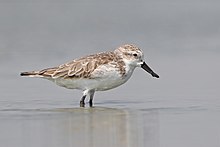
Eurynorhynchus pygmeus 2 - Pak Thale.jpg
On 30 December 2015, HKBWS volunteers Jonathan Martinez and John Allcock found at least 30 Spoon-billed Sandpipers near the Fucheng Estuary in south-west Guangdong Province, some of this land is located within the Zhanjiang Mangrove National Nature Reserve. This was the highest number ever found in China during winter, but the record did not even last a month

At the end of January further coordinated counts in Guangdong Province, including members from the Zhanjiang Bird Watching Society and staff from the Zhanjiang Mangrove National Nature Reserve Management Bureau. Together they counted at least 45 individuals from a four locations, with Fucheng Estuary having the highest count (38 individuals). 

Jonathan Martinez, commented: ”These numbers are a massive increase on just three individuals counted at Fucheng during our inaugural mid-winter survey in 2012. That year, we found long lines of mist-nets were found flanking shorebird roost sites. We counted hundreds of dead birds, and literally thousand of nets”.


Saturday, 2 November 2013

New hope for two of the most threatened birds in the world

Spoon-billed Sandpiper and Nordmann's Greenshank found in record numbers in China
October 2013. An international survey team found a sensational record total of 140 Spoon-billed Sandpiper and 1,200 Nordmann's Greenshank, two of the rarest and most threatened birds of the world in Rudong Jinagsu Province on the Chinese coastline.

Entire world population
"We believe the entire world population of the adult population of both Spoon-billed Sandpiper and Nordmannn's Greenshank are staging at the highly productive intertidal flats on the coast of Rudong" stated Dr Nigel Clark from the British Trust for Ornithology (BTO) in the UK, highlighting its vital importance for the survival of both species.

Special wetland reserve created
Representatives of the local and provincial government announced the creation of a special wetland reserve for Spoon-billed Sandpipers during a workshop following the survey. "This is a historic moment in the conservation of the species. For the first time since our efforts to conserve the species began in 2000, we can realistically hope to save the species from extinction" concluded Dr Christoph Zöckler, coordinator of the Spoon-billed Sandpiper (SBS) Task Force, who organized the survey and workshop with Jing Li and Tong Menxiu from SBS in China.

Sunday, 20 January 2013

Spoon-billed sandpipers threatened by trapping in China


Endangered spoon-billed sandpipers arriving at their wintering grounds in China are being threatened by nets designed to trap shorebirds.

The spoon-billed sandpiper is one of the world's rarest birds.

Recent sightings of the bird at several new sites along the coast of southern China indicate the species is more widespread than thought.

But the study also found evidence of large-scale shorebird trapping using "mist nets" in some of these key areas.

Last month four spoon-billed sandpipers were sighted at new wintering grounds in Fucheng, south-west Guangdong Province: the latest evidence that the bird is migrating to more widespread areas in China than previously known.
Members of the Hong Kong Bird Watching Society discovered a group of the critically endangered birds in partially drained fishponds in Fucheng.

During winter, spoon-billed sandpipers(Eurynorhynchus pygmeus) migrate from their breeding grounds in northeastern Russia and travel 8,000km to south and southeast Asia.

The sparrow-sized wading bird is the only species to be born with its distinctive spoon-shaped bill, which it uses to peck and probe in mud to find food.

The latest sightings, along with reports of the bird at several other sites in southern China in recent years, "[indicate] that this is a more important wintering area for the species than was previously known", according to BirdLife International.

Continued: http://www.bbc.co.uk/nature/21086610

Tuesday, 2 October 2012

Experts hail rare sandpiper success

Twenty critically endangered spoon-billed sandpiper chicks have been successfully bred in captivity in Britain and released into the wild. 

A team of British and Russian ornithologists collected the eggs from remote breeding grounds in the Russian Far East and brought them back to the Wildfowl and Wetlands Trust in Slimbridge, Gloucestershire, for incubation.

Nine spoon-billed sandpipers were also successfully reared in the village of Meinypil'gyno, in the Chukotsk peninsula.

All the birds were then released as fledglings to make their 4,971-mile (8,000km) migration to Burma.

The conservationists hope their work will ensure the survival of the rare species, which is unique in the animal kingdom for being born with a spoon-shaped beak.

There are thought to be fewer than 100 breeding pairs of spoon-billed sandpipers left in the world.

In recent years they have been declining steadily and it is thought they could be extinct within five to 10 years.
Continued: http://www.google.com/hostednews/ukpress/article/ALeqM5inFUWsgRIumN6LZYLeoCJDjCBj3w?docId=N0493261349001473367A