As regular CFZ-watchers will know, for some time Corinna has been doing a column for Animals & Men and a regular segment on On The Track... particularly about out-of-place birds and rare vagrants. There seem to be more and more bird stories from all over the world hitting the news these days so, to make room for them all - and to give them all equal and worthy coverage - she has set up this new blog to cover all things feathery and Fortean.
Showing posts with label Atlantic puffins. Show all posts

Thursday, 29 August 2019

Will Climate Change Cause Atlantic Puffins To Starve?


Aug 26, 2019, 10:27am

Priya Shukla Contributor Science

In the 19th century, Atlantic Puffins were nearly hunted to extinction for their meat and eggs. By the early 1900s, less than five breeding pairs were recorded in Maine. But, Steve Kress founded Project Puffin at the Audubon Society in 1973 to help recover the species. After transplanting a few Puffins from a healthy colony in New Foundland onto Eastern Egg Rock Island on the southeastern edge of Maine's Muscongus Bay, Kress' team put Puffin decoys around the island to encourage fledglings to return to the Island after migrating. And, from 1997 - 2011, the number of breeding pairs on Eastern Egg Rock increased from 20 to 123.

Despite these successes, the Puffin colony on Eastern Egg Rock is not yet self-sustaining. Regular human presence is required to maintain the puffin colony and keep predators at bay. Additionally, interns are tasked with recording the fish that the Puffins are catching, as these can be indicators of not only the Puffins' health but also regional climate change.

When record-breaking temperatures of 70°F were reached in 2012 (4°F higher than what was then considered average), the Puffins' preferred prey were in short supply. The herring, haddock and hake ("forage fish") that the Puffins feed their chicks may have perished or found refuge in deeper, cooler water not accessible to the puffins. These species are also sought after by lobster fishers for bait and may have made catching prey especially difficult.

Wednesday, 17 June 2015

Rare bird alert: Atlantic puffins spotted on the Isles of Shoals

These birds use their wings under water to swim
UPDATED 12:00 AM EDT Jun 14, 2015

ISLES OF SHOALS, N.H. —A pair of Atlantic puffins were spotted on the Isles of Shoals this past week and are included in this week's rare bird alert by the NH Audubon Society.

These clown-like birds with magnificent colored beaks spend most of their lives at sea, but return to land to form breeding colonies during spring and summer.

They are more often breeding north of New Hampshire.

These birds live most of their lives at sea, resting on the waves when not swimming.

According to National Geographic, they are excellent swimmers that use their wings to stroke underwater with a flying motion.

They steer with rudderlike webbed feet and can dive to depths of 200 feet, though they usually stay underwater for only 20 or 30 seconds.

Puffins typically hunt small fish like herring or sand eels.

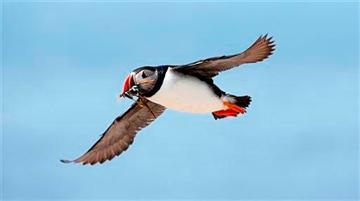
In the air, puffins are surprisingly fleet flyers. By flapping their wings up to 400 times per minute they can reach speeds of 55 miles an hour.

The birds often select precipitous, rocky cliff tops to build their nests, which they line with feathers or grass. Females lay a single egg, and both parents take turns incubating it, according to National Geographic.

When a chick hatches, its parents take turns feeding it by carrying small fish back to the nest in their relatively spacious bills.

Puffin couples often reunite at the same burrow site each year and have a lifespan of about 20 years.


Monday, 15 September 2014

Puffins: A small bird defies big odds

Human intervention, not nature, will ensure the puffin’s survival


By Derrick Z. Jackson | AUGUST 24, 2014

AFTER DECADES of successful efforts to restore its numbers, the Atlantic puffin remains a canary requiring more human care than ever. The last three years on the signature island of the National Audubon Society’s Project Puffin, Maine’s Eastern Egg Rock, have provided both a sobering and exhilarating illustration of that reality.

The project, which began in 1973 to rebuild a population all but wiped out by humans in the 1880s, reached a record number of 123 nesting pairs in both 2010 and 2011.

But the bird was brutally battered during the past two winters across the entire North Atlantic, with thousands of bodies washing upon European and American shores. Many of the dead birds showed signs of starvation. Scientists speculated puffins could not find traditional foods such as herring, either because of human overfishing or the fish moving away from waters being warmed by climate change. Puffins on Eastern Egg and other islands in Maine have, in recent years, caught more southerly fish that are unsuitable for chicks to eat, such as butterfish. The 2012 death of a chick nicknamed Petey, which could not eat butterfish, was captured on a web cam on another Project Puffin breeding ground, Seal Island.

Tuesday, 12 August 2014

Scientists ask bird oglers to help study puffins


SPosted: Aug 06, 2014 6:24 AM GDTUpdated: Aug 07, 2014 7:26 PM GDT

By PATRICK WHITTLE and ROBERT BUKATY
Associated Press

EASTERN EGG ROCK, Maine (AP) - Wanted: puffinologists. No experience necessary.

The Audubon Society wants bird lovers to contribute research to a project scientists hope will help save Atlantic puffins from starvation in Maine.

There are about 1,000 pairs of the seabirds, known for their multi-colored beaks and clownish appearance, in Maine. Audubon says the number of puffin fledging chicks has declined in the last two years, possibly because their key food source, herring and hake, are leaving for cooler waters. Puffins are on the state's threatened species list.

Audubon maintains three web cameras on Seal Island, a National Wildlife Refuge in outer Penobscot Bay, 22 miles off Rockland and one of the key puffin habitats in Maine. Volunteers are being asked to watch the puffins feed and answer questions about their feeding behavior, said Steve Kress, director of the National Audubon Society's seabird restoration program.

From 2007-2011, Kress said that 77 percent of puffin pairs on Seal Island produced fledglings, or birds that are able to fly. The number declined to 31 percent in 2012 and 10 percent in 2013 and while 2014 "appears to be better," he said, it's too early to tell.

"This is a citizen science project, hoping to advance the science as well as entertain the viewers," Kress said. "There are some questions that can be better answered through lots of people viewing."

Friday, 21 September 2012

Mysterious Winter Wanderings of Puffins Traced

Photo: nnWikipedia

Braving pecks from sharp, colorful beaks, researchers placed tags on 25 Atlantic puffins in Ireland this summer to track the elusive birds during their winter migration.

It's unknown exactly where the birds go in the winter (other than "out to sea"), and they are difficult to track because they spend much of their time on the water.

The tags, which keep a record of the bird's location using satellites, will allow scientists to pinpoint areas that are important to the animals' survival.

Populations of puffins throughout the North Atlantic and on the island colony off the coast of southwest Ireland known as Skellig Michael have declined in recent years. The decline could be due to climate change or availability of fish prey, according to the Zoological Society of London, a conservation group involved in the project. The tags will be retrieved next summer when the birds return to their island home.


Continued:
  http://www.livescience.com/23353-tags-track-puffins.html

More information on the Atlantic puffin (Fratercula arctica):