As regular CFZ-watchers will know, for some time Corinna has been doing a column for Animals & Men and a regular segment on On The Track... particularly about out-of-place birds and rare vagrants. There seem to be more and more bird stories from all over the world hitting the news these days so, to make room for them all - and to give them all equal and worthy coverage - she has set up this new blog to cover all things feathery and Fortean.
Showing posts with label Bengal florican. Show all posts

Sunday, 12 May 2019

Bengal Florican on the brink of extinction


PRAMITA DHAKAL, BHARATPUR
Apr 20, 2019-
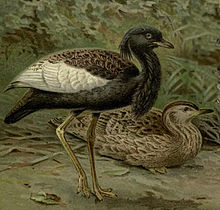
Critically endangered Bengal Florican (Khar Majur) is going extinct at an accelerated rate in Chitwan National Park, officials say. Bengal Florican is a large terrestrial omnivorous bird that nests on the ground.
Conservationists said that the number of the bird has been decreasing due to lack of habitat. Bed Bahadur Khadka, assistant conservation officer of the park said that 12 Bengal Floricans were found in the eastern sector of Sauraha during the census of 2011. “Now, we have hardly spotted five Bengal Floricans in Harrabas, Surungkhola, and Nawalpur areas,” said Khadka.
Besides CNP, Bengal Floricans are also found in Koshi Tappu Wildlife Reserve, Shuklaphanta National Park and Bardiya National Park. And like in CNP, the population of Bengal Florican has been declining at an alarming rate. It is estimated that there are 100 Bengal Floricans in Nepal. The species was uplisted from endangered to critically endangered status in the 2007 IUCN Red List. It is also listed in CITES Appendix I. According to conservationists, the bird could go extinct from Chitwan if immediate conservation measures are not taken. “Though the species is on its way to extinction, no programmes have been launched to conserve the species in the CNP,” said Khadka.
Published: 20-04-2019 07:59

Tuesday, 22 July 2014

Bengal Florican on verge of extinction

BengalFlorican.jpgRSSKANCHANPUR, July 18:Bengal Florican, known as khar majur in Nepal, one rarest bird species in the world, is on the verge of extinction. 

The population of the Bengal Florican, found only in Shuklaphanta Wildlife Reserve, Chitwan National Park, Koshi Tappu Wildlife Reserve and Bardiya National Park, has been found decreased for the past three years. 

As per the survey carried out by the Bird Conservation Nepal, number of Bengal Florican has been decreasing every year for lack of habitat and conservation. It is only found in lowland grasslands favouring thatch grass called khar in Nepali.


Tuesday, 22 April 2014

Census of rare Bengal Florican kicks off

Added At: 2014-04-21 12:11 AM

Last Updated At: 2014-04-21 12:11 AM

MAHENDRANAGAR: Nepal Birds’ Association has started counting Bengal Floricans, one of the world’s rare bird species, at Suklaphanta Wildlife Reserve in Kanchanpur.

The counting, which will continue till May 8, began for the second time yesterday. Census of the endangered birds was conducted for the first time at the Reserve last year. 

Apart from Suklaphanta, the rare bird species are available at Chitwan National Park, and Koshi Tappu Wildlife Reserve in the country. 

Though Bardiya National Park was home to the rare birds in the past, they have not been spotted for the last four years, said a source at Bardiya National Park.

Besides Nepal, Bengal Floricans are also found in India and Cambodia. 

The world has recorded a total of around 1,000 Bengal Floricans. Of which, Nepal hosts around 100.

A team of four technicians have been mobilised to count the Bengal Floricans. Technician Mohan Joshi said the counting will be carried out with binoculars.


Sunday, 27 October 2013

Beleaguered bustards

The declining fortunes of many bird species in India, and the likelihood that some of the critically endangered ones would barely exist in a small part of their historical range in coming years call for a serious review of conservation efforts. There are 145 avian species in the country facing various levels of threat according to a list compiled for the current year by IUCN, an international conservation organisation. Among the birds that face a bleak future is the great Indian bustard. By some estimates, less than 250 representatives of this heavy, terrestrial species survive today. Research insight points to the peculiarities of its grassland habitat, growing pressures from cattle grazing and expanding farming activity as significant causes for its depletion. The Bombay Natural History Society, after a lot of study, has expressed worry at the lack of a comprehensive approach to conservation. A comeback for the great Indian bustard, as well as the lesser florican and Bengal florican belonging to the same family, will now depend on a conservation programme that is based in science and quickly builds community support. Rajasthan has the largest known population of the great Indian bustard and has done well to allocate resources to aid a dedicated effort.