As regular CFZ-watchers will know, for some time Corinna has been doing a column for Animals & Men and a regular segment on On The Track... particularly about out-of-place birds and rare vagrants. There seem to be more and more bird stories from all over the world hitting the news these days so, to make room for them all - and to give them all equal and worthy coverage - she has set up this new blog to cover all things feathery and Fortean.
Showing posts with label Pennsylvania. Show all posts

Thursday, 14 February 2019

A Mandarin duck was a Central Park sensation. Now, one’s been spotted in Delco.


by Oona Goodin-Smith, Updated: February 7, 2019- 10:07 AM
Gliding through the mud-colored mallards over the frosty waters of Ridley Park Lake, he was a king among commoners. Showing off his technicolor plume, he paused before paddling near the photographer on the water’s edge, a feathered model beckoning for a glamour shot on an algae-lined runway.
His best angles? All of them.
Even in the waning winter light, Brian Quindlen knew what he saw: The “hot duck” had come to Delaware County.
“Seeing something like that, it just makes you feel like a kid again,” said Quindlen, an avid Philadelphia bird-watcher who rushed to East Lake Park in Ridley Park on a Sunday in January after receiving a text alert that the rare fowl sporting a colorful coat in hues of reds, blues, purples, and greens had landed in the area.
 “This things sticks out," he said. "It’s like looking at a gem in a very dreary winter haystack, you know what I mean?”
The Mandarin duck — an arrestingly handsome and out-of-place bird-turned-internet celebrity in Central Park last fall — is native to East Asia, with feral populations in Europe, North Carolina, and California.
Not to be confused with chill duck or goth duck, the Mandarin “hot duck” rose to viral fame and left the internet quacking after waddling around a Central Park pond last fall, becoming fodder for talk shows and cotton tees alike.
If the multihued waterfowl are spotted in areas like New York or the Philadelphia region, “you can bet that they’re pets" or bred in captivity, said Quindlen, 31, who has been bird-watching for more than 20 years and is a council member of the Delaware County Ornithological Club.
Quindlen, a fifth-grade teacher at Bethel Springs Elementary School, said he “lives hard to bird hard," and teaches after-school and summer birding programs for his students, in addition to his own recreational bird-watching.
Although he is unsure of the dazzling Delaware County duck’s origin story, Quindlen said the bird’s unusually friendly behavior toward humans and lack of bands on its legs leads him to believe it was bred in captivity.
One thing, however, is certain. The Ridley Park bird is not the same “hot duck” spotted in Manhattan and northern New Jersey. The Central Park celebrity has a band on its right leg, and was reported 100 miles northeast in New York on the same day Quindlen witnessed the waterfowl in Delaware County.
And while the Central Park duck has been making near-daily appearances in Manhattan since it was first spotted in October, the Delco duck may have just been stopping by. The next day, Ridley Park Lake was completely frozen, the bird nowhere to be seen, he said.
Its whereabouts have not since been reported by Philly’s birding community.
But wherever he may be, the Delco duck and his famous Central Park lookalike may soon learn there’s more to life than being really, really, really ridiculously good-looking.

Thursday, 7 February 2019

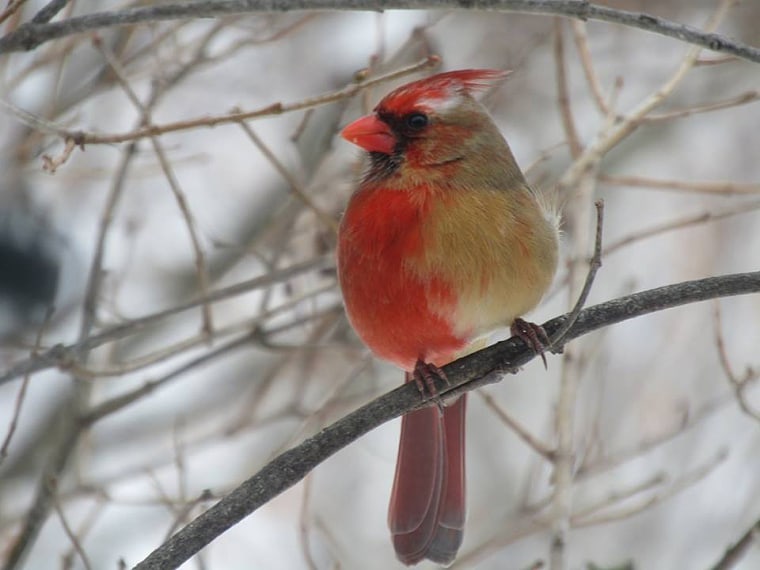
A cardinal that is half male, half female puzzles scientists, delights birdwatchers

Known as gynandromorphs, scientists say the creatures are extremely difficult to study because they are so rare.

Feb. 7, 2019, 2:16 AM GMT
By Ben Kesslen

Shirley and Jeffrey Caldwell don’t fashion themselves professional birdwatchers, but they dabble.

“We just watch out the window, and we have some feeders,” Shirley told NBC News.

But they know enough about birds to notice the cardinal that arrived in their backyard in Erie, Pennsylvania, about a month or so ago was “unusual.”

Shirley Caldwell took this photo of a rare gynandromorphic cardinal through her kitchen window.Shirley Caldwell
Two weekends ago, they got their first good look at the strange bird. They snapped some pictures of it through their kitchen window, amazed by what they saw.

“It was really a once in a lifetime thing,” Shirley said. “My first time seeing one and probably my last time.”

The cardinal they saw was half-red and half-tan, the colors split directly down the middle, like two bird halves combined.

There’s a name for this type of creature in the scientific community: a gynandromorph. In layman’s terms, it’s an animal that is half male, half female.

Gynandromorphs have been found among insects, birds, and even chickens, but can’t always be spotted.

Because male and female cardinals look markedly different, the gynandromorphs among them can be easily spotted.

Wednesday, 14 November 2018

Discovery: Rare three-species hybrid warbler


Date:  November 7, 2018
Source:  Cornell University
Scientists have shown that a bird found in Pennsylvania is the offspring of a hybrid warbler mother and a warbler father from an entirely different genus -- a combination never recorded before now and which resulted in a three-species hybrid bird. This finding has just been published in the journal Biology Letters.
"It's extremely rare," explains lead author and Cornell Lab of Ornithology postdoctoral associate David Toews. "The female is a Golden-winged/Blue-winged Warbler hybrid -- also called a Brewster's Warbler. She then mated with a Chestnut-sided Warbler and successfully reproduced."
A dedicated bird watcher and contributor to eBird.org in Roaring Spring, Pennsylvania, first noted the oddity in May 2018. Lowell Burket says he spends time birding and relaxing in the woods on family-owned property where he also likes to take photos and video of birds. In one piece of video he noticed a male bird that sang like a Chestnut-sided Warbler but had some of the physical characteristics of both Blue-winged and Golden-winged Warblers. Burket saw the bird again a number of times, reported it to eBird, and got in touch with researchers in the Cornell Lab's Fuller Evolutionary Biology Lab.

Friday, 25 May 2018

Endangered Bird With Ankle Identifier Found on Lehigh University Campus


The bird was found with an ankle identifier, which means someone's probably looking for it right now

Published at 5:41 PM EDT on May 11, 2018 | Updated at 5:52 PM EDT on May 11, 2018

This rare bird, believed to be a Sun Parakeet, was found on Lehigh University campus Thursday. Police are searching for its owner to hopefully return the bird home.

A rare, brightly-plumed bird was spotted on a college campus in Pennsylvania Thursday and police are now searching for its owner in hopes of returning the bird home.

Employees at Lehigh University in Bethlehem found a bird believed to be a Sun Parakeet, otherwise known as a Sun Conure, in a tree on campus.

The parakeet is an endangered species of parrot native to South America that can grow to be nearly two feet long.

Officers from the Lehigh University Police Department were able to place the bird in a cage. The bird, which police say is unharmed, was wearing an ankle identifier when found.

The bird has yellow, orange and green feathers, and its age is unknown.

The bird is currently being held at the Lehigh University Police Department while they try to track down the owner. Police have already received a couple of inquiries about the bird.

If you have information about the bird's owner, contact Lehigh University Police at 610-758-4200.


Source:  

Friday, 29 December 2017

How the Arrival of One Bird Brought $223,000 to a Pennsylvanian Town

The rare black-backed oriole showed up outside Reading, Pennsylvania, and birdwatchers flocked to the scene


SMITHSONIAN.COM 
DECEMBER 15, 2017

At almost any given time, there’s an unusual bird that has gotten lost. Perhaps it missed some migration cue or was blown off course by winds. For example, this week, a Eurasinan mistle thrush showed up in New Brunswick, the first time this bird has been seen on the continent. An irruption of snowy owls recently flocked to the northern U.S., creatures that normally live and breed in much colder climates. For each of these events, there are legions of bird enthusiasts ready and willing to drive for a few hours—or even a few days—to catch a glimpse of these avian vagrants. 


Sunday, 6 August 2017

Why are the roseate spoonbill and other Gulf Coast birds in Pennsylvania?


Updated on August 1, 2017 at 11:07 AMPosted on August 1, 2017 at 8:57 AM

Birds that normally spend their summers along the southern coast of the U.S. and points farther south in the Gulf of Mexico and South America are making almost unheard-of visits to Pennsylvania this year.

A roseate spoonbill has been drawing anxious birders to Conodoguinet Creek in Hampden Township, near Camp Hill in Dauphin County for the past week or so. Reports of a roseate spoonbill - likely the same bird - first emerged July 15 from the Conejohela Flats section of the Susquehanna River, near Washington Borough in Lancaster County.

If the two sightings about 30 miles apart were the same bird, together they would represent only the fourth time in nearly 150 years that a spoonbill has been documented in Pennsylvania. 

Lone spoonbills previously were confirmed in the state in 1869, 1924 and 1968, according to Dan Brauning, supervisor of the Pennsylvania Game Commission's Wildlife Diversity Program, project director of the second Pennsylvania Breeding Bird Atlas project in 2004-08 and co-author of "The Birds of Pennsylvania," the definitive book on birds in the state.
They are normally found along the Gulf Coast in Florida and Texas, islands in the Gulf of Mexico and South America.


Thursday, 3 August 2017

Missing bird for 60 years finally breeds again in Pennsylvania


MARY ANN THOMAS  | Sunday, July 30, 2017, 8:33 p.m.

The piping plover, a federally endangered bird missing from Pennsylvania for 60 years is finally breeding at Presque Isle State Park in Erie, according to the Pennsylvania Game Commission.

Named after its high-pitched piping call, the piping plover is a robin-sized shorebird that nests on beaches and is colored to blend in with sand and sticks.

Unfortunately, the birds' breeding habitat, open beaches, is also preferred by people.

Development and human traffic on beaches coupled with predation has caused steep declines in the plover population through the 1940s and 1950s.

The Game Commission and the Audubon Society reported two piping plover chicks, which were banded, from one of two nests at the park's Gull Point.

Strong waves overtook the second nest, however, the Game Commission and Audubon biologists rescued the eggs, which were transferred first to the Detroit Zoo and then to the University of Michigan Biological Station piping plover captive-rearing facility. Two chicks hatched and will be released on Lake Michigan in early August.

“This is a testament to dedication and teamwork, not only in Pennsylvania but throughout the species' range,” said Dan Brauning, Game Commission Wildlife Diversity Program Chief. “Their return wasn't by chance, or an accident.”

According to the Audubon Society, bringing the plovers back to the peninsula has taken a lot of work. Audubon provided the “eyes in the field” since 2009, with Mary Birdsong and other monitors providing daily updates on bird sightings and activity to all the agencies involved.
Audubon said it monitors noted, for instance, a tripling of the shorebird population at Gull Point after groups removed invasive plants and other vegetation taking over the sandy beach habitat that plovers and other shorebirds need.


Saturday, 7 March 2015

Surprise! Fisherman pulls bird (not fish) from ice

At least ice fishermen are enjoying this cold weather.

A group of friends were ice fishing in Pennsylvania when they made a surprise catch this week. Instead of finding a fish on the other end of the line, a man pulled a bird out of the ice.

Nicholas Colangelo filmed the clip of his friend, Fred Christensen, pulling in the bird and untangling it from the fishing line, according to KDKA-TV in Pittsburgh.

"My jaw hit the floor when it came out of the ice hole," Colangelo told KDKA-TV.

Red-breasted merganser ducks like the one Colangelo caught are common in Pennsylvania and stay under water while looking for food, reports KDKA-TV.

Not to worry, the bird is released in the video and flies away.


source

Saturday, 30 August 2014

Mystery solved: Unusual microbursts of downward air killed hundreds of birds in Lancaster County

Posted: Friday, August 29, 2014 11:07 am | Updated: 12:00 pm, Fri Aug 29, 2014.


The mystery of the hundreds of dead birds found in eastern Lancaster County the night after a violent storm on July 27 has been solved.

A deadly downward rush of air, known as a microburst, uprooted roosting songbirds from trees in the Leola, Gordonville and Bird-in-Hand areas and slammed them around.

“It appears they were literally blown into the tree branches, the ground — even into each other,” says Greg Graham, the Pennsylvania Game Commission’s wildlife conservation officer for northeastern Lancaster County.

“It doesn’t happen often.”

The unusual microburst conclusion was reached after the Game Commission sent the refrigerated carcasses of three robins and two house finches to the diagnostic section of the Southeastern Cooperative Wildlife Disease Study Lab in Athens, Georgia.

Monday, 16 June 2014

Pennsylvania man, 76, pleads in cockfighting case

Updated 3:41 pm, Tuesday, June 10, 2014

WASHINGTON, Pa. (AP) — A 76-year-old southwestern Pennsylvania man will spend two years on probation after pleading no contest to owning a bird used for cockfighting, though his attorney contended the man was no longer involved in the illegal sport.

The plea by Thomas MacFann, of West Pike Run Township, on Monday settled a case that began in August 2012 when state police raided his farm.

MacFann agreed to forfeit nearly eight dozen roosters seized during the raid, after Washington County prosecutors consented to dropping a related forfeiture action against his entire farm, the (Washington) Observer-Reporter reported Tuesday.

"Mr. MacFann was not engaged in any illegal activity at the time of the search," defense attorney Martin Dietz said after the hearing, adding that cockfighting trophies at the farm were more than seven years old.

Sunday, 1 June 2014

Pigeon Shoots: Pennsylvania's Secret Shame?

Pigeon shoots are not illegal in Pennsylvania, but animal cruelty is. Stuart Chaifetz, an investigator for SHARK, weighs in on controversy of shooting pigeons for sport.

Follow Nikki Moustaki on Twitter at @nikkimoustaki


Pigeon shoots are technically legal in the state of Pennsylvania, but cruelty toward pigeons is not. Two gun clubs in two Pennsylvania counties hold pigeon shoots, aiming their guns inside of a loophole based on an 1891 Pennsylvania Supreme Court decision that overturned the animal cruelty conviction of a participant in a live pigeon shoot.

In the brief written about the decision, the Court said that, "... were there anything in the finding of the jury to show that the object of this association was to torture pigeons we would not hesitate to sustain the judgment of the court below.”

Though pigeon shoots aren’t being prosecuted, they do violate Pennsylvania’s anti-cruelty statute, 5511. This is because the gun clubs routinely starve pigeons and fail to provide them with water for several days prior to the shoot, so that they will be easier targets. Once hit and injured, most of the pigeons are abandoned and left to suffer before they die.

Showing Animals Respect and Kindness, otherwise known as SHARK, investigates and campaigns against pigeon shoots in Pennsylvania, among other animal-related acts of cruelty. SHARK believes that the pigeon shoots are still legal because of the close ties some politicians may have to the gun clubs.

Stuart Chaifetz, an investigator for SHARK from Cherry Hill, N.J., weighs in on shooting pigeons for sport.

1) Is anything being done to try to stop the pigeon shoots?
SHARK is fighting hard against pigeon shoots in PA, and we are fighting on every front. We are on the ground at pigeon shoots, documenting cruelty and rescuing wounded pigeons. We have fought in the courts, in the media, and in the legislature. We’ve shown the absolute horrors of pigeon shooting with our videos from the killing fields and those who commit that violence by releasing the names of pigeon shooters. In every way, SHARK is working to end pigeon shoots once and for all.

2) When did SHARK get involved with this cause and why?

SHARK has been fighting pigeon shoots since the early 1990’s, when the annual Labor Day shoots were a major issue. When we discovered that pigeon shoots were happening in Illinois, we took immediate action and we won—pigeon shoots were shut down for good. The lesson is that we can win these battles, but there has to be a strong group of local people willing to help. Unless PA residents and groups are going to stand up, the battle to shut down shoots will be infinitely harder to win.

3) What do you personally like about pigeons? Why are they special? What has made this particular issue personal for you?

It’s not that pigeons as a species are special, but that every animal is special. They are all unique beings who deserve our protection.

Anyone who thinks negatively about pigeons needs to watch our videos and see the birds that we’ve rescued. Look into the eyes of a wounded bird as they rest in our arms, or the baby pigeon who had his head cut with a knife before being shot and you’ll see why this is such an important issue.

Pigeons have also saved human lives. In World War I, a homing pigeon named Cher Ami is credited with saving an army battalion during the Battle of Argonne.

Friday, 23 May 2014

Oil, gas development homogenizing core-forest bird communities

Date:
May 21, 2014

Source:
Penn State

Summary:
Conventional oil and gas development in northern Pennsylvania altered bird communities, and the current massive build-out of shale-gas infrastructure may accelerate these changes, according to researchers. The commonwealth's Northern Tier -- one of the largest blocks of Eastern deciduous forest in the entire Appalachian region -- is an important breeding area for neotropical migrant songbirds. These diminutive, insect-eating creatures, which breed in Pennsylvania and winter in Central and South America, contribute greatly to the health of forests.


Wednesday, 29 May 2013

Pa. to protect endangered birds on Susquehanna

By Myles Snyder - email

HARRISBURG, Pa. (WHTM) -

The Pennsylvania Game Commission announced it will take steps to protect two of the state's endangered birds with a limited culling of double-crested cormorants, a species that has been increasingly dominating a nesting area on the Susquehanna River near Harrisburg.


Culling was first used in 2006, and was used again in 2011 and 2012, to protect a colony of great egrets and black-crowned night-herons on Wade Island.

Dan Brauning, supervisor of the Game Commission's Wildlife Diversity Section, said Wade Island is home to the state's largest nesting colony night-herons and great egrets.

Cormorants, which were at one time rare in Pennsylvania, have been increasing rapidly in their numbers, and their abundance has led to increased conflicts other birds, their food supply, and vegetation.

A Game Commission survey conducted earlier this month showed that great egret nests decreased slightly from 185 to 181, and night-heron nests dropped from 67 to 48, compared to May 2012.

Brauning said the current number of night-heron nests is the second-lowest in 28 years of nest surveys on Wade Island.

He said extreme care will be taken so that the nesting of endangered species on the three-acre island is not disturbed, and the culling efforts will be stopped immediately if there is a perceived threat to egrets or herons.

Wednesday, 7 November 2012

Rare rufous hummingbirds show up at northeastern Pa. feeders


It's really nice to have the opportunity to enjoy your favorite pastime. One of my favorites is birdwatching.

As an avid birder, I try my best to add a new species to my "life list" as well my Pennsylvania and even county list. Sounds a bit obsessive? I'm afraid so.

There's a mess of listers and chasers out there. I guess it's the thrill of the chase when in pursuit of a reported rarity or possible new county record.

Just last week, a fellow birder, Jim Hoyson, called and informed me of a rare rufous hummingbird visiting a hummingbird feeder in Luzerne County.

"I'll pick you up in a few minutes, so we can get a new Luzerne County bird." was Jim's delightful early-morning wake-up call.

"Darn, I have to lead a nature walk this morning and if I go with you to see the hummer, I might not get back in time. Unfortunately, I have to pass, but thanks for the notice. I hope you see it, so keep me posted."

A few hours later Jim's text read, "Got it! Really easy bird."

If you recall, last November I wrote a "Pocono Outdoors" column about two sightings of rufous hummingbirds in Northampton County; one at Jacobsburg State Park, the other visiting a feeder in Plainfield Township. Jim and I both chased these Pocono rarities and were successful.


The rufous hummingbird, Selasphorus rufus, is a species from the Pacific Northwest and winters 2,000 miles south into Mexico, not in northeastern Pennsylvania. They are wide-ranging hummingbirds and the most northern breeders, even up into Alaska.

It's one tough, feisty hummingbird and, might I add, a remarkable wanderer. Their annual southward migration typically ventures through the Rocky Mountains up to elevations of 12,000 feet. Not the most balmy conditions, so it's no wonder they are showing up in Pocono backyards.

That Sunday afternoon I chased with high hopes to locate that new Luzerne County visitor, which was visiting a hummingbird feeder in Slocum Township, Luzerne County. When I arrived at the location, I was greeted with a warm smile by Bernice Ziniewicz.

Read on:

Sunday, 4 November 2012

Justina Laniewski Tries To 'Save' Ducks During Hurricane Sandy, Gets Arrested In Pennsylvania


GLEN ROCK, Pa. -- A Pennsylvania woman faces charges that include risking a catastrophe after she jumped into a raging creek to "save" a couple dozen wild ducks.

Southern Regional Police in York County says Justina Laniewski went into the Codorus Creek in Glen Rock on Monday evening, and her 4-year-old started to follow her.

A neighbor grabbed the child, but it took eight firefighters from a nearby station to rescue the 41-year-old Laniewski from neck-high waters. She was also charged with reckless endangerment, disorderly conduct and public drunkenness.

Court records say Laniewski told police she slipped and fell into the water.

Southern Regional Sgt. Darryl Smuck says a breath test showed Laniewski's alcohol level was more than twice the legal limit for driving. A phone listing for her couldn't be located.