As regular CFZ-watchers will know, for some time Corinna has been doing a column for Animals & Men and a regular segment on On The Track... particularly about out-of-place birds and rare vagrants. There seem to be more and more bird stories from all over the world hitting the news these days so, to make room for them all - and to give them all equal and worthy coverage - she has set up this new blog to cover all things feathery and Fortean.
Showing posts with label gannet. Show all posts

Sunday, 10 November 2019

The largest seabirds in the North Atlantic travel hundreds of miles just to catch food

NOVEMBER 1, 2019


Credit: CC0 Public Domain

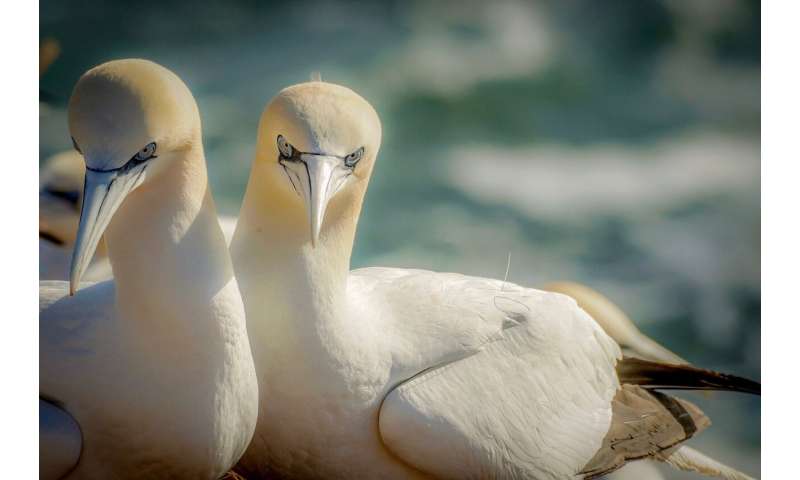
Gannets, the largest seabirds in the North Atlantic, can travel hundreds of miles from their homes just to catch food for their chicks. However, with around a million square miles of ocean to choose from, it has always been a mystery how they decide where is best to search for fish.

Now, new research led by the University of Glasgow and published today in the Journal of Avian Biology, offers new insights into why these iconic shaped seabirds choose to hunt the way they do.

Scientists recorded thousands of gannets commuting to and from the Bass Rock, in the outer part of the Firth of Forth in Eastern Scotland. The Bass Rock houses the world's largest northern gannet colony, with an estimated 75,300 breeding pairs calling it home.

They found that traveling as part of a flock appeared to be about more than just gaining aerodynamic benefits. The researchers were able to show that the more experienced adult birds were often found at the front of commuting flocks, with younger birds following behind. The results add weight to the theory that gannets learn to hunt by following their elders.

Dr. Ewan Wakefield from the University of Glasgow's Institute of Biodiversity, Animal Health and Comparative Medicine, said: "Our research offers a more detailed insight into how and why gannets search for food in the way they do. With such a large expanse of ocean to choose from it has always been a mystery as to how they know where fish are most likely to be found.

Wednesday, 7 February 2018

New Zealand gannet 'no mates Nigel' dies alongside fake partner - via Mark Raines

Nigel "no mates", a lonely New Zealand gannet who lived his life on the edge of the cliffs of an uninhabited island, has been found dead alongside his partner - a concrete replica bird.


Nigel had been on Mana Island for five years and was besotted with one of the 80 decoys spread across the island.

Conservation ranger Chris Bell, who found Nigel's body last week, said his passing was "incredibly sad".

"This just feels like the wrong ending to the story," Mr Bell said.

Nigel was found next to his immobile concrete partner, who was part of a fake colony created to help lure gannets to Mana Island off the west coast of New Zealand's North Island.

He had been observed over the years by volunteers who said they were touched after witnessing him carefully construct a nest from seaweed and twigs on the cliff edge in an apparent act of courtship in 2013.

In a Facebook post on Thursday, conservation group Friends of Mana Island wrote that Nigel "won the hearts" of its members and visitors to the island.