As regular CFZ-watchers will know, for some time Corinna has been doing a column for Animals & Men and a regular segment on On The Track... particularly about out-of-place birds and rare vagrants. There seem to be more and more bird stories from all over the world hitting the news these days so, to make room for them all - and to give them all equal and worthy coverage - she has set up this new blog to cover all things feathery and Fortean.
Showing posts with label released into wild. Show all posts

Thursday, 19 September 2019

Tiny penguin's clean bill of health after epic NZ-Australia swim

SEPTEMBER 18, 2019


The bird was so underweight it had to be gradually reintroduced to food and the water

A tiny penguin that made the mammoth journey from New Zealand to Australia has been nursed back to health and released into the wild—in the hope it will find its own way home.

The emaciated Fiordland penguin was found struggling on rocks near Lorne, south of Melbourne, about 2,500km (1,500 miles) from its native habitat of New Zealand.

Melbourne Zoo head of veterinary services Michael Lynch said the bird was so underweight it had to be gradually reintroduced to food and the water over several weeks.

"Over time it began to put on weight again," he said.

"We then started to reintroduce it to water when it was strong enough to swim to help build up some muscle."

Fiordland penguins are known to swim large distances to forage for food, sometimes even spending so long in the ocean that they grow barnacles on their tails.

They are classified as a threatened species, with an estimated 5,000 left in the wild.

Wednesday, 11 September 2019

WHITE-TAILED EAGLES RELEASED IN SECRET LOCATION ON THE ISLE OF WIGHT

22nd August 2019 07:45

A pair of white-tailed eagles have been reintroduced to the Isle of Wight this week for the first time in 240 years, with a further 4 eagles to be released today (Thursday).

The huge birds of prey, which can boast a wingspan of up to 8ft, were released in a secret location yesterday (Wednesday) and a further 4 will be let out into the wild this week. It is hoped that a total of 60 birds will be released over the next 5 years at a cost of £250,000.

As previously reported by Island Echo, the Forestry Commission and the Roy Dennis Wildlife Foundation have been working together to reintroduce these animals to the South and, more specifically, the Isle of Wight. The plans were originally announced in October 2018 and a licence was granted in April of this year.

It will take several years for the young birds to become established and breeding is not expected to start until at least 2024. However, over the next month or so the animals will start to disperse across the Island and will become a regular sight thereafter. During this time the birds will be closely monitored using satellite tracking devices and data on the movement of the birds will eventually be made available on the Roy Dennis Wildlife Foundation website.

Sunday, 19 May 2019

Highly endangered Florida grasshopper sparrows reared in captivity are released


MAY 13, 2019

by Kevin Spear, Orlando Sentinel
Three of the rarest birds in Florida took an extraordinary adventure this week, slipping out of a large pen into the freedom of an expansive, treeless prairie south of Orlando.
The year-old Florida grasshopper sparrows were hatched and raised in captivity, and designated as pioneers in a perilous bid to save their kind from oblivion.
Staffers of the Florida Fish and Wildlife Conservation Commission, the U.S. Fish and Wildlife Service and other organizations lined a dirt road Monday, observing the pen in the far distance as a pair of biologists removed panels from the enclosure.
Then, with a light breeze, clouds of love bugs and an air of worry and optimism, the group waited quietly for an hour for the secretive birds to make their move.
"One flew out," came a text message, followed a short while later by a text suggesting the other two had fled, as they are programmed to do, by running unseen through shrubs and grass.

Friday, 24 August 2018

Golden eagle chicks released to boost south of Scotland population

A long-awaited project to boost the population of golden eagles in the south of Scotland has taken off.

Three young golden eagles have been released into the wild at a secret location in the Moffat Hills.

They were moved from nests in the Highlands where the majority of the birds are usually found.

The translocation project hopes to increase the number of golden eagles in parts of the country where they have become an increasingly rare sight.

Fewer than five breeding pairs exist in the south of Scotland with none in England or Wales.
Iconic bird

The BBC was given exclusive access to see the young birds ahead of them taking flight for the first time in one of the most significant reintroduction projects ever under taken for a large predator.

It is hoped people from the south of Scotland, northern England and even Wales will have the chance to see this iconic bird in the coming months and years.

Tuesday, 1 March 2016

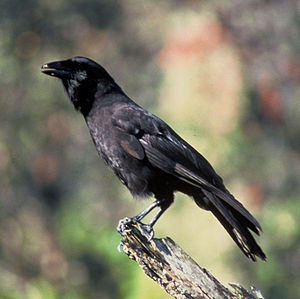
Triumphant return? ‘Alala to be released into the wild later this year

Published February 28, 2016 - 1:30am
HOLLYN JOHNSON/Tribune-Herald

Corvus hawaiiensis FWS.jpg
An ‘alala, which is extinct in the wild, stands on a perch at Keauhou Bird Conservation Center in Volcano.

By TOM CALLIS Hawaii Tribune-Herald
It’s almost time for the ‘alala to once again spread its wings over Hawaii Island’s forests.
Hawaii’s last remaining native crow species, extinct in the wild for about 14 years, will begin to be released from a captive breeding program in September, with a dozen in all to be offered freedom by year’s end to seed what biologists hope will be their comeback.

“The ultimate goal is a self-sustaining wild population of birds,” said John Vetter, a wildlife biologist with the state Department of Land and Natural Resources. “We expect that will take a number of years. It depends how successful we are.”

Success is not guaranteed.

The birds, which forage in undergrowth, face a number of threats in the wild, including feral cats, mongooses and rats. The ‘io, or Hawaiian hawk, also is a known predator.

An earlier attempt to release ‘alala in South Kona in the 1990s proved unsuccessful as the birds became susceptible to disease and predation. Of the 27 captive-raised juvenile birds that were released, 21 died and the remaining six were recaptured.

Vetter said the state hopes for better success this time around, with a larger breeding program and plans to release the birds in the Pu‘u Maka‘ala Natural Area Reserve near Volcano.

He said the area is fenced to keep out ungulates, allowing for a more mature undergrowth, which the ‘alala rely.

“We think that will help ‘alala with escape routes for ‘io,” Vetter said. There also might be fewer threats for juveniles from non-native predators.

South Kona was selected previously because there were known wild birds in the area at the time, he said. No wild ‘alala have been seen since 2002.

The captive birds — 114 in all — are raised at the Keahou and Maui bird conservation centers, operated by the San Diego Zoo.

The birds that will be released haven’t yet hatched.


Wednesday, 17 July 2013

Jurong Bird Park releases more hornbills on Pulau Ubin

Three more captive-bred Oriental Pied Hornbills were released into the wild on Wednesday, in a bid by the Jurong Bird Park to diversify the giant bird's genetic pool. "Increasing (the genetic pool)...is important to the conservation of the species because it allows for a healthier population of these birds. With more genetic diversity, the species is less susceptible to diseases," said Dr Minerva Bongco-Nuqui, avian curator at the Bird Park.

The birds had been fed whole fruit weeks prior to their release onto Pulau Ubin, to acclimatise them. They were then given a thorough health check on Monday, and measured for research purposes.

Since 2009, the Bird Park has released nine birds from its collection onto Pulau Ubin and the mainland. There are today about 100 hornbills here, up from an estimated 20 in 2004. The species - once common here - had vanished with urbanisation in the 1920s, but returned in the mid-1990s.

Friday, 12 July 2013

32 endangered birds released into the wild

Thirty-two crested ibises were released on Wednesday from a protected enclosure to their natural habitat in the northern reach of the Qinling Mountains in Shaanxi province.

After a two-year experiment in Yangxian county, the rare birds, including 14 adults, 10 subadults and eight juvenile birds, are now able to survive in the wild, said Chang Xiuyun, a senior scientist with the Wildlife Conservation Center under the Shaanxi Forestry Administration.

The birds, which were found in Japan, China, Russia and the Korean Peninsula, were believed to be extinct in the early 20th century.

Great efforts have been put into protecting the birds since 1981, when seven crested ibis were accidentally found in Yangxian county.

Since then, the number of crested ibises in China has increased to more than 1,700, including more than 1,000 in the wild, and 700 in captivity, according to the State Forestry Administration.

"These artificially bred birds are all descendents of the seven that were found in 1981," said Chang. "Interbreeding of the birds can cause risks such as deformity or high mortality due to low genetic diversity, and these issues threaten the already small population."

"Our aim in sending them back to the wild is to help the birds adapt to natural living conditions, improve their species and enlarge their habitat," she said.