As regular CFZ-watchers will know, for some time Corinna has been doing a column for Animals & Men and a regular segment on On The Track... particularly about out-of-place birds and rare vagrants. There seem to be more and more bird stories from all over the world hitting the news these days so, to make room for them all - and to give them all equal and worthy coverage - she has set up this new blog to cover all things feathery and Fortean.
Showing posts with label Shetland. Show all posts

Wednesday, 13 June 2018

RSPB warns of ‘apocalyptic’ seabird decline in Shetland


There has been a dramatic decline in the number of puffins on Shetland.

MARTYN MCLAUGHLIN
Published: 19:27 Sunday 03 June 2018 Updated: 07:58 Monday 04 June 2018

One of Scotland’s most significant seabird colonies has experienced an “apocalyptic” decline in numbers, according to the country’s largest nature conservation charity. The Royal Society for the Protection of Birds (RSPB) said the sharp drop off in the seabird population in Shetland was unprecedented. Scientists have attributed the downward trend to a series of factors, including climate change, declining food sources and the scourge of plastic pollutants. The charity, which runs a nature reserve at Sumburgh Head on the southern tip of the Shetland mainland, warned the plummeting numbers were “utterly tragic” Helen Moncrieff, RSPB’s area manager for Shetland, said at the society’s sites in Dalsetter and Troswick there were only 110 Arctic terns last week, compared with around 9,000 at the turn of the millennium.

Read more at: 


Monday, 31 October 2016

Tiny bird causes euphoria among twitchers


11:36 Monday, 10 October 2016 | Written by Hans J Marter 

BIRD WATCHERS from across the country are on their way to Shetland to catch a rare glimpse of a Siberian accentor, the first ever recorded in Britain.

The tiny bird was discovered at Mossy Hill, near Scousburgh, on Sunday afternoon by Shetland Wildlife guides Judd Hunt and Hugh Harrop.

"We were just checking the quarry at Mossy Hill, which is good for migrants now and then, when Judd set eyes on this bird and got very excited," Harrop described the moment they realised the "magnitude" of their discovery.

"Judd said 'I think I got a Siberian accentor'," Harrop continued. "It was total euphoria; we were both physically shaking."

The news soon made its way around the bird-watching community and by Monday morning around 100 twitchers were flocking to the site.

Among them was Britain's top bird watcher Steve Gantlett, from Norfolk, who arrived in Shetland on Monday morning after driving overnight to Aberdeen to catch the first flight north.

Harrop said the recent calm weather with steady easterly winds has been "producing lots of good birds".

"With any rare bird there is always an element of luck and pure chance," he said, "however the Siberian accentor is one of those birds that is on your radar as a bird watcher

Wednesday, 12 October 2016

Migrating birds 'more reluctant to leave UK' suggests Fair Isle study


27 September 2016
 
Migrating birds such as swallows and house martins are increasingly reluctant to leave the UK and return to Africa, a study on Shetland's Fair Isle has suggested.

The research, published in the science journal Global Change Biology, indicated some were arriving earlier and others were leaving later.

The study used daily observations of birds from Fair Isle Bird Observatory.

The aim was to measure changes over the past 60 years.

Dr Will Miles, of the Fair Isle Bird Observatory, said: "Environmental conditions are changing rapidly at a global scale.

"In response to these changes, the seasonal life-cycles of plants and animals are shifting too, often in dramatic and unexpected ways.

"It's too early to know for sure exactly why bird migrations now last so much longer in spring and autumn, but it's possible that conditions in Europe and Africa have gradually become more favourable for long-distance migration, and the birds are now under less pressure to migrate quickly within a short time window.

"For example, on Fair Isle, swallows and house martins are migrating up to a fortnight later than they did a few decades ago.

"Willow warblers used to migrate within a five-week period in spring but now this species is seen on migration for up to 10 weeks.


Wednesday, 4 May 2016

Rare American visitor graces Burra garden


14:55 Tuesday, 03 May 2016 | Written by Hans J Marter

When Lynn Goodlad noticed the bird on Tuesday morning she initially thought it was a toy and someone was playing a trick on her.

RosebreastedGrosbeak08.jpgBut when finch-sized bird started moving she quickly realised that she was dealing with something very special.
After failing to find the bird in her guidebooks she went online and posted a photo on the Shetland Birds & Wildlife Facebook page.

Within minutes the phone started ringing and online comments began to flow in. The Rare Bird Alert twitter feed posted a photo to the global twitcher community.

"It just snowballed from there. It has been amazing and a little surreal," Lynn described her morning.

She said a constant flow of people had started arriving near her family's home at Bridge End, in Burra, hoping to get a glimpse of the rare American visitor.


Wednesday, 20 January 2016

Finders-in-the-field: Mourning Dove, Lerwick, Shetland Dec 2015

Boxing Day, it was fine, cloudy and not very bright, but that didn’t matter since I wasn’t planning on going too far today. In fact another relaxed dinner with the family followed by a get together at a small local hall with friends in the evening was all we intended to do after the excitement of opening presents and eating far too much the previous day. Or so I thought.

It was late morning by the time I decided I’d better get dressed and go and get my partner’s parents, who were joining us for dinner again that day. I was getting dressed in the bedroom, which overlooks the back garden, with its various trees, Pampas Grass, shrubs and a variety of bird feeders that, together, attract a reasonable variety of birds, though seldom anything terribly unusual. At that moment there were a good number of starlings on the ground, on the feeders and hanging round in the perimeter trees, together with a couple of Collared Doves and a Rock Dove. However, my eye was instantly drawn to an altogether different dove to any I’d seen before, it was smaller, darker and less uniform than the Collared Doves I often see. My first thought was that it was the Oriental Turtle Dove from Scalloway – I hadn’t seen that bird but knew of it because of all the excitement it had generated.

Friday, 25 December 2015

Rare Asian bird discovered off Scottish coast


27 November 2015 by Reporter
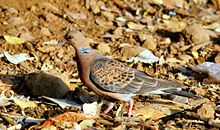
The Oriental Dove

It is normally found in the more exotic climes of Asia.

Orientalturtledove.JPGBut for only the twelfth time since records began, an Oriental Dove has been discovered thousands of miles off course in Shetland.

It was first spotted on Wednesday in a garden in Scalloway, the second time the species has been found on Shetland – the last in 1974 on Fair Isle – and the fifth for Scotland.

The dove is usually found in Russia, Japan, south-east Asia and the Indian sub-continent. Quite why this particular bird decided to veer off course is something of a mystery.

But Josh Jones of the authorative Bird Guides, said it could have been due to recent weather patterns.
“It is well off course – the nearest it usually comes is the Ural Mountains. But there is a good chance it may stick around for a while and could survive the winter and fly off again in the spring,” he said.


Thursday, 5 November 2015

Rare red-necked phalaropes 'best Scottish season in years'

3 November 2015

A bird described as an "extremely rare" visitor to the UK has had one its best breeding seasons in years in Scotland.

Red-necked phalaropes migrate to the Western Isles and to Orkney and Shetland during the summer.

Thirty-six breeding males were counted on RSPB Scotland's reserve in Fetlar, Shetland, equalling the highest number that has ever been recorded there.

A pair also bred at an RSPB reserve at Balranald in North Uist for the first time in 31 years.
Argyll, the most southerly the birds breed in the UK, had its best year on record with six males present, RSPB Scotland said.


Friday, 31 July 2015

Number of Puffin pairs plummets on Shetland

The numbers breeding there have halved from around 20,000 to 10,000

Friday 17 July 2015


The number of puffins breeding on Shetland has halved over nearly three decades, according to a recently published long-term study.

Researchers analysed a large puffin colony on Fair Isle, which lies halfway between mainland Shetland and the Orkney islands. They found the numbers breeding there have halved from around 20,000 to 10,000 individuals, with the most likely cause being that the Fair Isle’s young birds were failing to return to it. Experts say this could be because of a lack of fish to feed on.

Dr Will Miles of the Fair Isle Bird Observatory said: “It may be due to declining local fish stocks and poor feeding conditions for seabirds in Shetland waters.”“It is very difficult to find out exactly what happens to immature puffins after they have fledged because of the vast sea areas and the problems of tracing them within other colonies.”

Sunday, 19 July 2015

Number of Puffin pairs plummets on Shetland

The number of puffins breeding on Shetland has halved over nearly three decades, according to a recently published long-term study.

Researchers analysed a large puffin colony on Fair Isle, which lies halfway between mainland Shetland and the Orkney islands. They found the numbers breeding there have halved from around 20,000 to 10,000 individuals, with the most likely cause being that the Fair Isle’s young birds were failing to return to it. Experts say this could be because of a lack of fish to feed on.

Dr Will Miles of the Fair Isle Bird Observatory said: “It may be due to declining local fish stocks and poor feeding conditions for seabirds in Shetland waters.”“It is very difficult to find out exactly what happens to immature puffins after they have fledged because of the vast sea areas and the problems of tracing them within other colonies.”

Friday, 10 January 2014

Tracking device reveals 16,000 mile bird migration from Fetlar to Peru

A tracking device weighing less than a paperclip has helped scientists uncover one of the world’s great bird migrations.

It revealed that a Scottish bird migrated thousands of miles west across the Atlantic to the Pacific Ocean, a journey never recorded for any other European breeding bird.

In 2012, the RSPB, working in collaboration with the Swiss Ornithological Institute and Dave Okill of the Shetland Ringing Group, fitted individual geolocators to ten red-necked phalaropes nesting on the island of Fetlar in Shetland, in the hope of learning where they spend the winter.