If you’ve ever watched a bird hop
from branch to branch in search of food, you’ve caught a glimpse at how
prehistoric flying dinosaurs foraged among forest trees. That’s what
researchers are saying after they trained four Pacific parrotlets (Forpus coelestis)—small, pastel-colored
parrots about 13 centimeters long—to jump and fly for millet seed rewards. The
researchers designed a cage decked out with perches that doubled as sensors to
measure the birds’ leg forces, and surrounded the cages with high-speed cameras
to study the birds’ wing beats as they moved between branches. For short jumps,
the parrotlets primarily used their legs as their main source of momentum for
takeoff, using their wings only for “controlled collision,” where their legs
absorb the impact with the branch. During long jumps, the parrotlets mostly
relied on the forces generated from wing flapping. Using their models of
hopping and flapping from parrotlet data, the researchers estimated how four
birdlike dinosaurs may have used their early winglike arms. Archaeopteryx and
Microraptor—feathered dinosaurs that likely flew or glided between trees—would
have had the most success at boosting
the range of their long jumps by 20%. The larger and heavier
feathered dinosaurs Protarchaeopteryx and Caudipteryx would not have been able
to generate enough force from a wing beat to support their body weight or
significantly increase their long jumps. The scientists surmise that Archaeopteryx
developed an edge over other tree-foraging competitors by using their jumping
and wing flapping to minimize energy expenditure while foraging for food in
their trees. Thus, long jump Olympians of the Archaeopteryx world may have
spurred the evolution of flight.
Showing posts with label dinosaur flight. Show all posts
Showing posts with label dinosaur flight. Show all posts
Wednesday, 24 May 2017

Thursday, 17 July 2014
New feathered predatory fossil sheds light on dinosaur flight
Date:
July 15, 2014
Source:
Natural History Museum of Los Angeles County
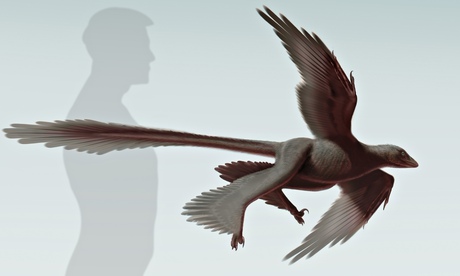 |
| Illustration: Stephanie Abramowicz/Dinosaur Institute, NHM |
Summary:
A new raptorial dinosaur fossil with exceptionally long feathers has provided exciting insights into dinosaur flight. A new article asserts that the fossil has a long feathered tail that scientists believe was instrumental for decreasing descent speed and assuring safe landings.
Subscribe to:
Posts (Atom)