As regular CFZ-watchers will know, for some time Corinna has been doing a column for Animals & Men and a regular segment on On The Track... particularly about out-of-place birds and rare vagrants. There seem to be more and more bird stories from all over the world hitting the news these days so, to make room for them all - and to give them all equal and worthy coverage - she has set up this new blog to cover all things feathery and Fortean.
Showing posts with label yellowhammer. Show all posts

Monday, 3 September 2018

Yellowhammer: Farmers urged to save 'iconic bird'


By Conor MacauleyBBC NI Agriculture & Environment Correspondent
21 August 2018
Declines in iconic farmland birds like the yellowhammer can be reversed by sympathetic farming, a study by a leading conservation charity has said.
And farmers can get a payment for simple measures which will enhance their numbers.
The brightly-coloured bird has been in huge decline in Northern Ireland due to the diminishing crop sector.
This means there is less suitable habitat and seed which they rely on for food.
But the RSPB says a five-year study shows the collapse in numbers can be turned around.
It surveyed five priority species - including the yellowhammer - on 33 farms in County Down which signed up to agri-environment schemes.
They give farmers a payment for measures which enhance biodiversity.
The results were compared to 22 control farms which did not participate.
Participating farmers planted wild bird cover; grew taller hedges and allowed field margins of rough vegetation to provide cover and food.
The survey results showed yellowhammer numbers increased by 78%. Linnets and tree sparrows are also up.
Cereal farmer Jack Kelly is involved in the project.


Wednesday, 18 January 2017

Lost British birdsong discovered in New Zealand birds

Recordings of New Zealand yellowhammer accents enable scientists to hear how their British relatives might have sounded 150 years ago


Georgia Brown

Thursday 12 January 2017 13.26 GMT Last modified on Thursday 12 January 2017 15.41 GMT
 
A new study reveals that a type of native birdsong, now lost in Britain, can still be heard in New Zealand where the birds were introduced in the 19th century.

By comparing recordings of yellowhammer accents in both countries scientists were able to hear how the birds’ song might have sounded in the UK 150 years ago.

The study, published in Ecography, examined yellowhammer accents in the UK and New Zealand, where over 600 of the birds were introduced in the 1860’s and 70’s and later became pests. It found some dialects that likely existed in the UK appear to have gone extinct, yet they still exist in New Zealand – a phenomenon that also occurs in human languages.

The researchers say the decline in birdsong is likely to be linked to falling yellowhammer populations in the UK.

The research was led by a Czech team, who encouraged volunteers to collect and submit recordings of singing yellowhammers using smartphones and cameras. Using these citizen science project recordings, the scientists compared the patterns of yellowhammer dialects in the native range of Great Britain, and in the invaded range of New Zealand.

The New Zealand birds had almost twice as many dialects as their British relatives, overturning the scientists’ expectations that the range of dialects would be greater in the mother country.

Lead author Pavel Pipek, of the Charles University in Prague, said: “It was fascinating to have this unique opportunity to study yellowhammer dialects from native and introduced populations and how they have evolved over 150 years.


Continued

Tuesday, 20 January 2015

How the yellowhammer bird became a Kiwi: From hero to villain in 15 years

Date:
January 16, 2015

Source:
Pensoft Publishers
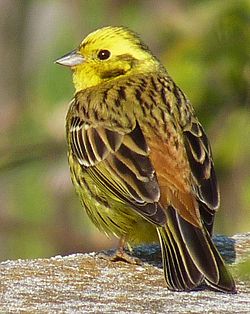
Goldammer (Emberiza citrinella) 2011-05-10 crop.jpg
Summary:
Yellowhammers are small, colorful and apparently innocuous birds, but they were once considered to be enemies by farmers in New Zealand. Yellowhammers were introduced there to help fight insect crop pests, but instead became pests themselves. A new study uses newspapers and documents from the 19th century to reconstruct the history of how the yellowhammer went from hero to villain in New Zealand in just 15 years.