As regular CFZ-watchers will know, for some time Corinna has been doing a column for Animals & Men and a regular segment on On The Track... particularly about out-of-place birds and rare vagrants. There seem to be more and more bird stories from all over the world hitting the news these days so, to make room for them all - and to give them all equal and worthy coverage - she has set up this new blog to cover all things feathery and Fortean.
Showing posts with label Massachusetts. Show all posts

Sunday, 21 July 2019

Eastern student, East Haddam resident studying endangered birds in Buzzards Bay


By Press Staff
 Published 4:47 pm EDT, Friday, July 12, 2019
Rachael Finch ‘21, a biology major at Eastern Connecticut State University from East Haddam, has spent the past five weeks working with the endangered birds in Massachusetts’ Buzzards Bay.
WILLIMANTIC — Rachael Finch, ‘21, a biology major at Eastern Connecticut State University from East Haddam, has spent the past five weeks working with the endangered birds in Massachusetts’ Buzzards Bay.
As the recipient of an Eastern Summer Research Fellowship, she is working to help restore the population of roseate terns — an endangered, migratory seabird that nests in the Northeast, according to a press release.
Under the supervision of Biology Professor Patty Szczys, and in collaboration with Mass Wildlife, Finch’s field work occurred on Ram and Bird Islands in Buzzards Bay. Each morning, she’d take a boat ride to either of the islands and spend the day monitoring the birds, the release said.
“Being on the island every day is exhausting,” she said of the early mornings and long hours in a prepared statement. “However, the work we’re doing for the birds is crucial to help their survival.”
Among her objectives, Finch is assessing whether leg banding — the traditional method of tracking and monitoring terns — is in fact harming the already endangered birds.
“The bands may cause an increase in mortality on their wintering grounds, thus potentially contributing to their slow population growth,” said Finch, who is comparing survival rates in banded versus unbanded terns.


Thursday, 21 March 2019

These Bird Songs Are Disappearing From Nature, So This Artist Captured Them In A Sound Installation


March 12, 2019
Hadley Green
The song of the Kauaʻi ʻōʻō, a bird native to Hawaii, is a delicate, flute-like melody. If you listen closely, you can hear a short succession of chirps gliding playfully from lower to higher tones. The Kauaʻi ʻōʻō was last seen on the island of Kaua’i in 1987. Its call, now archived as a field recording, is no longer heard in the wild. Yet this weekend, the Kauaʻi ʻōʻō and 11 other critically endangered or extinct creatures will be heard in "Requiem," a sound installation at the Boston Nature Center in Mattapan.
It combines the noises of birds and frogs, whose sounds have been sourced from field recordings at the Cornell Laboratory of Ornithology and The Amphibian Foundation in Atlanta. "Requiem," which has traveled from Maine to Boston and back again, is a purely auditory experience.
Staged in a large, empty room with four speakers, guests will hear the sounds of 10 birds and two frogs continuously looping on an audio file. The recording begins with one or two animals noises, and slowly builds to a mild cacophony of tweets, chirps, whoops and wood-peckings. Throughout the piece, familiar noises fade out, and new calls are introduced, overlapping and punctuating each other without rhyme or reason.
“It’s entirely unpredictable,” says Steve Norton, the Maine-based artist and musician who created the installation. “Sometimes it gets very dense and then also falls silent." Norton says these pauses in the audio can surprise listeners. “There have been occasions where people have said, ‘Is it over?’ It’s theoretically never over. It could run until the power goes out.”

Wednesday, 29 August 2018

Grasshopper sparrows return to Katama plains


August 23, 2018
Grasshopper sparrows have returned to the Katama grasslands and pastures surrounding the FARM Institute, according to a press release from The Trustees of Reservations. The sparrows are a threatened species which had historically nested on the Katama plains and across the Island, but have not been recorded in the area since 2005, according to the release.
An ecological assessment conducted in late June by Trustees ecology staff to evaluate the farm’s habitat and natural resources led to the discovery of the species’ presence.
As sandplain grasslands began to be invaded by woody species of plants and trees, the sparrows vacated the area as it grew less suitable for nesting.
Trustees ecology assistant Caitlin Borck wrote in an email to The Times that seeing the birds is a good sign. “The fact that a small population used the FARM Institute’s pastures this summer indicates the birds liked the habitat, suggesting the pastures can be managed with grazing to encourage productive habitat for rare birds,” Borck wrote. “Without grazing, the habitat would not exist at the farm.”

Wednesday, 13 June 2018

Nearly 400 Birds Seized From Cockfighting Ring in Western Mass.


Published at 1:50 PM EDT on May 28, 2018 | Updated at 6:37 PM EDT on May 29, 2018

Birds Seized From Northampton Cockfighting Ring
Hundreds of birds were taken from a cockfighting ring in Northampton, Massachusetts, and the MSPCA is hoping to save some of them from being put down.

Police have seized nearly 400 roosters and chickens from what is being called an illegal cockfighting operation on a western Massachusetts farm.

Officials with the Massachusetts Society for the Prevention of Cruelty to Animals said the birds, which including about 150 hens and chicks, were removed from a barn at Ravenwold Greenhouses in Northampton on Friday.

Animal control officers discovered signs of cockfighting during a barn inspection which included gloves used during fights and a bag of medication commonly used to cockfight. Other hints included roosters with sharpened spurs and an area with blood splatters. State law prohibits anyone from training animals for cockfighting.

The farm's owner says he rented the space to another person and had never been inside.

MSPCA officials said they will have to euthanize many of the roosters seized in the western Massachusetts bust due to their aggressive behavior

(Published Tuesday, May 29, 2018)
The birds were brought to the MSPCA-Nevins Farm in Methuen where officials say nearly all of them will have to be euthanized due to their aggressiveness.

"Sadly, they cannot be rehabilitated or re-trained and nearly all of them will have to be euthanized. The MSPCA cannot place them into homes as they would kill or attack any other bird (or other animals) that are nearby," the MSPCA said in a statement.

Wednesday, 4 April 2018

Rare Common Murre bird found in Scituate backyard


MARCH 26, 2018

SCITUATE, Mass. (WHDH) — A family in Scituate made a unique discovery, finding a bird that resembles a penguin in their backyard.

“We were just looking at it waddling around the yard like a penguin and it looks like a penguin,” said Joby Norton, who found the bird and brought it inside.

The Massachusetts Audobon Society said the bird was not a penguin but a Common Murre. The species is normally found in the northern Atlantic or Arctic oceans and rarely goes ashore.

Wednesday, 9 April 2014

What The Duck? Police Quack Home Intruder Case

Posted: 04/07/2014 9:40 am EDT Updated: 04/07/2014 9:59 am EDTPrint Article

NORTH READING, Mass. (AP) — Police in Massachusetts responding to reports of an intruder in a woman's home quickly quacked the case.

A North Reading (REH'-ding) woman called police Saturday from her upstairs bedroom to report that she heard loud banging noises downstairs and feared someone had broken into her home.

Officers who responded found no sign of a break-in.

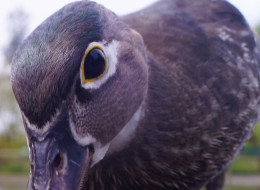
But during a quick search of the home, police found a soot-covered wood duck.

Police say it appears the duck got in through the chimney.

An officer caught the duck and released it into a nearby pond.


Sunday, 5 January 2014

Hunters fire on Walmart

WESTFIELD, Mass. (The Westfield News) - Walmart shoppers in the store’s Springfield Road parking lot Saturday may have thought they were under attack when a caller advised police that he saw a bird fall from the air and heard pellets land on parked vehicles.

Police report that at 10:07 a.m. Saturday a caller reported that he saw a bird fall and subsequent callers reported that duck hunters were shooting near the store and expended birdshot was falling on vehicles in the store’s parking lot.

Saturday, 21 September 2013

Researchers turn to cannons to save elusive birds


EASTHAM, Mass. (AP) — Three cannons explode on a deserted Cape Cod beach, unleashing a startling cloud of white smoke and sand. In tandem, projectiles erupt from the ground, flinging a net over a group of elusive shorebirds known as red knots.

A dozen wildlife researchers emerge from hiding and sprint to transfer the prized catch into holding boxes and then to a camp nearby. There, they collect feather samples as they measure, weigh and tag the robin-size birds, then fit their legs with tiny geolocators and release them.

Biologists hope the geolocators will use ambient light to calculate and record the locations of the rosy-breasted birds, helping conservation workers who will recapture them to determine their migration routes and refueling stops.

The red knot is already on New Jersey's endangered species list and has been proposed for inclusion on the federal list. It's known for its South America-to-Arctic migration, a 10,000-mile flight.

Wednesday, 10 April 2013

Conservation officials: Let plovers nest in peace


Updated 12:02 am, Monday, April 1, 2013
BOSTON (AP) — State conservation officials are asking beachgoers to not disturb piping plover nests as the rare birds return to Massachusetts this spring.

The shorebirds come back to Massachusetts' coastal beaches to nest and raise their young.
Experts say visitors should avoid marked areas where the birds nest. They also say to watch out for plover eggs and chicks, which can blend in with the sand and be vulnerable to people and pets.

Atlantic Coast piping plovers were listed as threatened by the federal government in 1986.
Government officials say that means the birds would become endangered and face possible extinction without Endangered Species

During spring and summer, the small, stocky birds nest from Newfoundland south to North Carolina.

Read more: http://www.sfgate.com/news/science/article/Conservation-officials-Let-plovers-nest-in-peace-4399025.php#ixzz2PatVHHBmAct protection.


Monday, 14 January 2013

Rare northern lapwing makes a visit


Northern lapwings are not normally found in the Northeast, but one recently touched down in Bridgewater, Mass., and became a star of the birding world.

By Bob Duchesne, Special to the BDN
Posted Jan. 11, 2013, at 4:42 p.m.

This northern lapwing never had a chance. The world of birding has changed.

It’s a mobile, high-speed, interconnected planet. Formerly, birding was a solitary pursuit, which appealed to shy, retiring introverts like myself. When a rare bird showed up, the fastest way to hear about it was through gossip. Eventually, it might be mentioned on a weekly bird line or listed in the newspaper. Usually, by the time word got out, the bird had flown the coop.

No more. Cellphones, text messages, emails, tweets, GPS and digital cameras have transformed birding into a social activity — a vast left- and right-wing conspiracy. A century ago, the surest way to confirm the presence of a rare bird was to shoot it. Many collections of dead rare birds are still in museums. We no longer open fire on rarities. We merely surround them and talk them into giving themselves up. “Come out with your wings up.”

And so it was that that I tracked down this northern lapwing in Bridgewater, Mass. The bird was discovered shortly after Hurricane Sandy and has stuck around. It was present during the Thanksgiving holiday, but I couldn’t slip away because there were precious few hours to spend with the in-laws. When the bird lingered in its favorite cornfield through December, I jumped in the car on the day after Christmas and snuck away long enough to get my lifer.

A northern lapwing is as rare as an NRA bumper sticker on a Prius. The lapwing is a shorebird in the plover family, common and widespread across Europe and Asia. It is similar to the killdeer and behaves the same way, but it is larger, crested and more strikingly colored. Like a killdeer, its call is a loud and sharp two syllables. It sounds like peewit, and so is also known by that name in Europe. In winter, it migrates to the Persian Gulf and areas along the north coast of Africa.

During fall migration, cyclonic storms can snatch a few of these lapwings off their course and throw them across the Atlantic. After Hurricane Sandy, one or two were seen briefly in Maine, several were sighted on Cape Cod, but only the Bridgewater lapwing remained in one location for an extended period. For me, the hardest part was finding Bridgewater. Massachusetts is a collection of oversized colonial towns connected by random cow paths. The addition of pavement has scarcely improved the road system. Pavement only accelerates the pace at which one gets lost. Thank you, Google Maps.

Monday, 7 January 2013

Rare, Iconic Bird Makes Wenham Appearance

It was a relatively rare sight on Wenham Lake on Friday.

A group of bald eagles was spotted on the lake, eating away at an animal carcass on the ice. It wasn’t the first time bald eagles have been seen on the lake, but the sight is somewhat rare.

Bald eagles were also seen on the lake back in 2007, according to a report in the Salem News at the time.

An amateur photographer from Beverly, Rob Whiting, told the paper at the time that he often photographs eagles on the Merrimack River but had not seen them in the Wenham area.

The state Division of Fisheries and Wildlife does not have any evidence that the eagles are nesting on the lake, said assistant director Tom French. It is more likely that the birds are from Maine or Canada and are headed south to find warmer air.

“Having birds on the lake doesn’t mean they are nesting on the lake,” he said.

Yet French noted that the bird is one of the most recognizable creatures since it serves as the national bird and is on the quarter.

The eagles likely spotted "lunch" and stopped to eat.

The eagles like to nest in white pines and try to find an area protected from wind. A bald eagle nest can be up to five feet tall, up to 4-1/2 feet wide and weight up to a ton, French said.

Known nests are along the Merrimack River in Amesbury, Haverhill, Methuen and Tyngsboro, along the Massachusetts Turnpike in Framingham and on Lake Shirley in Lunenburg.

The location of 38 pairs of nexting eagles is known in Massachusetts, French said.

For more than 80 years in the 1900s, there were no known pairs of bald eagles with nests in Massachusetts, French said.

But with the help of 41 chicks that were brought here from Michigan plus Manitoba and Nova Scotia in Canada and released at the Quabbin Reservoir, that's growing.

“The population is starting to go up,” he said.

The presence of the birds on Wenham Lake on Friday attracted significant attention, causing cars to pull alongside Route 1A where it passes near the lake by Lakeview Golf Course in an area known as Pond Hill.