As regular CFZ-watchers will know, for some time Corinna has been doing a column for Animals & Men and a regular segment on On The Track... particularly about out-of-place birds and rare vagrants. There seem to be more and more bird stories from all over the world hitting the news these days so, to make room for them all - and to give them all equal and worthy coverage - she has set up this new blog to cover all things feathery and Fortean.
Showing posts with label red kites. Show all posts

Wednesday, 15 May 2019

Don't feed Red Kites, warns RSPB


14/04/2019

The RSPB has warned the public not to feed Red Kites after two toddlers were alleged to have been left with cuts following a close encounter with the species in Buckinghamshire.
The incident was said to have taken place at Higginson Park, Marlow, when two children – aged three and five – had their sandwiches stolen by a quick-thinking kite. Their mother, Emily Viarnaud, claimed one of her daughters was left with a small scratch on her head and said she's now worried about letting her children outside. Consequently, the RSPB issued a statement asking people not to feed Red Kites.
Ms Viarnaud said: "We were just sitting in the park on a bench and got sandwiches out. A few seconds later and it [the Red Kite] swooped down and went for my daughter's sandwich. It didn’t get that and it then went for my son's. My daughter was quite scared and was more upset about it. We went inside and they didn't want to go back outside again. I have literally never heard of this happening before.
"I wouldn't want to leave them outside, even in our garden at home, with food. We often have swarms of Red Kites outside in the afternoon. I wasn't really worried about it before but I am now. I just want more people to be aware that this can happen."

Friday, 29 June 2018

Protected red kites poisoned in Northern Ireland


June 20 2018
The PSNI have launched an investigation after a pair of protected birds died after being poisoned in Co Down.
The Royal Society for the Protection of Birds (RSPB) NI and the PSNI have appealed for information after the pair of protected red kites died.
A male bird was found in distress close to a known nest site in the Katesbridge area on April 24. A member of the public alerted RSPB NI but the bird died shortly afterwards.
When the RSPB NI red kite project officer attended the scene, she found the female parent bird immobile on the nest – she too was dead. A rescue mission was launched in an attempt to save three orphaned eggs found in the nest beneath the deceased mother.
The bodies of the parent birds were collected and taken for toxicology testing by the PSNI. This has now revealed that both birds – known as Blue 21 and Red 63 because of their identifying tags - died from Carbofuran poisoning.

Monday, 23 April 2018

PICTURES: RSPB warns against feeding red kites after toddlers Giulia and Luca Viarnaud, from Marlow, attacked in Higginson Park


10th April

People are being warned not to feed red kites after two toddlers were left with cuts when a bird swooped in and tried to snatch their sandwiches at a park in Marlow.

Giulia and Luca Viarnaud, aged five and three respectively, were enjoying their lunch in Higginson Park with mum Emily when the bird of prey dived at the children and tried to steal their sandwiches.

It went to Giulia first and, when it was unsuccessful, pounced on Luca’s lunch, managing to take it away.

Emily said her daughter was left with a scratch to her head as a result and she is now worried about letting her children play outside


Monday, 26 March 2018

RSPB needs your eyes on the skies to help spot Red Kites


Published: 14:19 Friday 16 March 2018


Have you spotted a majestic red kite in the skies above Tyrone? 

RSPB NI is reminding members of the public to report sightings of this amazing bird of prey as we enter the 2018 breeding season, 10 years after they were reintroduced to Northern Ireland. 

Last year, phone calls and emails to them resulted in two new territories being discovered and the RSPB NI are keen to remind people about the importance of reporting their chance encounters with kites. 

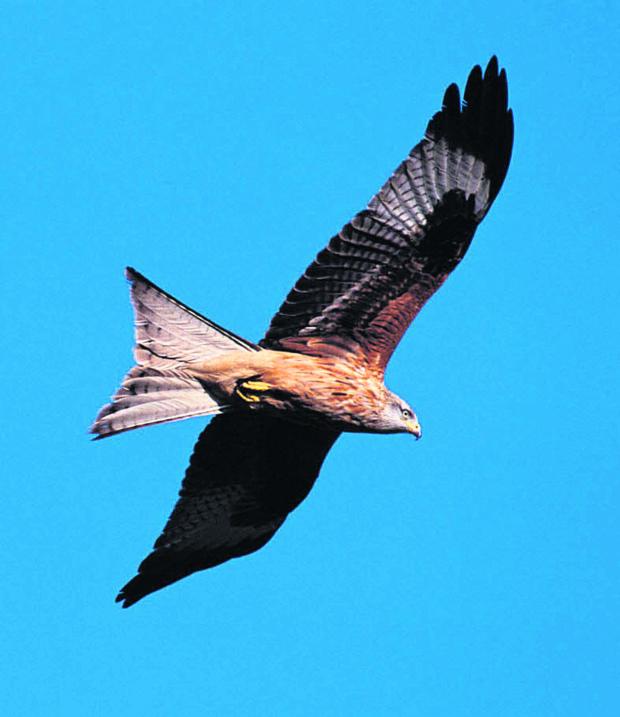
Red kites are magnificent birds of prey which were sadly persecuted to extinction more than 200 years ago because people mistakenly saw them as a threat to game and livestock. They are medium-sized raptors that primarily feed on dead animals, but can hunt small mammals, crows and rooks. They are reddish brown with black wingtips and a silver grey head, usually seen slowly flapping their long wings or using their distinctive V-shaped forked tail like a rudder. Most in NI have been fitted with a tag on each wing to help with identification.

Read more at: 

Sunday, 28 January 2018

Police investigation launched after red kites found dead

17th January

A POLICE investigation has been launched after five red kites, a raven and a buzzard were discovered dead in a village in Oxfordshire.

The birds were discovered by a family on Sunday, September 17, near the village of Pyrton, on the edge of the Chilterns, who reported them to the RSPB.

All the birds were recovered and X-rayed by a local vet. The X-rays revealed no signs of shot.

However, the birds have now been sent off for toxicology testing by Natural England as part of the Wildlife Incident Investigation Scheme (WIIS), to see if the birds have been poisoned.

All birds of prey and ravens are protected by UK law, making it illegal to kill or harm them. Those found to have done so could face six months in jail or an unlimited fine.

Thames Valley Police, Natural England and RSPB are now working together on a joint investigation and are appealing to the public for information.

If you have any information relating to this incident, call Thames Valley Police on 101.

With their six-foot wingspan, red kites are Britain’s third-largest bird of prey and feed mainly on carrion.

If you find a wild bird which you suspect has been illegally killed, contact RSPB Investigations on 01767 680551, email crime@rspb.org.uk or fill in the online form: https://www.rspb.org.uk/our-work/our-positions-and-campaigns/positions/wildbirdslaw/reportform.aspx


Monday, 30 January 2017

Red kites are believed to be breeding in Kent again after 150 years


By jane_bakowski  |  Posted: January 15, 2017

Strong signs that red kites, which died out in England almost 150 years ago, are breeding in Kent have been welcomed by the RSPB.

Reports of sightings of the dazzling bird, unmistakeable with its forked tail and angled red wings tipped with black, are pouring in from all over the county . Although unable to confirm that there are breeding sites in Kent, spokesman Tim Webb said: "The county does have the right habitats and conditions so it's amazing the birds haven't spread sooner from their stronghold in the Chilterns."

Hunted down as "vermin" for many years, red kites were declared extinct in England in 1871. A few survived in remote parts of Wales, but even by the 1960s, by now protected, numbers were tiny.

Since being re-introduced to various parts of the UK, however, red kites have begun to thrive. No longer on the endangered species list, the large, graceful birds of prey are frequently spotted soaring above the M4 motorway. They are also often seen in the Midlands and North. However it has taken them some years to reach Kent, which is why birdwatchers are so excited.

"I saw one above my house in Paddock Wood the other day," said gardener Trevor Davies. "It was a wonderful sight, it is s

Sunday, 14 August 2016

How this majestic British bird was saved from the brink of extinction

Here are five of Europe's most impressive natural wonders

6 AUGUST 2016 • 6:00AM

It is approaching 3pm at Gigrin Farm, and feeding time. For a few hours now, red kites have been steadily streaming in from their perches across the sparse, steep valleys of Powys. The birds scythe overhead in holding patterns, tawny plumage fluttering and amber eyes staring with intent. A scarlet tractor trundles into view and the sky clouds further.

The driver parks in the  middle of a field and begins shovelling 90lb of gristle-grey meat on to the grass. He is still unloading when the birds begin to dive, their 5ft wings hooked into a corkscrew to accelerate the descent. They feed on the wing, fanning their tail feathers at the very last moment and snatching the food in their talons before wheeling away screeching.

As the frenzy reaches  its peak the kites number 300 at the very least, a single swirling vortex from earth to sky. Only after 30 minutes or so, when most of the kites have soared off into the afternoon, does a column of crows feel sufficiently emboldened to mob over from the branches of a dead chestnut tree, fighting for the few morsels left behind.


Thursday, 7 July 2016

Rare birds of prey stealing underwear from skinny dippers

Auslan Cramb, scottish correspondent 23 JUNE 2016 • 2:02PM


Rare birds of prey have been caught stealing the underwear of skinny dippers at a popular wild swimming spot in a Highland glen.

The red kites have taken pants and socks to line their nest, including designer brands such as Armani, which have helped keep four chicks warm this summer.

Dave Clement, a gamekeeper on the Gannochy estate in the Angus glens, made the discovery after contacting the RSPB to have the kite chicks ringed and recorded.

It is the second year in a row that he has found a variety of underwear in the nest, high in a larch tree, not far from a gorge in Glen Esk where walkers often strip off to have a swim.

Mr Clement, a member of the Angus Glens Moorland Group, which promotes the benefits of grouse estates, said it appeared that the kites had become more discerning this year by choosing more expensive pants.

Tuesday, 21 June 2016

Bird of prey persecution "nothing short of disgraceful"


5:30pm 15th June 2016
(Updated 1:32pm 16th June 2016)

Police are describing the shooting of red kites as "totally unacceptable", after another bird was killed in North Yorkshire.

A member of the public found a dead adult red kite at Timble Ings, between Harrogate and Skipton, on Monday.

It was taken to a vet to be examined and X-rayed.

A number of shotgun pellets were found in it, and this appears to have been the cause of death.

In the last two months, six red kites in North Yorkshire have been shot or died in circumstances which suggest poisoning.

The red kite found at Timble Ings will have been killed sometime before it was found, and police are appealing for information to help bring those responsible to justice.


Wednesday, 2 September 2015

Two more red kites illegally killed in North Scotland


Two more red kites were illegally killed in north Scotland during 2014 the Scottish Government have confirmed. 

The first victim was found last June near Beauly, and was subsequently confirmed by post-mortem, at the SAC Veterinary laboratory in Inverness, to have been shot.

The second red kite was found in September 2014, some 5 kilometres south-east of Cawdor village in Nairnshire. It was confirmed by Scottish Government testing to have been illegally poisoned with a banned pesticide. This female bird was part of a successful breeding pair which bred at Cawdor Castle in Nairnshire in 2014, representing the first breeding record of red kites in the county for over 100 years. 

Monday, 6 July 2015

Skinny-dippers' horror as birds of prey fly off with their UNDERWEAR

The unsuspecting swimmers who had stripped off for a naked dip were baffled by the disappearance of their pants and socks as they cooled off au naturel at a popular bathing spot near Glen Esk in Angus. 

But the mystery was solved when a gamekeeper stumbled cross a natty nest of a local pair of red kites - lined with pilfered pants and stolen socks.

Dave Clement, head keeper at the Gannochy Estate, said: "Our trainee gamekeeper discovered the nest and we rang the RSPB to have them ringed and tagged. 

"What was really interesting was to see socks and underwear from a popular swimming spot actually in the nest and the surrounding trees. 

"It was like the kites were cleaning up the glen." 

Two red kite chicks were later discovered in the new nest - proving that the clever insulating tactic has paid off. 

This isn't the first time kleptomaniac animals have made the headlines.

Saturday, 25 October 2014

Police say Highland raptors 'not deliberately targeted'

Birds of prey found dead in Ross-shire in the Highlands earlier this year were most likely not targeted deliberately, police have said.

More than 20 raptors were discovered at various locations in March and April.

Police Scotland confirmed that 16 of them - 12 red kites and four buzzards - were probably accidentally killed by pest control measures.

A reward is being offered for witnesses or further information which could help with the ongoing inquiry.

A criminal investigation into the deaths remains ongoing.

Det Supt Colin Carey said: "Investigations into the suspicious deaths of wildlife and especially raptors can be difficult and prolonged.

"The areas covered can be vast and it is seldom immediately apparent why a bird may have died.

"We work closely with partners to identify and thoroughly investigate all wildlife crime."

He added: "The death of the raptors in Ross-shire remains an on-going investigation during which we are endeavouring to establish all of the circumstances around this crime.

"We would ask anyone who may have further information to come forward."

Tuesday, 17 June 2014

Dead in their nest ... red kite and her chicks killed by poisoners

BY LINDA STEWART – 10 JUNE 2014
Three kites have been found dead in Co Down following a suspected poisoning incident.
A female red kite was found slumped in her nest in Katesbridge along with her two dead chicks.
The authorities were alerted by a local resident who had been watching the nest from her house and was worried that something had happened to the female.

The birds have been recovered by members of the Northern Ireland Raptor Study Group (NIRSG) and the PSNI and submitted for a post-mortem and toxicology testing.

This is the latest in a series of illegal poisonings apparently targeting Northern Ireland's tiny red kite population. Red kites were re-introduced here between 2008 and 2010 after having been persecuted to extinction in the north of the island 200 years ago.

Wednesday, 11 June 2014

Air base is told killing birds will not solve danger threat

5:00am Tuesday 10th June 2014 in News By Ben Wilkinson, 
Crime Reporter, also covering Barton and Wood Farm.


BIRD watchers have warned RAF Benson will get no benefit from shooting red kites out of the sky.

The military helicopter air base has said it may need to kill some of the birds of prey for safety reasons after two flew into aircraft in the past two months.

The base got permission to kill the birds from Natural England in June last year. But experts have said more of the birds will come and replace any killed.

Ian Lewington, Oxford Ornithological Society’s bird recorder for the county, said: “If it is that much of a problem they have to get rid of all of them. You cannot just get rid of two of them.

“It is a void – it will be filled. They are opportunist, that is why they are so successful.”

Between 1989 and 1994, 93 fledgling kites were released in the Chilterns where the birds had been hunted to extinction.

It is thought there are now more than 1,000 pairs in the area.

Monday, 14 April 2014

Kites 'on the edge of extinction' now back in the skies


Hungry hunter which swooped in on squirrel is now prevalent thanks to Bucks reintroduction programme

Red kites are now a familiar sight in our skies because of a revival programme, as one astonished reader found out.

Lynn Baldwin from Chalfont St Peter was riding in a car's passenger seat when she saw the bird of prey snatch a squirrel from a tree in Bull Lane.

As the hunter flew away with its catch, Mrs Baldwin, of Layters Close, grabbed her camera at the front of the car and snapped the scene on Saturday, April 5.

The birds are usually known to be scavengers but hunt small animals when they are hungry. RSPB officer Nik Shelton congratulates Mrs Baldwin on her quick reactions.

He said: "What a fantastic picture – well done to your reader for capturing this, it looks like a blink-and-you’ll-miss-it moment. Red kites are normally scavengers – you often see them near busy roads waiting to pick up a roadkill dinner.

Friday, 18 October 2013

Scotland's red kites thriving again after 10 years of effort

Red-letter day for red kite projects as they celebrate tenth anniversaries

October 2013. Two of Scotland's most successful wildlife viewing projects are set to celebrate their tenth anniversaries this October.

Argaty Red Kites and the Galloway Kite Trail,
Both Argaty Red Kites near Doune, and the Galloway Kite Trail, near Castle Douglas, were opened in 2003, close to the sites of kite re-introductions that took place in the preceding years. Red kites are sociable birds, and naturally congregate together, particularly in the winter months, flocking noisily to available food sources, and forming large communal roosts at night.

The viewing projects give the public an opportunity to watch the birds up close in their natural environment, and since launching, both have attracted thousands of visitors, and provided an unforgettable experience for wildlife enthusiasts of all ages.


Monday, 18 February 2013

Grizedale's Red kites thriving - Have you seen any?


More than 200 sightings of Grizedale Forest's red kites recorded but public's help more important than ever

February 2013. Red kites released in the Forestry Commission's Grizedale Forest appear to be thriving following more than 200 sightings of the birds in England and Scotland - however help from the public is becoming more crucial than ever.
Photo courtesy of Forestry Commission

Wildlife officers from the Forestry Commission released 90 red kites as part of a three-year reintroduction programme to return the species to North West England - with the final release of 30 birds taking place last summer.

Mull to Hastings
Grizedale's red kites have been spotted as far north as the Isle of Mull, and as far south as Hastings. Many sightings have been made in Dumfries and Galloway, North Yorkshire and throughout Cumbria, particularly around Broughton-in-Furness and Kirkby Moor. It is hoped the birds will return to Grizedale Forest to breed and establish a sustainable population.

Orange tags
The birds carry an orange tag on their left wings to show they are from Grizedale, and one on the right to indicate the year of release - blue for 2010, white for 2011 and red for 2012. A selection also carried radio transmitters to allow officers to monitor their progress. However, some of the transmitters attached to birds released in 2010 are reaching the end of their battery-life so it is becoming increasingly important to record kites through visual sightings.


Monday, 15 October 2012

Concerns on risk to birds of prey over turbine plan


Red kites and other rare birds of prey would be at risk from big new wind turbines proposed for a zoo near Huntingdon, a conservation organisation has warned.

An objection to the scheme at Hamerton Zoo Park by a member of the British and Irish Red Kite Co-ordination Group said the birds would “undoubtedly” be at risk.

The zoo wants to install two new turbines standing almost double the height at 150ft as its current turbines.

People living near the zoo are also objecting to the scheme because they believe it would have a major impact on the small rural community.

Members of Huntingdonshire District Council’s development management panel came close to refusing the turbine plan at their meeting in August, but decided to defer their decision until after making a site visit and gathering further information.

Planners at the council are standing by their original recommendation that the bigger turbines should be approved. They believe the scheme would not have a major impact.
Cllr Doug Dew, panel chairman, said they would have to agree plausible reasons for rejecting the application and that the site visit would take in similarly-sized turbines elsewhere so councillors could make a comparison.

He said: “We have to find positive reasons for saying no which stand up. If we do that would be brilliant.”


Saturday, 22 September 2012

Warning over rat poison risk to wildlife


Conservationists working to re-establish rare birds of prey in Yorkshire are warning against DIY use of rat poison.
Yorkshire Red Kites says there is increasing concern about the use rat poisons, particularly those containing brodifacoum, a substance intended for controlled use indoors.
The organisation, which has released red kites on the Harewood Estate over several years, fears improper use of the poison could harm other wildlife. In its latest newsletter, Yorkshire Red Kites says more cases have emerged of illegal poisoning of kites, but also reported a successful breeding season in 2012.
The group said: “Professional advice on the use of rat poisons should ensure that the situation is properly evaluated and that the correct produce is used and properly applied. This reduces the risk of other species falling victim to their use.”