As regular CFZ-watchers will know, for some time Corinna has been doing a column for Animals & Men and a regular segment on On The Track... particularly about out-of-place birds and rare vagrants. There seem to be more and more bird stories from all over the world hitting the news these days so, to make room for them all - and to give them all equal and worthy coverage - she has set up this new blog to cover all things feathery and Fortean.
Showing posts with label seabirds. Show all posts

Thursday, 12 March 2020

Florida birds nest on rooftops instead of beaches now because of people, dogs, predators

Tyler Treadway Treasure Coast Newspapers
Published 6:00 AM EST Mar 4, 2020

Seabirds and shorebirds should start nesting on Florida beaches soon, but these days, they're more likely to be settling on rooftops.

Even those unnatural habitats are getting harder for the birds to find.

"There's just been too much loss of beach habitat and interruption from people, their dogs and predators for the birds to keep nesting on beaches," said David Simpson of Fellsmere, owner of Birding with David Simpson, a company offering guided birding tours and classes.

Birds that nest in colonies — least terns, black skimmers and American oystercatchers — and those that nest alone, such as Wilson's plovers, used to nest on beaches throughout the Treasure Coast. Now, beachgoers are unlikely to see nesting birds, except in a few sites.

Turns out, the beachgoers and their pets are a big part of the reason.

Most beach-nesting birds lay their eggs in shallow depressions in the sand, "not much more than dimples on the beach," said Ricardo Zambrano, a biologist for the Florida Fish and Wildlife Conservation Commission.

The nests don't provide much protection, and the birds seem to know it. Often, a single encounter with a perceived predator is enough for the birds to abandon a nest or colony of nests, leaving eggs and chicks behind.

"Least terns are very sensitive to intruders," Simpson said. "They'll just up and leave."

Sunday, 23 February 2020

Seabirds rescued after wild weather pushes them as far inland as NSW Central Tablelands


Wild weather off Australia's east coast has pushed seabirds hundreds of kilometres inland, with some rescued at Canberra and on NSW's Southern and Central tablelands.

Key points:
A number of the seabirds were found exhausted and underweight; some have since died
It's hoped they will eventually be released back out to sea, certainly not until Cyclone Uesi has had its time impacting the east coast
There's also been another rare sighting of a Bulwer's petrel, which don't usually venture too far from the equator

Mick Roderick from Birdlife Australia said it was not unusual for rough weather to knock birds off course, but the latest weather system had resulted in some very rare sightings.

"Even before the wild weather, we saw a lot of sooty terns close to the coast, which is unusual — there may be something going on with their food source," he said.

"But then the east coast low hit during the week and that has absolutely sent a lot of these seabirds off course.

Thursday, 6 February 2020

New study: are teen seabirds safe?

5 Feb 2020


Seabirds have an exploratory adolescent phase, often looking for food in ocean areas quite different to breeding adults. A new collaborative BirdLife study warns that current seabird protection measures should not neglect such crucial stages of seabird development.

Whether it’s to get space from their parents, ‘find themselves’ or see more of the world before they settle down, human teenagers and young adults tend to have an exploratory phase. The same could be said for young seabirds, which have been tracked for long periods wandering great distances at sea. And just as this crucial stage in a person’s psychological development can sometimes take them down dangerous alleys, the paths taken by young and non-breeding albatrosses and petrels may well be leading them towards dangerous interactions with fishing vessels. To counter this, a recent study led by BirdLife scientists provides a new and improved method for identifying seabird hotspots for at-sea conservation measures.

Lightweight tracking devices attached to the backs or tails of seabirds, or to a ring on their legs, have given us a completely new insight into their movements and lives – insight that is crucial to, for example, set measures for long-line fisheries in certain important zones to prevent seabird deaths. Yet, despite major recent advances in tracking technology, studying at-sea movements of juvenile, immature, and non-breeding adult seabirds remains particularly challenging, because they can be gone for months or years, returning to colonies only for short periods – making it difficult to retrieve devices and download data.

Sunday, 26 January 2020

New wind turbines could be harming thousands of endangered bird populations, says RSPB

BY DENIS BEDOYA ON JANUARY 21, 2020SCIENCE

Wind farms installed offshore to tackle climate change are actually threatening thousands of endangered seabirds around the UK, according to the RSPB.

The bird charity says new wind farms could be the ‘final nail in the coffin’ for more than 1,000 birds across four of the most threatened species.

Many of these birds feed on fish at sandbanks, where developers prefer to build offshore wind turbines.

There are more than 15 proposed UK offshore wind farms, which tend to be more efficient than those on land, as stronger winds cause the turbines to spin faster, meaning they generate more energy. 

Wind power is a sustainable source of energy and has a smaller impact on the environment than burning fossil fuels.

However, in a report published in Biological Conservation, the charity has identified areas where the building of wind farm infrastructure should be banned, such as sandbanks, where birds tend to feed on small fish.

Thursday, 23 January 2020

RSPB reveals new seabird hot-spot map

19/01/2020

The RSPB has produced new maps identifying the location of marine hot-spots for some of the UK's most threatened seabirds, based on tracking data, for the first time.

A five-year RSPB project previously tracked the movements of Kittiwakes, Guillemots, Razorbills and European Shags from colonies around the UK during the breeding season. Now, hotspot mapping techniques have been applied to this data to identify the most important areas used during this crucial time.

All four species are either Amber- or Red-listed. The new research demonstrates the large areas required by UK seabirds and comes at a time when there is a vital need to understand more about our seabirds as decisions are being made relating to fishing, offshore windfarms and how we can best protect our seas.

Four different hot-spot mapping techniques were trialled during the project and provide a range of potential areas that could be considered for formal protection. The researchers recommend that the choice of hot-spot identification method should be informed by considering species ecology alongside conservation goals to ensure hot-spots are of sufficient size to protect target populations.

Wednesday, 11 December 2019

Island 'soundscapes' show potential for evaluating recovery of nesting seabirds

DECEMBER 6, 2019


Nocturnal seabirds nesting on remote islands can be extremely difficult to study. An increasingly important tool for monitoring these populations involves acoustic sensors deployed in the field to record sounds over long periods of time. But analysis of the resulting recordings to identify and count the calls of different species can be time-consuming, even with computers and artificial intelligence.

An alternative approach for acoustic monitoring is to evaluate all of the sounds in an environment as a 'soundscape', using features such as acoustic diversity, complexity, and intensity as indicators of ecosystem health. In a new study, recently published in Restoration Ecology, researchers used soundscape analysis to evaluate the outcomes of restoration efforts in the Western Aleutian Islands.

"We learned that we can collect sound data at larger scales and understand where the ecosystem is responding to our actions," said first author Abraham Borker, who led the study as a graduate student in the Conservation Action Lab at UC Santa Cruz. Now an adjunct lecturer in ecology and evolutionary biology, Borker came to UCSC to study seabird conservation and earned his Ph.D. in 2018.

"Seabirds are special because they serve as a link between the ocean and land, transporting nutrients from the sea to land and transforming the islands they breed on," he said.

The new study took advantage of a highly successful campaign to remove invasive species and restore seabird nesting colonies in the Western Aleutian islands as a natural experiment. These remote islands, located in the Northern Pacific Ocean between Russia and Alaska, are important nesting sites for many species of seabirds.

Sunday, 10 November 2019

The largest seabirds in the North Atlantic travel hundreds of miles just to catch food

NOVEMBER 1, 2019


Credit: CC0 Public Domain

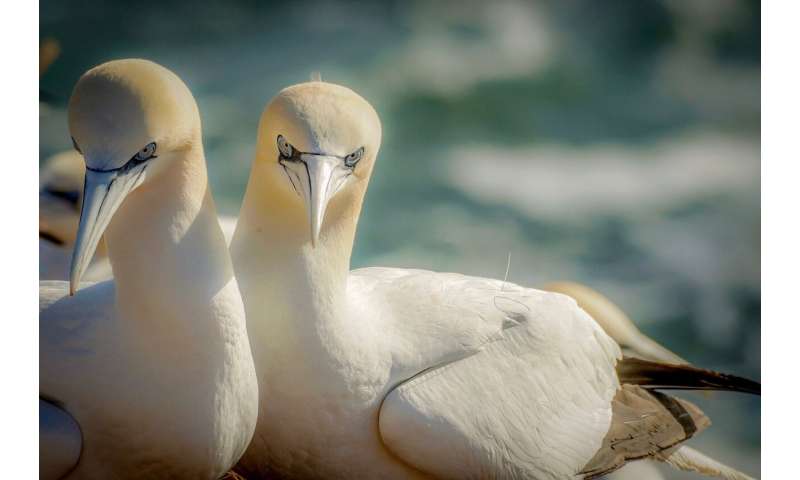
Gannets, the largest seabirds in the North Atlantic, can travel hundreds of miles from their homes just to catch food for their chicks. However, with around a million square miles of ocean to choose from, it has always been a mystery how they decide where is best to search for fish.

Now, new research led by the University of Glasgow and published today in the Journal of Avian Biology, offers new insights into why these iconic shaped seabirds choose to hunt the way they do.

Scientists recorded thousands of gannets commuting to and from the Bass Rock, in the outer part of the Firth of Forth in Eastern Scotland. The Bass Rock houses the world's largest northern gannet colony, with an estimated 75,300 breeding pairs calling it home.

They found that traveling as part of a flock appeared to be about more than just gaining aerodynamic benefits. The researchers were able to show that the more experienced adult birds were often found at the front of commuting flocks, with younger birds following behind. The results add weight to the theory that gannets learn to hunt by following their elders.

Dr. Ewan Wakefield from the University of Glasgow's Institute of Biodiversity, Animal Health and Comparative Medicine, said: "Our research offers a more detailed insight into how and why gannets search for food in the way they do. With such a large expanse of ocean to choose from it has always been a mystery as to how they know where fish are most likely to be found.

Wednesday, 2 October 2019

Diving birds follow each other when fishing


Date:  September 23, 2019
Source:  University of Exeter
Diving seabirds watch each other to work out when to dive, new research shows.
Scientists studied European shags and found they were twice as likely to dive after seeing a fellow bird go underwater.
The study is the first to investigate why large groups (known as "rafts") of shags dive together at sea.
University of Exeter scientists filmed the birds off the Isles of Scilly to examine their behaviour.
"Our results suggest these birds aren't just reacting to underwater cues when deciding where and when to dive," said Dr Julian Evans, who led the study as part of his PhD at the University of Exeter.
"They respond to social cues by watching their fellow birds and copying their behaviour.
"They're essentially using other flock members as sources of information, helping them choose the best place to find fish."

Thursday, 26 September 2019

Chile announces vital new regulations to protect seabirds


25 Sep 2019

At the end of last month, the Chilean Government took a vital and welcome step towards saving thousands of seabirds from being needlessly killed in their trawl fisheries by introducing new regulations making the use of mitigation measures mandatory.
New regulations introduced by the Chilean Government at the end of August will require a number of important trawl fleets to implement measures that reduce the bycatch of seabirds. This includes not only the use bird-scaring lines, which keep birds away from the trawl cables that can break their wings and kill them, but also other measures, including ‘snatch blocks’ to reduce the risk of albatrosses colliding with the net monitoring cable, and limits to the discarding of offal, which attracts birds to fishing vessels in the first place.
These regulations are the culmination of over a decade of work from our Albatross Task Force (ATF) team in Chile, who have worked alongside fishers, researchers and the national observer programmes of the Chilean Fisheries Development Institute (IFOP) and the Undersecretariat of Fisheries (SUBPESCA) to draw attention to the issue of seabird bycatch by testing and demonstrating the simple ways that these unnecessary deaths can be avoided.
“The announcement of these new regulations is wonderful news for the many albatrosses and petrels that use the seas around Chile to find food for themselves and their chicks,” Cristián Suazo, leader of ATF-Chile says. “This includes birds that breed both in our remote southern colonies and on the other side of the Pacific in New Zealand.”

Wednesday, 17 July 2019

Wind can prevent seabirds accessing their most important habitat


Date:  June 19, 2019
Source:  Swansea University

We marvel at flying animals because it seems like they can access anywhere, but a first study of its kind has revealed that wind can prevent seabirds from accessing the most important of habitats: their nests.

If human pilots or animals are to land safely, they must monitor and respond to the wind. These ideas are well established in aeronautical engineering, but how the win affects the ability of birds to land has never been considered before.

In a paper published by eLife, biologists including Dr Emily Shepard at Swansea University observed common guillemots and razorbills attempting to land on their breeding cliffs on Skomer Island, Wales. They then teamed up with Dr Andrew Ross, a meteorologist at Leeds University, to assess how the number of successful and aborted landings varied with the wind and turbulence around Skomer.

Seabirds live in windy, often remote places. Many species choose to breed on steep cliffs, where nests cannot be reached by land-based predators. Here, adults must land on small ledges, and they must do this with sufficient control that they do not dislodge their egg or chick.


Thursday, 4 July 2019

More than a dozen seabird species in decline off south-east Australia, study finds


The findings are ‘worrying’, researchers say, and are likely to be partly because of warming ocean temperatures
Australian Associated Press
Mon 1 Jul 2019 07.40 BSTLast modified on Mon 1 Jul 2019 11.54 BST
More than a dozen species of seabirds are in decline off Australia’s south-east coast – likely because of warming ocean temperatures, new research has found.
The study revealed sightings of almost half of the 30 most abundant seabirds – including the wandering albatross and flesh-footed shearwater – had fallen in the region between 2000 and 2016.

Sunday, 9 June 2019

Study shows penguins attract seabirds when they corral fish


by Bob Yirka , Phys.org
A pair of researchers with Mandela University has found that when African penguins work together to corral fish, they attract seabirds intent on taking advantage of the suddenly available prey. In their paper published in the journal Royal Society Open Science, Alistair McInnes and Pierre Pistorius describe their multi-year study of African penguins and what they learned about them.
African penguins are the only penguins that live off the shores of Africa, and they are endangered—population levels are 70 percent lower than they were just 15 years ago. Prior studies have shown that the primary reason for their decline is a decrease in their food supply—sardines and anchovies and other small fish. Humans use nets to catch the same fish, leaving little for the penguins to eat. In this new effort, the researchers sought to learn more about the eating habits of the penguins in hopes of finding a way to save them from extinction.


Friday, 7 June 2019

Lundy Island's seabirds triple after rat removal


28 May 2019
The number of seabirds on an island in the Bristol Channel has soared following the eradication of rats, conservationists have revealed.
There has been a boost in the numbers of Manx shearwater, puffins and guillemots on Lundy Island 15 years after a project to remove rats ended.
The RSPB said the number of seabirds on the island, off Devon, had tripled to 21,000.
The charity said the recovery had "far exceeded our expectations".
Helen Booker, senior conservation officer for RSPB, said: "This study clearly shows how quickly and positively seabirds respond to the removal of non-native predators.
"Of course, we had anticipated major population increases when the project was launched, but the scale of this recovery has far exceeded our expectations."
The project was launched in 2003 by Natural England, the Landmark Trust, the National Trust and RSPB, and aimed to eradicate the rats because they posed the biggest threat to the survival of the birds.


Friday, 22 March 2019

Balloons are the deadliest plastic to seabirds


15/03/2019
A new study has found that balloons are the highest-risk plastic debris item for seabirds, being 32 times more likely to kill them than ingesting hard plastics.
Researchers from the Institute for Marine and Antarctic Studies (IMAS), Commonwealth Scientific and Industrial Research Organisation (CSIRO) and Antarctic Climate & Ecosystems Cooperative Research Centre (ACE CRC) looked at the cause of death of 1,733 seabirds from 51 species and found that one in three of the birds had ingested marine debris. The data showed that a seabird ingesting a single piece of plastic had a 20 per cent chance of mortality, rising to 50 per cent for nine items and 100 per cent for 93 items.
Led by former IMAS-CSIRO PhD student Dr Lauren Roman and published in the journal Scientific Reports, the study found that although hard plastic accounts for the vast majority of debris ingested, it is far less likely to kill than soft plastics such as balloons.
Dr Roman commented: "Marine debris ingestion is now a globally recognised threat. However, the relationship between the amount or type of debris that a seabird ingests and mortality remains poorly understood. Among the birds we studied the leading cause of death was blockage of the gastrointestinal tract, followed by infections or other complications caused by gastrointestinal obstructions.
"Although soft plastics accounted for just 5 per cent of the items ingested, they were responsible for more than 40 per cent of the mortalities. Balloons or balloon fragments were the marine debris most likely to cause mortality, and they killed almost one in five of the seabirds that ingested them.
"As similar research into plastic ingestion by sea turtles has found, it appears that while hard plastic fragments may pass quickly through the gut, soft plastics are more likely to become compacted and cause fatal obstructions."

Friday, 7 December 2018

Industrial fisheries are starving seabirds all around the world


December 6, 2018, University of British Columbia

Industrial fisheries are starving seabirds like penguins and terns by competing for the same prey sources, new research from the French National Center for Scientific Research in Montpellier and the Sea Around Usinitiative at the University of British Columbia has found.

In a study published today in Current Biology, researchers found that annual seabird food consumption decreased from 70 to 57 million tonnes between 1970 and 2010. Meanwhile, fisheries increased their catches of potential seabird prey from an average of 59 million tonnes in the 1970s and 80s to 65 million tonnes per year in recent years.

"Fisheries persist in starving a vanishing seabird community, like a boa tightening its grip on prey," said David Grémillet, lead author of the study and a researcher at the French National Center for Scientific Research. "Despite the fact that the world's seabird community is shrinking, the level of competition between seabirds and fisheries remained the same between the 1970-1980s and 1990-2000s."

This diminished food supply is putting seabirds at risk—making them the most threatened bird group—with a 70 per cent community-level population decline in the past seven decades.


Thursday, 6 December 2018

What seabirds can tell us about the tide


Date: November 29, 2018
Source: European Geosciences Union

When the UK's Royal Society for the Protection of Birds (RSPB) set out to tag razorbills, their aim was to track their behaviour and movements along the coast of North Wales. The tag data revealed that, at night, these seabirds spent a lot of their time idle on the sea surface. "We saw this as an opportunity to re-use the data and test if the birds might be drifting with the tidal current," says Matt Cooper, a Master of Oceanography graduate from Bangor University in Wales. It turns out they were, according to a new study led by Cooper that shows the potential of using seabirds to measure ocean currents. The results are published today in the European Geosciences Union journal Ocean Science.

Using seabirds to tell us about the tide could be especially useful for the marine renewable energy industry. Generating tidal energy requires detailed knowledge of current speeds. Scientists and engineers traditionally measure tides by using radar or deploying anchors and buoys with scientific instruments. However, these scouting methods are challenging and expensive. If tagged seabirds could provide tidal data over a large area, they could help identify sites that would be good sources of tidal energy.

Sunday, 2 December 2018

Curious Coast: Birds vanish from Port Orange’s “Bird Island”


By Dinah Voyles Pulver 

Posted Nov 25, 2018 at 12:01 AM Updated Nov 27, 2018 at 6:01 PM
In a mystery that has residents and scientists stumped, the birds that give Seabird Island in Port Orange its name have left their island home.
Local residents say huge flocks of brown pelicans, herons and egrets that normally cluster on an island known as “Bird Island” just south of the Dunlawton Avenue Bridge over the Halifax River suddenly stopped doing so in October.
Bill and Irene Beck noticed the birds were no longer on the island more than a month ago, said Irene Beck. “My husband basically grew up here and in his lifetime there have been three bridges built and that never seemed to scare the birds away,” she said.
But while boating past the island at least four times in recent weeks, they were shocked to find no birds. So, she reached out to Curious Coast, The News-Journal’s ongoing series where readers reach out with their questions about the community.
“Is it global warming? Is it construction? Who knows?” Beck said. “It’s a mystery to us, and to those who have been here for a while. What happened to our birds?

Wednesday, 17 October 2018

Seabirds found with more than 250 pieces of plastic lodged in their stomachs

24 SEPTEMBER 2018 • 12:01AM
Scientists examining the devastating impact plastics are having on the world's oceans have identified seabirds with more than 250 man made objects lodged in their stomachs.
From bottle tops to pen lids, the flesh footed shearwaters are thought to consume more plastic than any other marine animal.
Often mistaking plastic objects floating in the sea for food, the adult birds pick them up and then feed them to their young, with disastrous consequences.
Researchers working on Lord Howe island, off the coast of Australia, where the flesh footed shearwaters nest, claim that on average every chick has between 30 and 40 pieces of jagged plastic in their stomachs before they are fully fledged.

Continued  

Monday, 13 August 2018

Seabird die-off has scientists on high-alert

Tuesday, August 7th 2018, 11:15 am AKDT
Updated: 
Tuesday, August 7th 2018, 4:46 pm AKDT
By Makayla Clark


The cause behind unusual bird behavior on Alaska's coastline has scientists on high alert.

Beginning in May, wildlife officials began receiving reports of dead and dying seabirds from the northern Bering and southern Chukchi seas, including in the vicinity of the Western Arctic National Parklands. 

National Park Service investigators found 100 carcasses in a 4-kilometer stretch of beach in late June, most of which were murres along the coast of the Bering Land Bridge National Preserve. Although, investigators say other species were found there and in Cape Krusenstern National Monument. 

Scientists say the culprit is starvation-- but they don't know why. There has been no evidence of disease, and tests are pending to determine if birds were exposed to harmful algal toxins. 

A Facebook post from Alaska National Parks outlines the birds in question.

Monday, 9 July 2018

A new study to improve seabird conservation in Patagonian ecosystems


July 4, 2018, University of Barcelona

Preserving a 300,000 square km area in Patagonian waters could improve the conservation of 20 percent of the population of sea birds in their natural habitat, according to a study published in the journal Conservation Biology and led by Francisco Ramírez, researcher from the Faculty of Biology and the Biodiversity Research Institute of the University of Barcelona (IRBio).

The new study, which shows a multidisciplinary approach to define marine areas of interest in conservation, is also signed by Isabel Afán, Joan Giménez and Manuela G. Forero, from the Doñana Biological Station (EBD-CSIC).

One of the marine ecosystems with more biodiversity worldwide

Only 3 percent of the ocean surface is protected, which is a lower level to the one in terrestrial ecosystems. Marine ecosystems in the Argentinian Patagonia are among the areas with higher biodiversity and the highest biological production worldwide. Despite their ecological value, they are now among the most threatened marine areas by the impact of intense fishing activity and changes related to global warming.