As regular CFZ-watchers will know, for some time Corinna has been doing a column for Animals & Men and a regular segment on On The Track... particularly about out-of-place birds and rare vagrants. There seem to be more and more bird stories from all over the world hitting the news these days so, to make room for them all - and to give them all equal and worthy coverage - she has set up this new blog to cover all things feathery and Fortean.
Showing posts with label Bermuda. Show all posts

Thursday, 14 June 2018

Rare visitor from Antarctica spotted


Sarah Lagan
Published May 29, 2018 at 8:00 am (Updated May 29, 2018 at 7:30 am)

A photographer has captured a photo of a rare visitor to the island — a bird that flew more than 6,500 miles from the Antarctic.

Fisherman Kevin Winter photographed the south polar skua which he said was “feeding aggressively around the boat without fear”.

Skuas are the size of large gulls and feed by chasing migrating shearwaters and other birds and forcing them to regurgitate their food.

Mr Winter suggested that as there were no shearwaters around, the skua, from the South Shetland Islands off Antarctica, was hungry.

South polar skuas are rarely spotted in Bermuda and the sighting was particularly unusual as the bird was tagged on its leg. Mr Winter posted his find on eBird, a database for bird sightings. Andrew Dobson, president of the Bermuda Audubon Society, saw the photos and contacted seabird researchers in a bid to find out who tagged the bird.

Ben Raymond of the Australian Antarctic Division forwarded the enquiry to French researcher Yan Ropert-Coudert who passed the query on to colleagues in Europe.

Dr Hans-Ulrich Peter, head of the Polar and Bird Ecology Group at Friedrich Schiller University in Germany, replied the bird had been tagged by his researchers.

Read on 

Friday, 15 December 2017

Rare bird sighted for second time


Jonathan Bell
Published Dec 1, 2017 at 8:00 am (Updated Dec 1, 2017 at 7:36 am)

An unusual feathered visitor has been spotted for only the second time in Bermuda.

Birdwatcher Ian Fisher snapped a picture of a western tanager, first sighted in 2006 by David Wingate, in Ferry Point Park, the same location as the American songbird was spotted 11 years ago.

The birds range through the west coast of North America and spend their winters in Central America.

Andrew Dobson, president of the Bermuda Audubon Society, said: “It should have been heading south, but some birds obviously get disorientated. “This one kept going and luckily found Bermuda.”

The sighting by Mr Fisher, with bird watcher Paul Watson, was reported in late October.


Sunday, 4 December 2016

Grey-headed swamphen spotted in Bermuda

A grey-headed swamphen has been recorded in Bermuda for the first time, according to the Audubon Society.

The bird was spotted at Somerset Long Bay last week by Audubon member Tim White and several local residents.

“The bird has been confirmed as the first grey-headed swamphen to be recorded in Bermuda,” Audubon president Andrew Dobson said.

“This purple coloured chicken-sized bird has huge red feet to enable it to negotiate reed beds.

“It is highly likely that this bird has come from the population of grey-headed swamphens in Florida which became established there in the late 1990s.

“It may well have arrived as a result of Hurricane Matthew. The bird appears perfectly healthy and feeding well, oblivious to kite surfers, dog walkers and the local paparazzi.”

The species is native to the Middle East and the Indian subcontinent to southern China and northern Thailand.

Its sighting in Bermuda comes seven years after an African swamphen was seen in Bermuda to the astonishment of the ornithological world.

The bird — the first of its kind to be recorded on this side of the Atlantic — remained in the Pembroke Marsh area for two weeks.


Source

Tuesday, 24 November 2015

Trindade Petrel Bird Makes First Visit To Bermuda

November 17, 2015 | 2 Comments

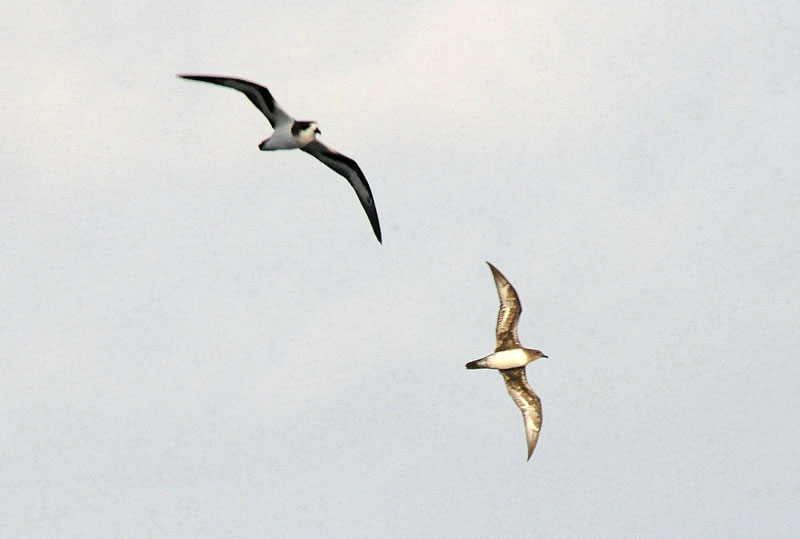
A visiting group of seabird enthusiasts photographed a Trindade Petrel — the first time the species has been recorded in Bermuda – and in an interesting coincidence, one of the group happened to be wearing a t-shirt depicting a Trindade Petrel bird.

The Cahow flying with the Trindade Petrel 
The Bermuda Audubon Society has been running Cahow fieldtrips this month and has assisted with the groups that seabird expert Bob Flood has been bringing to Bermuda for several years.

Last week while off the South Shore looking for Cahows [Bermuda Petrels], they also saw a Trindade Petrel.

Andrew Dobson, president of the Bermuda Audubon Society said, “It was a dream for them to see this bird.

“One of the group, Kate Sutherland was even wearing a t-shirt depicting a Trinidade Petrel – somewhat prophetic!

“It is a rare gadfly petrel like our Cahow with a world population estimated to be anywhere between 1,100 to 15,000 birds. It breeds in the Trindade and Martin Vaz Islands off the coast of Brazil.

Thursday, 12 June 2014

Black-Bellied Whistling-Ducks Set Record

June 11, 2014 | 0 Comments

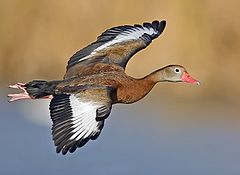
Whistling duck flight02 - natures pics-edit1.jpgBreaking the previous record of one of the birds seen in 2008, no less than 13 Black-bellied Whistling-Ducks paid a visit to Bermuda on June 7, according to the Bermuda Audubon Society.
A post on social media from the Society said, “Extraordinary record of 13 Black-bellied Whistling-Ducks today on Port Royal GC, Bermuda. There is one previous record of a single bird in 2008.”

Saturday, 31 May 2014

Audubon donates 50 homes for cahows

Press release

Thursday, May 29, 2014 7:00 AM

Fifty new homes are ready and waiting for our endangered national bird, the cahow. The artificial nest boxes were donated to the cahow recovery programme by the Bermuda Audubon Society. 

The nest boxes were designed by former conservation officer Dr. David Wingate, who worked with cahows for 50 years. “Cahows are soil-burrowing birds and in pre-colonial times they would have dug their own burrows, but for hundreds of years they had to survive on rocky little islands where that was impossible,” he explained. “As the numbers increased under the restoration programme, we started building artificial burrows out of cement, which was labourious, back-breaking work. I saw the need for a mass-produceable surrogate which was durable, light and compact enough to transport to remote locations.” Conservation Officer Jeremy Madeiros tried some artificial burrows from Australia, but they were designed for a smaller petrel and were not ideal for the cahow, so Dr. Wingate decided to design his own. “These meet all the requirements of our picky national bird – a long, curved tunnel and a nest chamber that is in total darkness.”


Friday, 14 February 2014

Bluebirds struggle to find happiness on island paradise

Date:
January 27, 2014

Source:
University of Chicago Press Journals

Summary:
A recent study shows that Eastern bluebirds in Ohio differ in a variety of ways from their relatives in Bermuda.