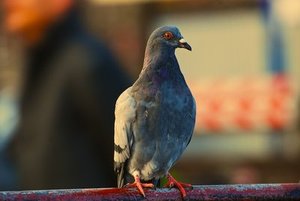
As regular CFZ-watchers will know, for some time Corinna has been doing a column for Animals & Men and a regular segment on On The Track... particularly about out-of-place birds and rare vagrants. There seem to be more and more bird stories from all over the world hitting the news these days so, to make room for them all - and to give them all equal and worthy coverage - she has set up this new blog to cover all things feathery and Fortean.
Showing posts with label pests. Show all posts

Thursday, 14 June 2018

Can New Zealand really kill every rat, possum and stoat?


2 Jun, 2018 2:00pm

The ambitious new plan to make Taranaki, and the rest of New Zealand, predator free. / Alan Gibson

Science Reporter, NZ Herald

It's been nearly two years since New Zealand announced to the world we'd be free of pest predators by 2050. Are we any closer to winning the war? Jamie Morton reports.

It had been raining for weeks in Taranaki.

When the clouds finally cleared this week, the mountain's new cloak of white snow shone resplendent against a brilliant blue sky.

It was a good day for pictures.

It was a bad one for pests.

At the foot of the Pouakai Range, in the rainforest garden Pukeiti, the region's leaders came together to declare war on every rat, stoat and possum in more than 4500ha of farmland surrounding the national park.

A $47 million, five-year battle would clear one wedge of countryside after another.

Cleaned-out areas, the gathering was told, would be bolstered against reinfestation by a network of natural barriers, traps and remote sensors clever enough to alert smartphones every time a vermin was killed.

Here was the largest-yet project of its kind: a beachhead from which New Zealand could reclaim its wilderness from the scourge of predators.

It seemed fitting that Taranaki should be where the fight starts - its lofty peak symbolic of the hike ahead.

Continued  

Friday, 11 December 2015

Pests push native birds to brink

5:00 AM Monday Nov 23, 2015


The loss of our native birds from the wild has been revealed in its full extent for the first time, with a bleak and sweeping stock-take showing major hits for most endemic species.

But keeping our birds in large numbers can be achieved for a realistic price, says the Landcare Research scientist who has presented the startling figures to top ecologists.

A comparison of monitoring data, collected over periods in the 1970s and early 2000s, showed significant falls in well-known species such as brown kiwi, kokako, kaka, rifleman, tomtit and blue duck, or whio.

"The species that have been hit the hardest are the ones found nowhere else in the world - so there's a strong relationship between loss and endemism," Dr Susan Walker told the Herald. "That seems to be because they have these traits which make them very vulnerable to predators - their breeding simply can't keep up with the rate of predation."

Saturday, 20 September 2014

Pests wiping out unique ‘land of birds’

OPINION: Maryann Ewers and Bill Rooke spell out the importance of using 1080.

Nicky Hager
tomtit
The debate regarding 1080 use is again hot news and opponents are making headway via the media and some political parties. The general public are being led to believe that this issue is far more divisive than it actually is.

The greater proportion of those against its use comes from a hunting ethos that's embedded in New Zealand's culture. No amount of peer-reviewed scientific evidence or two in-depth reports have changed their opinions.

Quite simply, to these people, the protection of introduced game animals, to later kill at will, is more important than halting the extinction of species that evolved here millions of years ago.

Do human recreational values take precedence over the survival of these species? This is the question the public is being asked to make a judgment on.

We and many people like us, who have spent years trapping pests, not as a recreational pursuit but out of a deep felt obligation to try and save our precious native biota, have no hidden agenda.

Deer, pigs, thar, chamois, goats and wallabies are found in accessible places all over New Zealand and on DOC estate, yet an increase to 7 per cent of 1080 use on DOC land has spawned the emergence of a Ban 1080 political party and constant ridicule of our Department of Conservation (DOC), Forest and Bird and other conservation groups.

Tuesday, 16 September 2014

Red Kites are becoming a pest - don't feed them, say conservation groups

First published Wednesday 3 September 2014 in News
Last updated 18:25 Wednesday 3 September 2014
by Pete Hughes, Reporter covering Abingdon and Wantage, South Oxford and Kennington. 

BIRD watchers have been asked to stop feeding Red Kites because the creatures have become too successful in Oxfordshire.

Snatching fledglings out of nests, chasing smaller birds for food and hovering in an “intimidating” way over homes and gardens, conservation groups have said the once-rare species may have become reliant on food left out by its admirers.

Hunted almost to extinction by farmers and poisoned by pesticides, the Red Kite was brought back from the brink of extinction when 93 were introduced into the Chilterns in 1989.
The Chilterns Conservation Board now estimates there are 1,000 breeding pairs in the Area of Outstanding Natural Beauty.

But the board and the Royal Society for the Protection of Birds (RSPB) say they are receiving a growing number of calls from worried residents about the large raptors swooping down on garden bird tables and school playgrounds.

Tuesday, 3 December 2013

Woodside Officials Try Hawk "Squawk Boxes" to Keep Pigeons At Bay

By Lyndsay McCabe Published: November 29 2013 

To counter the growing pigeon problem at the 51st Street Station in Woodside, boomboxes playing recordings of predatory bird calls have been set up in ...

In a new move to get rid of pesky pigeons, the 51st Street Station in Woodside is now echoing with the calls of predatory birds.

Hawks and falcons have not been introduced to the area, but their calls were brought to the city in the form of “squawk boxes” – electronic boxes that play recordings of the predators’ screeches so as to scare away the pigeons that have been settling in Woodside in large numbers.

Saturday, 25 May 2013

Bird pest 'disaster' warning

AN incursion of Indian myna birds into Tasmania would be an "environmental disaster", says BirdLife Tasmania. 

Sightings of the bird – a serious pest on mainland Australia – have been reported in Devonport and Hobart near the Domain and slipyards. 

"The introduction and establishment of the myna is an ecological disaster," Birdlife Tasmania convenor Eric Woehler said. 

"This is a high priority, red-alert species and alarm bells would be ringing in State Government agencies. 

"They're an aggressive bird. They literally displace native birds. They gather in big flocks, they're very noisy and aggressive. 

"Where you have Indian mynas you don't have native birds. 

"They will chase other birds out, kill the chicks of other birds and eat their eggs." 

Over the past decade sightings had been made in the north, especially Devonport and its port area, and in those cases government officers have killed the birds and destroyed eggs. 

Department of Primary Industries, Parks, Water and Environment Invasive Species Branch manager Craig Elliott said staff were continuing surveillance in the Hobart Regatta grounds area after a report last month of three birds. 

"The sighting has not been confirmed and the ISB is keen to hear from anyone who may have seen what they believe to be an Indian myna," Mr Elliott said.


Wednesday, 3 October 2012

Bird Jolt Flat Track™ Shocks Pigeons off of the Rockwall County Courthouse


Rockwall County Courthouse Uses Electric Track System to Keep Birds Away For Good
(PRWEB) September 30, 2012

Pigeons have long been making the Rockwall County Courthouse their roosting spot, until today. Bird Jolt Flat Track™, an electric track bird control system, was installed by A All Animal Control on the courthouse ledges and roof edges. The track system consists of a ¼’ high electric track that is attached to a charger, giving pest birds a small shock when they land on the surface of the track. The jolt does not harm the birds – it conditions them to leave the area for a more comfortable place to roost and nest.

The Rockwall County Court House building officially opened on November 11, 2011 and pigeons have claimed it as their home since then. As many as 500 pigeons have been seen at any given time roosting along the roof and ledges of the court house, leaving behind a mess of droppings and other debris. The county was getting numerous complaints from the public about having to walk through the droppings to get into the building. Pigeon droppings are very acidic and can quickly deteriorate building materials, which is a problem for the $37.2 million dollar building. Bird droppings can also carry any of 60 transmittable diseases, which pose a health risk for anyone who comes in contact with the feces.

The building was not yet a year old when the daily cleanup expense for the bird droppings became excessive. The county needed a bird control solution. A All Animal Control of Collin County came to the rescue. Michael Beran, a bird behavioral expert, Master Falconer and owner of A All Animal Control recommended that the county install Bird Jolt Flat Track from Bird-B-Gone, Inc. to get rid of the birds. The Flat Track won the bid for this job because of its low visibility, durability and ease of installation. “Within a day of installation of the electric track, the flock had dispersed and moved on to another roosting place”, said Beran. A All Animal Control prefers the Flat Track System because it is easy to install, is extremely effective and has the longest guarantee on the market.


Monday, 24 September 2012

Bird plague no myna matter

Photo:  Wikipedia
JULIA Gibson never gave Indian mynas much thought until about 2000, when they began a slow invasion of her Arthurs Creek property. ''I came to notice these jolly birds as such a nuisance, mainly pooing everywhere, eating the cat food, horribly noisy. There's a pole near my clothesline and they'd sit up there and poop on my washing,'' she says.

Later she heard how mynas dispossessed native species, taking over their nests in tree hollows and tossing out their eggs and chicks. She realised many of the small birds that had been on the property when she arrived in 1998 had disappeared.

In 2009, she began fighting back. Now mynas venturing on to her 40 hectares are lured into a purpose-built wire trap with bits of dry cat food, imprisoned and humanely and legally euthanased.

She has eradicated 570 of the birds, voted in the ABC Wildwatch Australia Survey in 2005 as the nation's most significant pest and the one most needing control. She has seen native birds, from fairy wrens to rosellas and king parrots, return. She has also inspired almost 300 other like-minded environmentalists.

Mynas were introduced to Melbourne in the 1860s to combat insects in market gardens. Now, it is estimated their numbers have swelled to the millions.

Read more: http://www.theage.com.au/victoria/bird-plague-no-myna-matter-20120922-26dvl.html#ixzz27IxSok4c


more information on the Indian myna (common myna) (Acridotheres tristis):
http://www.indianmyna.org/
http://en.wikipedia.org/wiki/Common_Myna

Real-Life 'Birds' Remake in Belgium

OSTEND, Belgium—This North Sea resort welcomes millions of visitors a year to its wide sandy beaches and seafood restaurants. But as peak season ends, mayors along the coast are planning crisis talks to tackle a scourge that nearly spoiled the summer of 2012: marauding seagulls.

In a real-life Hitchcock remake, the birds have been snatching food from tourists, attacking people, spreading garbage, and sowing conflict among business owners, scientists and local officials over who is responsible.

Some say European Union regulations need to change; others say property development along the coast is responsible for a problem that didn't explode until recently.

The lesser black-backed gull and the herring gull are protected species in the EU. There are 6,500 breeding pairs in the whole of Flanders, according to Eric Stienen, an expert in colony birds at the Flemish Institute for Nature and Forests. Around 6,000 breed and live on the harbor in Zeebrugge, a container port where they first settled in the 1980s and have remained relatively undisturbed by humans and predators. Most others are concentrated west of the port, in Ostend, he said.

Continued: http://online.wsj.com/article/SB10000872396390444914904577621410792445928.html?mod=googlenews_wsj