As regular CFZ-watchers will know, for some time Corinna has been doing a column for Animals & Men and a regular segment on On The Track... particularly about out-of-place birds and rare vagrants. There seem to be more and more bird stories from all over the world hitting the news these days so, to make room for them all - and to give them all equal and worthy coverage - she has set up this new blog to cover all things feathery and Fortean.
Showing posts with label starling. Show all posts

Wednesday, 31 July 2019

The decline of British starlings

26/07/19

It's winter and the sun is setting over the waving reeds in front you. A few small, black dots begin to fly in: Common Starlings. They're joined by more and more coming from left, right and centre, until thousands of starlings come together as one, and suddenly you're watching a breathtaking murmuration. With so many thousands of birds dancing through the winter sky above you, it's easy to be fooled into thinking the species is doing rather well. Sadly, this couldn't be further from the truth.

The stark facts are that between 1995 and 2016, Britain's breeding population of Common Starling crashed by a staggering 51 per cent. Just let that sink in. It means that there are now only half as many starlings in Britain than when I started watching birds with my dad during the mid-1990s. The situation in England is even worse: we saw an 87 per cent decline between 1967 and 2015. Starlings no longer nest in large parts of Wales and southern England.

Back to that murmuration – many of the starlings you're watching above your head will have travelled here to escape the winter freeze in countries to the north and east. In those places too, numbers are falling, and we're seeing fewer of these birds arriving each year. It means that the large winter gatherings we're used to seeing are becoming smaller. Are the days of starling murmurations numbered?

Thursday, 11 October 2018

Playful starling poses for selfies in Devon


26 September 2018

An "unusually tame" starling has been on a city pub crawl in Devon.

The bird, which behaves as if it is hand reared, first turned up at the Passage House Inn, Topsham, on Monday.

Its behaviour - flying into people's hands and hopping onto their arms for selfies - is the exact opposite of what is normal for its species.

The RSPB said that the bird had "lost its natural fear of humans" as it appears to have been regularly fed.

The bird visited two other pubs within the Topsham area where it posed for selfies on people's heads.

Pub customer and wildlife specialist Jayne Farleigh, from Kingsteignton, took the bird home after fearing it may fall victim to a cat or other predator.

She has now posted on Facebook to find the owner of the starling, which she believes is a pet.
She said: "I was quite concerned about him.

"I'm thinking he must belong to somebody, somebody has hand reared him and I'm not sure if they've tried to release him with the intentions of him going back into the wild or whether they've lost him.


Wednesday, 4 June 2014

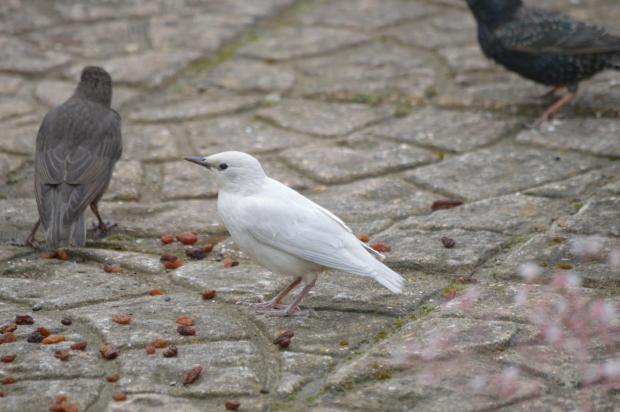
Snowy the starling is rare sight for York couple

8:01am Monday 2nd June 2014 in News

You could have knocked Derek and Sandra Shewan down with a feather when a rare white bird swooped onto their patio.

At first they though the starling they christened Snowy was an albino but they then spotted it did not have pink eyes.

The couple, from Hemlock Avenue, Huntington, discovered the bird was a Leucistic starling, sightings of which are occasionally reported in national wildlife magazines.

Experts say Leucism is a very unusual condition whereby the pigmentation cells in an animal or bird fail to develop properly.


This can result in unusual white patches appearing on the animal, or, more rarely, completely white creatures.

Retired Royal Mail sorting office worker Derek, 66, said: “From what I have read it is more rare than an albino.

Saturday, 1 March 2014

What a stink! Street drenched in bird poo after invasion by 20,000 starlings

A suburban street is being drenched in bird droppings after being invaded by a flock of 20,000 starlings

The huge swarm - called a murmuration - turns the sky black at dawn and dusk as they prepare to feed or roost for the night.

But they also shower the street in droppings.

Residents cower under umbrellas when they venture outdoors and clean their cars and windows on a daily basis.

The birds arrived in the street at the start of the year as they flew south to escape the bitterly cold winter in their native Scandinavia.

They perform spectacular acrobatic displays before returning to a Leylandii hedge at the back of the houses in Hereford to roost.