As regular CFZ-watchers will know, for some time Corinna has been doing a column for Animals & Men and a regular segment on On The Track... particularly about out-of-place birds and rare vagrants. There seem to be more and more bird stories from all over the world hitting the news these days so, to make room for them all - and to give them all equal and worthy coverage - she has set up this new blog to cover all things feathery and Fortean.
Showing posts with label loss of habitat. Show all posts

Monday, 5 February 2018

Ireland's dead forests: graveyards of the Hen Harrier


Irish Government’s forestry strategy threatens to wipe out the Hen Harrier

Ireland is the most westerly outpost of the Hen Harrier’s global range. The species is in big trouble here and has been falling towards extinction as its habitat is being lost majorly by conversion to industrial forestry. If the Hen Harrier is lost from this frontier due to habitat loss, it will not return nor cannot it be re-introduced for that very reason – there will be no habitat.

There are already approximately 220 million non-native trees, covering more than half of the land within Special Protection Areas that are supposed to be the last bastion of Hen Harrier conservation in Ireland. These areas are designated in line with the EU birds directive and national law and within these areas, member states are supposed to “avoid pollution or deterioration of habitats…”.

Not many Rare Bird Alert readers will need this, but a quick science lesson: Hen Harriers, as with other harrier species, evolved in virtually treeless landscapes. Harriers are birds of open country – steppe, prairie, mountain, swamp, moorland. This is why they nest on the ground. The exception to this rule for Hen Harriers as it happens came in Ireland, where for a number of years Don Scott observed harriers nesting on the tops of stunted trees. This soon came to an end however, ultimately proving to be maladaptive, as when the young harriers fell from the trees and were hidden beneath the canopy, they could not be fed or rescued by their parents. Suffice it to say that Hen Harriers and industrial plantation forestry dominated by non-native sitka spruce do not mix well. Some private foresters with financial interests in planting more land will tell you otherwise, in the same way as chemical companies told us DDT was not reducing raptor populations for decades. However, as with DDT, there are volumes of scientific studies and evidence from the field as to who the silent killer is. Truth always wins out.


Sunday, 8 October 2017

More than a 38 percent of the Neotropical parrot population in the American continent is threatened by human activity


September 27, 2017

More than 38 percent of the neotropical parrot population of the American continent is endangered due the impact of human activity, according to a scientific study published in the journal Biological Conservation.

Hunting for local and international trade and the loss of natural habitat are the main threats for these tropical birds, according to the article led by the experts Igor Berkunsky (National University of Central Buenos Aires) and Juan Masello (Justus Liebig University, Germany). The study involved the collaboration of 101 experts from 76 institutions and non-governmental organizations to determine the main threats affecting 192 populations of 96 neotropical parrots in 21 countries.

From hunting pets to extinction
Capture for the pet trade is one of the main threats to the preservation of wild parrots. From 1980 to 1990, millions of individuals were captured in the neotropic and taken to the United States and Asia. This huge removal of parrots could be the cause of the decline and local extinction of many species, such as the Spix's macaw. In the African continent, the trade of the grey parrot played a main role in its removal in Ghana and other areas of Africa. Currently, some of the most threatened species in Brazil are the Spix's macaw (Cyanopsitta spixii) and the red-tailed amazon (Amazona brasiliensis). Species such as the sun parakeet (Aratinga solstitialis) and brown-backed parrotlet (Touit melanonotus) are quite vulnerable due the small size of their populations.

Wednesday, 16 December 2015

As Habitat Vanishes, Migratory Birds Are in Free Fall (Op-Ed)

Claire Runge, University of California, Santa Barbara; James Watson, WCS and the University of Queensland; Richard Fuller, University of Queensland | December 11, 2015 06:23pm ET

Claire Runge is a postdoctoral scholar at the National Centre forEcological Analysis & Synthesis (NCEAS) at the University of California, Santa Barbara, previously at the University of Queensland; James Watson is director of science and research with the Wildlife Conservation Society (WCS) and an associate professor at the University of Queensland; Richard Fuller is an associate professor at the University of Queensland. The authors contributed this article to Live Science's Expert Voices: Op-Ed & Insights.

In one of the most amazing wildlife spectacles on the planet, millions of birds migrate each year between their breeding and wintering grounds, undertaking journeys that are remarkable feats of navigation, yet incredibly dangerous. 

Migrations can span vast distances, such as the bar-tailed godwit's single flight of nearly 7,000 miles (11,000 kilometers), or the Arctic terns, which over the course of their lifetimes travel the same distance as going to the moon and back — three times. Some of them return year after year to the same location, navigating across a planet now vastly changed by humans.

Monday, 1 September 2014

Boris Island birds: how will they fare if airport goes ahead?

Wednesday, August 13, 2014 
11:35 AM

Report by British Trust for Ornithology highlights scale of the issue

The proposal to build an airport on the Isle of Grain would cause a significant loss of coastal wetland habitat, according to a report published by the British Trust of Ornithology (BTO).

This would largely be within the Thames Estuary and Marshes Special Protection Area (SPA), but would also affect the Medway Estuary and Marshes.

Because these areas support more than 140,000 waterbirds, they are protected under international law.

Development at these sites would have significant negative impactson the bird populations that live there.

This would occur due to habitat loss within the footprint of the airport and disturbance or habitat change affecting other areas near the airport.

Over 21,000 waterbirds currently use the area proposed for development, which represents around 25% of the current total bird population on the two affected SPAs, and 37% of the current bird population on the Thames Estuary and Marshes SPA.

Sunday, 31 August 2014

Warblers and turtle doves join RSPB list of birds at risk of dying out

Bad weather and loss of habitat blamed as more breeding native species are at risk of extinction

Jamie Doward and Atoosa Gitiforoz

The Observer, Saturday 30 August 2014 21.21 BST

Any true love who wants to give their significant other two turtle doves to celebrate the second day of the 12 Days of Christmas may soon be looking for an alternative gift.

In a move that will dismay ornithologists and poets alike, the bird, immortalised in verse by Shakespeare and Wordsworth, could shortly find itself on the near 100-strong list of the rarest birds in the UK as compiled by the RSPB's rare breeding birds panel – a sign that its numbers are plummeting by such a degree that there are fears it could become extinct in the UK within a decade.

The list compiled by the panel, now in its 40th year, is based on sightings by dedicated bird watchers who provide the society with a wealth of information that is used to track the fortunes of different species over time and is the envy of wildlife organisations around the world.

Tuesday, 26 August 2014

Last ditch plea to protect pine forest adopted by Carnaby's black cockatoos

The Australian government has been asked to intervene to save the habitat of about 4,000 black cockatoos near Perth


theguardian.com, Monday 25 August 2014 07.59 BST

Calyptorhynchus latirostris Carnaby gnangarra.jpgConservationists have made a last ditch plea to the federal government to intervene to help prevent a species of cockatoo from becoming extinct due to the felling of its habitat.

Research by BirdLife Australia found there are 3,922 Carnaby’s black cockatoos in the large Gnangara pine plantation, north of Perth. This equates to around 10% of the global population of this endangered cockatoo.

The Western Australian government has been clearing the 23,000 hectare (57,000 acre) plantation to protect Perth’s water catchment area due to the amount of water the trees require.

However, BirdLife Australia said the plantation isn’t being replaced with any native forest, meaning the “catastrophic” clearing will hasten the Carnaby’s black cockatoo’s extinction. The wildlife organisation said the cockatoo’s population is in collapse, declining by around 15% a year.

Unlike many other woodland creatures, the Carnaby’s black cockatoo has adapted somewhat to the widespread felling of native forest in favour of timber plantations.

Sunday, 3 August 2014

Loss of meadow habitat bad news for birds

The open spaces that humans think are wonderful places for wildlife are, more often than not, better suited to people.

The Connecticut Audubon Society, in its State of the Birds 2014 report, issued a scathing assessment of how open spaces are managed in Connecticut, noting that the population numbers of some bird species are in a tailspin because their traditional habitats have all but disappeared. The report also notes there's no accurate count as to how much bona fide open space really exists in the state.

The reasons for the loss of the meadow environment are many, but the fact that birds aren't allowed to vote is part of it, according to Stephen B. Oresman, chairman emeritus of the Connecticut Audubon Society. Oresman, who wrote the opening essay in the report, notes that support in the state Legislature is scant for preserving habitats that humans don't find attractive or valuable, such as scrubland and meadows.

Continued

Monday, 27 January 2014

Rare bird at risk as farms encroach

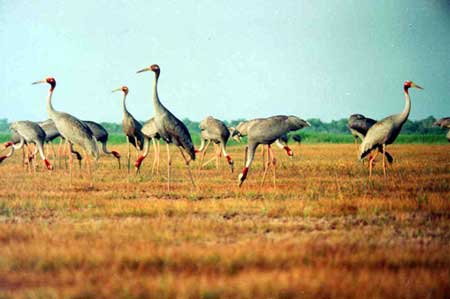
VietNamNet Bridge – The decline of the Sarus crane, the tallest flying bird in the world, is causing concern for conservationists.

Sarus cranes at Dong Thap Province's Tam Nong
Natural Conservation
 Centre. A decline in the bird's
 population has conservationists concerned about its survival.
Less than 2,000 members of the Indochinese subspecies are left in Cambodia, extreme southern Laos, Myanmar and southern Viet Nam.

Every November, the birds migrate to Tram Chim National Park in the Cuu Long (Mekong) Delta's Dong Thap Province. In 1998, about 1,100 Sarus cranes arrived in the national park.

But in recent years, that number has dwindled to approximately 200, said Nguyen Van Hung, director of the national park.

Wednesday, 28 November 2012

Critically Endangered Great Indian bustards spotted in India


Two Great Indian bustards seen in Karnataka

November 2012. There are thought to be just a few hundred Great Indian bustards left alive in India. They have suffered mostly from hunting and loss of their dry grassland habitat.

According to press reports in India, two Great Indian bustards were seen and photographed near a small village in Karnataka in an area where they haven't been recorded for 10 years.

Friday, 28 September 2012

Habitat management can work to conserve birds

EMC Lifestyle - From last week's note on the status of Canada's birds, the successful management of our wetlands and hunting demonstrate that habitat management can work to conserve birds. However, wetlands still face many threats. including draining for agriculture and development, pollution, invasive non-native species and increasing droughts due to climate change. Thus, conservation efforts must continue.

Another factor, a positive one, is our direct intervention to enable raptor populations to increase in numbers, which has allowed dramatic recoveries to take place. For example, the banning of DDT helped Peregrine Falcons and Eagle populations maintain their species numbers.

The biggest threats for many species during their long migrations are loss of habitat at stopover sites and on their wintering grounds. International co-operation is required to address these threats. There is much to be done, but solutions can, and must, be implemented at all levels of Canadian society, along with international organizations to achieve conservation success.

In our local world, in Mississippi Mills, Terry Kotjila had a female Evening Grosbeak and a Rose-breasted Grosbeak eating black cherries on her property. On Sept. 15 Cliff Bennett spotted a Northern Goshawk as it flew over the gas station at the corner of Highway 15/County Road 29 and Christian Street in Almonte. On the river in town, during clean up, Cliff and Bryn Mathews spotted several juvenile Belted Kingfishers chasing their parents for food. Two Great Blue Herons and one juvenile Green Heron were standing by themselves on the shoreline, down river from Metcalf Park.

Continued: http://www.emcalmontecarletonplace.ca/20120927/lifestyle/Habitat+management+can+work+to+conserve+birds