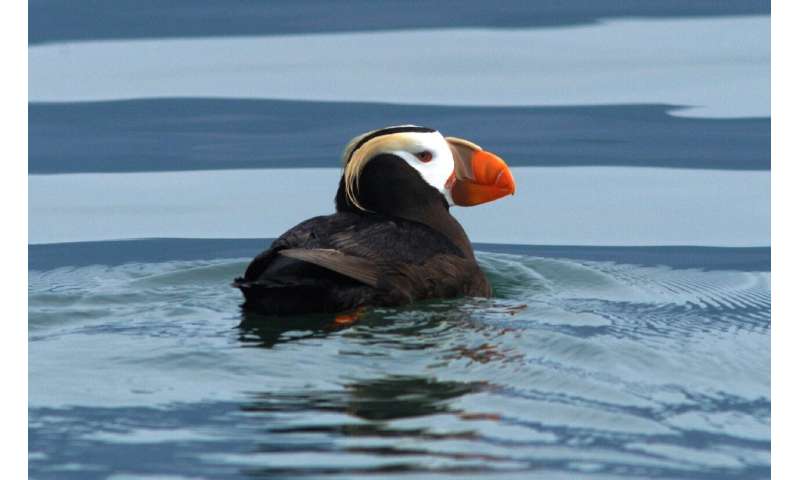
As regular CFZ-watchers will know, for some time Corinna has been doing a column for Animals & Men and a regular segment on On The Track... particularly about out-of-place birds and rare vagrants. There seem to be more and more bird stories from all over the world hitting the news these days so, to make room for them all - and to give them all equal and worthy coverage - she has set up this new blog to cover all things feathery and Fortean.
Showing posts with label tufted puffin. Show all posts

Sunday, 1 March 2020

Tufted Puffin in the Faroe Islands – a Western Palearctic fourth

31/01/2020

At around 2 pm on the afternoon of Friday 17 January 2020, Faroe Islands resident Helgi Fossdal was hunting for food off Slættanes in Vestmannasund, a strait separating the Faroese islands of Streymoy and Vágar.

Spotting what he assumed to be a Guillemot, and knowing that the date fell within the legal hunting season for auks in the Faroe Islands, Helgi shot the bird to take home for dinner. However, on retrieving the corpse, he quickly realised it wasn't that species and in fact something quite different. Helgi described the bird as having the all-dark body of a European Shag, yet evidently displaying the bill and head of a Puffin, and crucially took some photos of the mystery bird when he arrived back at home that evening.

It was only some days later on 26 January that the identification was realised, when the images were sent to Anthony Oates, who correctly diagnosed the bird and circulated the images online. The mystery auk was indeed a puffin, but in fact a Tufted Puffin – a species native to the North Pacific and seen only three times previously in the Western Palearctic. The skin was then donated to the Faroe Islands natural history museum.
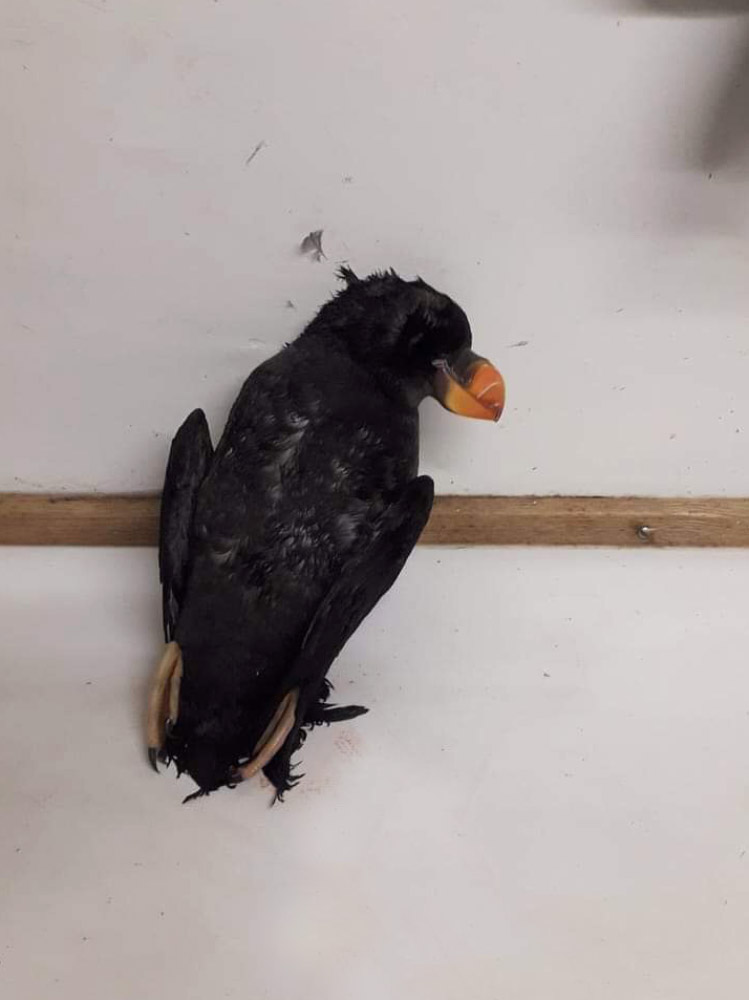

Tufted Puffin, Slættanes, Faroe Islands, 17 January 2020 (Helgi Fossdal).

The three previous accepted Western Palearctic records are as follows:
Adult at Laholmsbukten, Sweden, on 1 and 8 June 1994;
Adult at Oare Marshes, Kent, England, on 16 September 2009 (read more here);
Adult at Bear Island, Svalbard, on 14 July 2019.

There is a fourth previous record of a bird photographed at sea off Land's End, Cornwall, on 20 May 2016, although this bird was never submitted to the BBRC and therefore does not appear in any official listings. Read more about that bird here.


Acknowledgements

With thanks to Jens L Thomsen for his assistance and contribution to this summary.

Friday, 29 November 2019

Puffins stay cool thanks to their large beak

NOVEMBER 27, 2019

Credit: CC0 Public Domain

Tufted puffins regulate their body temperature thanks to their large bills, an evolutionary trait that might explain their capacity to fly for long periods in search for food.

In a new study published in the Journal of Experimental Biology, researchers from McGill University and the University of California, Davis, used thermal imaging cameras to measure heat dissipation off the bodies and beaks of wild tufted puffins in the minutes after flying.

Their data showed that within 30 minutes of landing, the temperature of the puffin beaks dropped by 5°C (25°C - 20°C), while the heat radiating from their backs hardly changed. The beak "accounted for 10-18% of total heat exchange despite making up only 6%" of the bird's total surface area.

Big bills help cool birds as they fly

But why would puffins have evolved such a large bill? Kyle Elliott, a professor in McGill's Department of Natural Resource Sciences, thinks it could have to do with the energy they use when they fly.

Energetically speaking, flying is very taxing to birds. During flight, the thick-billed murre—which is closely related to the puffin—has an energy expenditure 31 times greater than when resting, the largest ever measured in vertebrates. This produces significant amounts of heat, says Elliott, the study's senior author, suggesting that some birds evolved a large bill to help them cool down when they fly.

Friday, 20 June 2014

Tufted puffin seen on Atlantic coast for 1st time since 1830s

Mystery surrounds how a bird common on Pacific coast arrived on Machias Seal Island in Bay of Fundy

The first sighting of a tufted puffin on the east coast of North America in almost 200 years has people wondering how the common Pacific coast seabird made it to the Atlantic waters.
Ralph Eldridge, the lighthouse keeper on Machias Seal Island in the Bay of Fundy, spotted the bird and noted it was different from the thousands of Atlantic puffins found at the Canadian Wildlife Service sanctuary on the island.
Tufted Puffin Alaska (cropped).jpg"It stood out as different from our Atlantic puffins — larger, blacker but with a conspicuously orange beak and most notable, a very white face," said Eldridge in an email to CBC News.
Eldridge alerted Tony Diamond, a biology professor from the University of New Brunswick, who is on the island running the Atlantic Laboratory for Avian Research.
Diamond was able to view the bird in a large telescope and confirm the identification.
Tufted puffins are common on the Pacific coast from Alaska to northern California, breeding on offshore islands.