As regular CFZ-watchers will know, for some time Corinna has been doing a column for Animals & Men and a regular segment on On The Track... particularly about out-of-place birds and rare vagrants. There seem to be more and more bird stories from all over the world hitting the news these days so, to make room for them all - and to give them all equal and worthy coverage - she has set up this new blog to cover all things feathery and Fortean.
Showing posts with label Queensland. Show all posts

Wednesday, 5 June 2019

No-one knows true status of Adani finch


Researchers say there are gaping holes in what's known about a bird that has delayed Adani's contentious new coal mine in Queensland.
UPDATED 4 DAYS AGO
No one knows the true status of an endangered finch that's delayed the Adani coal mine, including the Queensland government, experts say.
Researchers have reviewed contemporary studies on the black-throated finch and say there are big knowledge gaps on how many are left, exactly where they are living, and how far they roam.
They warn that uncertainty about distribution means knowledge of the bird's optimal habitat is likely to be "biased or incomplete".
They also point to limited outcomes from a national recovery plan for the species.
The finch is known to inhabit Adani's controversial Carmichael mine site, in Queensland's Galilee Basin.
Earlier this month the state government rejected Adani's plan to protect the bird, saying it was deficient. The company was told to go back to the drawing board and come back with a better plan if it wants its mine to proceed.
But it's now apparent that Adani's plan is not the only deficiency hurting the bird's prospects of recovery.

Friday, 29 March 2019

Rare 'Ringo Starr' cockatoo faces extinction due to habitat loss in Far North Queensland


Updated 7 Mar 2019, 11:33pm
A rare and beautiful cockatoo, known as the "Ringo Starr" of the bird world, could be extinct in Australia within a decade unless urgent action is taken to protect its habitat in a remote part of Queensland.
Key points:
The Palm Cockatoo is extremely rare and is the only bird in the world that uses a tool musically.
Researchers are worried the bird will be extinct in a couple of decades due to habitat loss and low reproductive success.
The cockatoo is currently listed as vulnerable but researchers are building a case to reclassify it as endangered.
The Palm Cockatoo, which can make its own musical instrument, is only found on the top of Cape York in far north Queensland but its numbers are declining rapidly.
Researchers fear the distinctive black bird, which is Australia's largest cockatoo, could soon disappear because its habitat is being lost to mining and land clearing.
Professor Robert Heinsohn from the Australian National University has been studying the Palm Cockatoo since the 1990s and describes it as "one of the spectacles of the bird world".
"They are magnificent large parrots and very ancient ... right from the start of the family tree for parrots ... and they are just incredibly striking to look at," he said.
"They not only look good but are the rock stars of the bird world ... making drumsticks from branches and banging out tunes to attract the bird ladies."
Professor Heinsohn said the Palm Cockatoo is the only bird in the world that uses a tool musically.
"They break off a branch and peel back the bark, they whittle it down to about 30 centimetres and they hold it in their foot and tap on the edge of their nest hollow," he said.
"They have a very good sense of rhythm and different styles of drumming signatures.


Sunday, 10 February 2019

How to send a finch extinct


Date:  January 29, 2019
Source:  University of Queensland
An endangered Queensland bird is at risk of extinction because environmental legislation is failing to protect its habitat, according to a University of Queensland-led study.
Researchers reviewed Australian and Queensland laws that protect threatened and endangered species, in light of a more than 80 per cent reduction in the distribution of the southern black-throated finch's population.
They found that despite the protection laws, extensive finch habitat loss has continued to be approved - with more in the pipeline.
Dr April Reside, from UQ's Centre for Biodiversity and Conservation Science, said the best of the bird's remaining habitat was now under threat.
"Extensive clearing for agriculture and grazing has been allowed in the finch's open woodland habitat - from north of Townsville to New South Wales," Dr Reside said.
"Australia and Queensland have laws to protect threatened species, but they're failing to do just that.

Friday, 26 October 2018

Rare bird found in Toowoomba after 20 years

Black-breasted Button-quail male inskip.JPG
10th Oct 2018 1:30 PM
GATTON ornithologist Patrick Webster's work has put the spotlight on one of the region's rarest birds, the black-breasted button-quail.
Mr Webster has travelled throughout Queensland researching the endangered bird.
The black-breasted button-quail was recently spotted at Redwood Park, Toowoomba.
The bird is listed as a vulnerable species in Queensland and hadn't been seen in Toowoomba for 20 years prior to this year's spotting.
Mr Webster said habitat destruction was the leading cause that impacted on bird numbers.
"It is a extremely fussy bird when it comes to their habitat. They only live in dry rainforest or littoral scrub-land," Mr Webster said.
"The majority of the habitat has been destroyed for development or by introduced weeds such as cats claw creeper.
"Research found that 90 per cent of the birds' habitat was destroyed in the 90s.
"The best thing someone can do to help the species is to report any sightings so we know where the bird is," Mr Webster.
"The bird needs to be recognised. Very few people know of them and you can't protect what you don't know."

Sunday, 11 February 2018

Baby night parrot sighted in drought-ridden outback Queensland puzzles researchers

Posted about 11 hours ago

The sighting of a newly-hatched night parrot in drought-ridden western Queensland has surprised researchers, raising more questions than answers.

The bird, thought to be two to three months old in December, was photographed on Pullen Pullen reserve by PhD candidate Nicolas Leseberg, who has been studying the elusive species for the past two years.


"It's really interesting that even though it had been a really dry year that this desert bird was still willing to keep breeding," Mr Leseberg said.

"Based on its age we can tell that it was born around September and in the area there'd been no serious rain for seven, eight or even nine months."

Baby night parrots were last sighted in November 2016 after the area had received extensive winter rain.

"That was the first time a baby had ever been photographed and that was fascinating but that was sort of expected," Mr Leseberg said.
More questions than answers

The night parrot was considered extinct for more than 75 years but in 2013 it was rediscovered at Pullen Pullen nature reserve, a location that has been kept secret.

The 56,000-hectare property in western Queensland has been designated specifically for the purpose of protecting the parrot.

Wednesday, 31 May 2017

DNA research provides new hope for a bird on the brink

May 26, 2017 
 
In a fresh bid to save the southern black-throated finch from extinction, researchers are turning to a novel analysis of DNA to help plot a path to survival. Already extinct in NSW, this woodland species is endangered in Queensland, having lost 80 per cent of its range in the last 30 years. Under current development plans for its last stronghold, the Galilee basin, it's predicted to lose a further 57 per cent of its remaining habitat.

Under the cutting edge new plan, researchers will compare the DNA of living wild birds to the DNA of 100-year-old museum specimens that lived before the species' decline.

"Genomics is a powerful new tool in the conservationist's arsenal. Near extinction leaves its mark on a species' DNA, and by decoding this DNA signal, we can glean vital clues about the extent and nature of the black-throated finch's demise", explains scientist and team leader Dr Kerensa McElroy from the Australian National University.

"This will tell us whether the remaining birds have enough of this species' original genetic repertoire to survive and thrive if habitat is restored," says Dr McElroy.

"Changes in specific genes could also reveal previously unknown threats, such as pesticides. Our results will be crucial to the design of future captive breeding programs."

Dr McElroy's enterprising team is turning to crowdfunding to kick-start this high-tech research. With a target of $100,000, this is the largest Australian environmental crowdfunding campaign yet.


Read more at:

Wednesday, 2 November 2016

Night parrot population discovered in Queensland national park


Discovery of elusive bird, thought to be extinct for a century until 2013, leads scientists to believe the ‘dumpy budgerigar’ may be more common than thought

A large population of night parrots have been discovered in Queensland’s Diamantina 


Tuesday 25 October 2016 07.10 BST Last modified on Tuesday 25 October 2016 07.11 BST

The elusive night parrot has been recorded in Diamantina national park in central-west Queensland, expanding its known range and leading scientists to believe it may not be as rare as previously thought.

The bird, described by Bush Heritage Australia’s Jim Radford as a “dumpy budgerigar” or a “podgy, sort of smallish, green and yellow parrot”, was thought to be extinct for more than 100 years before ornithologist John Young managed to photograph it in 2013. 

That discovery was made on an area of reclaimed pastoral lease now known as Pullen Pullen nature reserve.

This month, another team of researchers from the Australian Wildlife Conservancy (AWC) and the Queensland Parks and Wildlife Service, led by Young, announced they had found what they believe to be a larger population of night parrots in the nearby national park.

The birds were discovered as part of a broader survey of threatened species in the park. Researchers made seven records of the bird this year: four sightings, three of which included nests with eggs, and three recorded calls.

“My immediate reaction was excitement – this is great, there are more birds out there than we thought,” Atticus Fleming, chief executive of AWC told Guardian Australia.

“But when you start to analyse it, the really significant thing about this is that these birds may be more common than we thought. That is something that we will be developing in the next few years as the study extends into other areas.” 

The parrots were discovered in an area of the park bordered by the Diamantina and Mayne rivers. 

Wednesday, 31 August 2016

Scientists take first picture of night parrot nest. But who ate the eggs?


Bridie Smith

Scientists confronted the crime scene before them with disbelief. There was no mistaking it. Precious lives had been lost here in Queensland's vast, isolated desert. But what or who was behind this outback murder-mystery?

Days earlier ecologist Steve Murphy had knelt down and peered through a scrubby spinifex tunnel to a nursery stocked with two eggs.

Ecologists from Bush Heritage Australia are working to create a safe place for the one-of-a-kind parrot found in Queensland.

This was the first time since the 1880s that anyone had seen an active nest belonging to a night parrot, one of the world's most elusive birds.

It was a big deal. The eggs promised new life. And new life promised a boost to the prospects of the endangered night parrot, which until 2013 hadn't been recorded for 75 years and was believed extinct.

But the promise would never be fulfilled. Six days later Dr Murphy discovered the nest had been raided; the contents of both porcelain-white eggs plundered.

Thursday, 25 August 2016

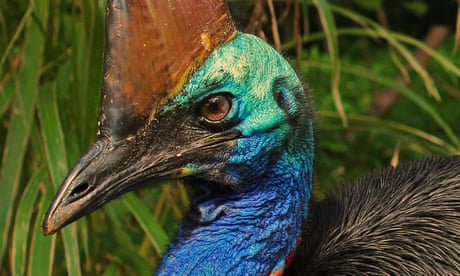
Cassowary 'Ruthie' relocated after trying to break into elderly man's home

Bird in Queensland’s Innisfail had come to associate people with being fed, says environment department, and decision to relocate it was taken ‘reluctantly’

Australian Associated Press
Monday 22 August 201603.21 BST


Wildlife officers have relocated a young cassowary, known by locals as Ruthie, after it threatened an elderly man and tried to enter his Innisfail home.

It is the second time this month a cassowary has been relocated in north Queensland due to aggressive behaviour.

The Department of Environment and Heritage Protection said it was first alerted to potential problems with the bird in early August.

Rangers were called to the Coquette Point home last week after reports the bird was behaving aggressively and trying to break into an elderly man’s home.

 “The decision was reluctantly taken to relocate the bird after it was clear it had become accustomed to associate people with being fed,” according to the department.

The cassowary was tranquilised and relocated to a remote area of rainforest, away from human interaction.

EHP has again urged people not to feed or interact with the endangered species.


Monday, 18 April 2016

Shore birds population facing dramatic decline in face of habitat destruction, UQ scientists say


Updated Sun at 1:49am

Habitat destruction is pushing the world's migratory shore birds to the brink, Queensland scientists say.

Key points:
Habitat critical to shore bird migration, scientists say
Loss of habitat putting many species on brink of extinction, conservationist says
Particular concern for survival of eastern curlew

University of Queensland researcher Rob Clemens said the evidence was clear and that many of the species were in dramatic decline.

"You can look at any bit of data in the country whether it's a nice pristine site or a depleted site you're going to see this decline right across the continent," he said.

Shore birds, which migrate up to 12,000 kilometres in one trip to and from places like Siberia or Alaska, use sites such as the Toondah Harbour tidal flats in Moreton Bay to fatten up over summer and rest for their epic journeys.

But BirdLife Southern Queensland convenor Judith Hoyle is worried the tidal flats will be threatened by a $1.3 billion proposal that would take over a small part of Moreton Bay's internationally significant Ramsar wetland.

"We've got this concept that it's OK to nibble away, that if we just take this little bit it doesn't matter," she said.

"But right along the eastern seaboard this is happening and if we don't start to say 'every little piece of habitat matters' then these birds will become extinct in my life time."

There was particular concern for the world's largest migratory shorebird the eastern curlew.

Secret reserve for rare Qld parrot

April 16, 2016 8:27pm
AAP


Secret reserve for rare Qld parrot

An elusive outback parrot barely seen for a century will now have a secret reserve dedicated to its survival.

The low-flying night parrot was thought extinct, virtually disappearing in the 1900s with only fleeting sightings in the past three decades.

That was until a chance photo resulted in the capture of the nocturnal bird in April last year.

This week, government approval for a 56,000 hectare sanctuary in southwestern Queensland was granted to Bush Heritage Australia to safeguard the rare bird.

It will be fitted with a handful of surveillance cameras to deter poachers, as well as traps to keep feral animals at bay.

Friday, 15 April 2016

Curious cassowary 'Peanut' ventures into home, forcing owners to take cover

Australian native bird considered to be dangerous has long wandered through the backyard in Queensland’s north but until this week stayed outside


Thursday 14 April 2016 08.58 BSTLast modified on Thursday 14 April 201609.51 BST

A cassowary named Peanut has surprised a Queensland family by venturing into their home as they were preparing dinner.

Sue and Peter Leach, from Wongaling Beach in the state’s north, were forced to take cover after discovering the native bird – which can grow up to 2m tall – standing in their lounge-dining room.

“We leave all the doors open when we’re at home and I guess he was curious, but I hot-footed it out of the house and hid in the garage because although we know him he is still a wild animal,” Sue Leach told the Cairns Post.

Peanut, thought to be about three years old, has long wandered through the Leach backyard but until this week had stayed outside.

“My husband hid behind the dining room table and took some photos and he was only in there for a few minutes. He must have come in through the garage door and walked back out the front door.”

Wednesday, 9 March 2016

Coalmines could wipe out threatened black-throated finch habitat – study

Proposed mines in Queensland, including Adani’s huge Carmichael project, will destroy so much habitat the damage cannot be ‘offset’, researchers say

Thursday 3 March 2016 07.58 GMT
Last modified on Thursday 3 March 201608.00 GMT

Proposed coalmines in Queensland, including the huge Adani Carmichael project, would destroy the majority of the remaining habitat of the threatened black-throated finch, according to research.

Australia on the spot over Adani mine and funding of Attenborough reef series
Compensating for the loss of habitat – which Adani has been given federal government approval to do with “biodiversity offsetting” – was not possible since the best remaining habitat would be impacted by the Carmichael mine, the study by researchers at James Cook University in Townsville found.

In addition, about 60% of the remaining habitat for the finch was already covered by mining or exploration licenses.

The bird, which was recently declared extinct in New South Wales and has lost 80% of its habitat globally, is already the centre of a federal case in which the Australian Conservation Foundation has challenged environment minister Greg Hunt’s approval of the mine. It argues that he failed to adequately consider advice about the mine’s impact on the finch.
Approving the Carmichael mine, Hunt said it “would not have any unacceptable impacts on listed threatened species,” because they would either be avoided, mitigated or compensated for (offset).


Tuesday, 29 December 2015

Indian myna bird eradication program claims success in far north Queensland


Mark Rigby
Posted 1 Dec 2015, 1:59am

A far north Queensland community alliance is waging war against the Indian myna bird and believes it may have trapped and euthanased nearly 40,000 birds since 2011.

Earlier in 2015 the Cairns Remove Indian Mynas (RIM) group, in conjunction with the Cairns Men's Shed, set about collecting information on the numbers of myna birds captured by the owners of bird traps in far north Queensland.

RIM president, Peter Goulding said the group had contacted less than half of the people on their database of trap owners, but the number of birds euthanased already exceeded 23,000.

"We're saying if it's 23,000 for that group, we're probably quite reasonable in saying that we've caught somewhere near 40,000 since we started," Mr Goulding said.

The man who designed the bulk of the traps being used in far north Queensland, Ron Moon, said the program's success in far north Queensland was largely thanks to the amount of support it had received from the community.

"People just got behind it and it's really taken off," he said.

"Over 1,500 traps have been built and they're out there in the community."

The design of Mr Moon's trap tricks the birds into moving away from the bait and into a separate compartment of the trap — the collection box.

"I reverted back to how I used to make crab pots years ago," Mr Moon said.

"They get in there, they find out they're caught, and then they find the entrance to the collection box and think they're getting out."


Tuesday, 11 August 2015

Parrot Feared Extinct For 100 Years Is Found

The night parrot, believed extinct since the last confirmed sighting in 1912, is found to be alive in arid desert in Queensland.


10:45, UK,Tuesday 11 August 2015

A breed of parrot thought to be extinct since the early 20th century has been rediscovered.

Scientists in the Australian state of Queensland had long believed the rare night parrot was no more.

The breed, endemic to Australia, was feared extinct after there were no recorded sightings after 1912.

The discovery of two dead birds between 1990 and 2006 only added to the belief that the parrot was no more.