As regular CFZ-watchers will know, for some time Corinna has been doing a column for Animals & Men and a regular segment on On The Track... particularly about out-of-place birds and rare vagrants. There seem to be more and more bird stories from all over the world hitting the news these days so, to make room for them all - and to give them all equal and worthy coverage - she has set up this new blog to cover all things feathery and Fortean.
Showing posts with label storks. Show all posts

Wednesday, 13 June 2018

Scientists can predict which storks will migrate to Africa in autumn and which will remain in Europe


Date:  May 24, 2018
Source:  Max-Planck-Gesellschaft

For little Louis, it is the most exciting day of his life: just six or seven weeks ago, the young stork came into the world on a birch tree in Radolfzell on Lake Constance. Up to this day in June 2014, he has only known his parents and three siblings. But suddenly strange beings have appeared at the nest and are holding the four small white storks captive. They are Andrea Flack and Wolfgang Fiedler of the Max Planck Institute for Ornithology and the University of Konstanz. In the coming years, the scientists will learn from Louis and other young storks that, on their migrations south, storks follow other storks who are particularly good at exploiting thermals, allowing them to flap their wings as little as possible as they fly. The efficient fliers migrate to West Africa, while the others spend the winter in southern Europe. From their data, the researchers can tell which storks will fly where just ten minutes after the birds take off.


Sunday, 3 June 2018

Scientists can predict which storks will migrate to Africa in autumn and which will remain in Europe


Date:  May 24, 2018
Source:  Max-Planck-Gesellschaft

For little Louis, it is the most exciting day of his life: just six or seven weeks ago, the young stork came into the world on a birch tree in Radolfzell on Lake Constance. Up to this day in June 2014, he has only known his parents and three siblings. But suddenly strange beings have appeared at the nest and are holding the four small white storks captive. They are Andrea Flack and Wolfgang Fiedler of the Max Planck Institute for Ornithology and the University of Konstanz. In the coming years, the scientists will learn from Louis and other young storks that, on their migrations south, storks follow other storks who are particularly good at exploiting thermals, allowing them to flap their wings as little as possible as they fly. The efficient fliers migrate to West Africa, while the others spend the winter in southern Europe. From their data, the researchers can tell which storks will fly where just ten minutes after the birds take off.
For days, Andrea Flack and Wolfgang Fiedler have been visiting storks' nests on the western shore of Lake Constance. The aerial ladder of the fire brigade raises them to the stork nests at lofty heights so that they can strap small tracking devices onto the backs of the nestlings. The aim is to follow Louis and 60 other young storks on their migration. The instruments, which weigh less than 60 grams, record the GPS coordinates of the birds' location. They also measure the animals' movements using accelometers. This allows the researchers to determine whether and, if so, how the birds are moving.


Friday, 30 March 2018

Bulgarians rush to save a phalanx of distressed, frozen storks


Villagers come to the rescue after icy wings ground hundreds of migrating birds

Agence France-Presse
Wed 21 Mar 2018 18.33 GMTLast modified on Wed 21 Mar 2018 18.40 GMT

What would you do if you encountered scores of distressed storks covered in ice lying in a snow-covered field? In Bulgaria, people have been taking them home.

A cold snap in the north-east of the country has stranded hundreds of the migrating birds this week, covering their wings in ice and grounding them.

“I found five frozen storks near the village road the day before yesterday,” Safet Halil, 53, from the village of Zaritsa, near the town of Dulovo said on Wednesday. “I took them home, lit a stove to warm them and fed them fish.”

Halil, a road maintenance worker, sparked a wave of support on social media on Monday and others in the region followed his example, with more than 40 birds sheltered inside people’s homes, garages or barns.

Experts said the frozen wings had forced the birds to spend the night on the ground instead of perched on trees as usual.

“It’s the first time that we have seen so many storks in distress in Bulgaria,” said Hristina Klisurova, from the Green Balkans wildlife rehabilitation centre in Stara Zagora.


Monday, 5 February 2018

Storks set unusually early course for Denmark


Ritzau/The Local
30 January 2018
17:17 CET+01:00

Storks appear to be migrating to Denmark at an unusually early time of year.

Warmer weather means the sight, usually a sign spring is coming, is now occurring with a sizeable chunk of winter still to go, say birdwatching enthusiasts.

The bird has been spotted several times in the northern German province of Schleswig-Holstein near the Danish border, according to the storkene.dk society.

Warmer Danish winters mean the animals are able to fly to the country at an earlier stage of the year, according to Jess Frederiksen, chairperson with the society.

"The same storks are coming earlier and earlier each year. This is because they can now be here in January and February, when it used to be too cold. The storks have learned that there's no longer any need to wait to get going [on their migration]," Frederiksen said.

Storks coming to Denmark look for optimal space to be able to breed, so migrating earlier can be an advantage for the animal.

Read on  

Tuesday, 26 January 2016

STORKS SURVIVING WINTER BY EATING JUNK INSTEAD OF MIGRATING

Jan 23 2016, 2:51am CST | by Sumayah Aamir

Storks have stopped their Annual Migrations due to Human Interventionism

Storks have stopped their annual migrations due to human interventionism. It seems mankind has a lot of expertise in producing tons of garbage.

Human meddling in the affairs of Nature is not something new. Since primitive man burned down whole areas of grassland, mankind has been pushing Nature to the edge with the many wasteful activities.

Destruction of wildlife via hunting and fishing causes many species to undergo a loss of habitat. The ensuing climate change due to the release of greenhouse gases has led to wildlife populations migrating to other areas or dwindling in their numbers.

The latest news suggests that we have the capacity to alter or even completely annihilate the migration patterns of animals. This would be a big mistake since it damages the ecological webs more than anything else.

Since many animal species are fast becoming extinct, they have been placed on the endangered species list. They happen to be our #1 priority right now as stewards of the planet. Animal migration patterns are firmly set in their ways and a part and parcel of the fabric of Nature. 

The migration trajectories followed by young white storks are common knowledge among biologists. These birds are being influenced by human communities that lie along the route of their journey.

Where the storks stop on the way to their destination and for how long is determined by mankind. This might surprise many, but it is true.


Sunday, 29 November 2015

'Grounded' storks fly again one year after power lines crash

A group of rescued storks, which were never expected to fly again after hitting power lines, have made a "miraculous" recovery.

Twenty-two of the birds arrived in the UK from Poland after breaking their wings in the accident a year ago.

After regaining enough strength to undergo operations, three were able to take flight again this week.

Shorelands Wildlife Gardens, Norfolk, hopes it will be able to reintroduce the species to England.

Ben Potterton, Shorelands' owner, said: "For a bird to hit a power line, fall to the ground, have all that trauma and veterinary care and then fly again is miraculous.

"They're soaring around as we would expect them to do."

Mr Potterton said it was hoped the wounded birds could breed in captivity, and any chicks introduced to the wild.

Sunday, 1 March 2015

Storks could become poisoned by pesticides during their migration to Africa


Date:
February 24, 2015

Source:
Plataforma SINC

Summary:
Not all storks migrate to Africa. Many stay for the winter in the Iberian Peninsula, where landfills have become a permanent source of food. Scientists have analyzed the presence of pollutants and pesticides (some prohibited in Spain) in the blood of nestlings from three colonies, two of which are close to landfill sites. The results reveal that the main source of contamination can be due to the use of insecticides still used in African countries where the birds migrate to, who transfer their contaminated load onto their offspring through their eggs.


Thursday, 11 September 2014

Large birds wing their way out of Adilabad

Reduction in area under paddy cultivation is said to have had a telling effect on their food supply

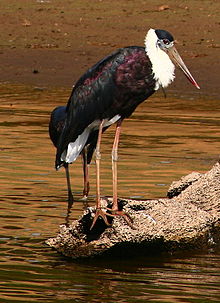
White necked stork (Ciconia episcopus) 21-Mar-2007 7-37-51 AM 21-Mar-2007 7-37-52.JPG
Bishop stork
Birds which had hitherto made areas under paddy cultivation as their home in the district seem to have abandoned the place following a drastic decrease in the area under that crop. Birds that are not to be seen are storks, painted storks, open bill storks, bishop storks and ibises, which had food aplenty in the paddy fields in the recent years.

About 45,000 hectares of land as against the normal paddy cultivation area of 56,000 hectares has been left fallow owing to long dry spell this monsoon. Almost all the minor tanks in the district have gone dry which evidently has a telling effect on the food supply for larger birds.
Different varieties of storks started arriving at Adilabad after paddy cultivation picked up in the mandals along the Godavari river and in the interior mandals of Koutala, Bejjur, Dahegaon, Vemanpalli and Nennel in the last few years. The larger birds shared the habitat with other local species like cormorants, egrets and ibises of all types.

These birds, except for the painted storks, can now be seen, albeit less in numbers, in Bejjur mandal which continued to be an excellent bird habitat even during the harsh summer and monsoon months. According to the Bejjur Forest Range Officer, M. Ram Mohan, the number of black ibises seems to have increased during the period in question. “The open bills are present in good numbers as also the large, medium, lesser and the ubiquitous cattle egrets,” he pointed out.

Sunday, 18 August 2013

Hamburg – A haven for white storks

In contrast with much of Europe, Hamburg's white storks are thriving

August 2013. Hamburg has emerged as an unlikely haven for white storks, according to Jürgen Pelch, of NABU International - Foundation for Nature (BirdLife in Germany - NABU) in Hamburg.

NABU Hamburg have announced the best stork breeding season for 51 years in Hamburg, where 23 pairs have raised 50 young this year. In 2012 there were just 15 pairs and 37 fledglings, and in 2011 19 pairs with 46 young. 

It is possible that, as habitat declines in other parts of northern Germany, more storks are identifying Hamburg as a haven. In the region to the east of Hamburg, In Mecklenburg-Pomerania, the breeding population has declined by 30 percent due to intensification of agriculture.

NABU Hamburg has been working to improve conditions for the storks, by erecting nesting platforms and improving other habitats. NABU helped recreate some wetlands along the Kirchwerder meadows to attract frogs and other wildlife.

In 2012 NABU launched a campaign with Vattenfall, a power company, after two young storks were electrocuted to place wind flags on some power lines to stop such accidents in future. 

More risks
Jürgen Pelch stressed that despite Hamburg's recent success, the birds are still at risk. On their migration routes they are exposed to a range of hazards, and only one in four fledgling storks make it back to the breeding area. Agricultural monocultures, drained wetlands, trigger-happy hunters and the use of pesticides continue threatened the white stork. 

Bad year for Czech storks.