As regular CFZ-watchers will know, for some time Corinna has been doing a column for Animals & Men and a regular segment on On The Track... particularly about out-of-place birds and rare vagrants. There seem to be more and more bird stories from all over the world hitting the news these days so, to make room for them all - and to give them all equal and worthy coverage - she has set up this new blog to cover all things feathery and Fortean.
Showing posts with label peregrine falcons. Show all posts

Sunday, 27 January 2019

How do you bring wildlife back to the city


By Martha Henriques
21 January 2019
Urban rewilding projects are tempting nature back into our cities, from creating city butterfly meadows to building unlikely homes for deadly birds of prey.
The middle of London’s hectic West End doesn’t seem like the likeliest location for one of the UK’s rarest birds. There are only an estimated 20-40 breeding pairs of black redstarts in the country. But in recent years, without being artificially introduced into the area, this rare bird has started to make a home in this crowded part of Central London.
The black redstart isn’t the only unexpected species of wildlife to start living in conspicuously urban landscapes. Moths, butterflies, woodpeckers and even serotine bats, more commonly found in rural pastures, have also been on the rise in this part of London.
It’s a trend growing in strength worldwide. While in New York, peregrine falcons – once nearly extinct in the US, can now regularly be seen diving at breakneck speeds from skyscrapers across the city.

Friday, 16 February 2018

Raptors guarding Mexico City’s airport to ward off ‘bird strikes’


AFP-JIJI
FEB 2, 2018

MEXICO CITY – Far from the crowds of passengers, lines and passport control, Madison spreads his wings on the side of a runway at Mexico City’s international airport, the busiest in Latin America.

He is one of several peregrine falcons deployed to prevent “bird strikes” — a hazardous collision between birds and planes that can have dangerous and even catastrophic consequences.

In 2009, for instance, a U.S. Airways jet had to ditch in the Hudson River in New York after a flock of birds took out its engines. In January this year, a Mexico-bound KLM flight made an emergency landing after hitting birds on takeoff in the Netherlands.

“It’s dangerous. Birds don’t mix with planes. They can hit a turbine,” Oscar Chavez, a 26-year-old who is one of the biologists handling the falcons, told AFP.

Each day, Madison and another peregrine falcon named Ilse are on duty at the airport, which sees 44 million passengers pass through it each year.

Wednesday, 13 December 2017

Replicating peregrine falcon attack strategies could help down rogue drones


December 4, 2017

Researchers at Oxford University have discovered that peregrine falcons steer their attacks using the same control strategies as guided missiles.

The findings, which overturn previous assumptions that peregrines' aerial hunting follows simple geometric rules, could be applied to the design of small, visually guided drones that can take down other 'rogue' drones in settings such as airports or prisons.

The research, initially funded by the US Air Force Research Laboratory and published open access in the journal PNAS, may also give scientists greater insight into the pursuit behaviours of other predatory species - in the air, in water, or on the ground.

Principal investigator Professor Graham Taylor, of the Oxford Flight Group in Oxford University's Department of Zoology, said: 'Falcons are classic aerial predators, synonymous with agility and speed. Our GPS tracks and on-board videos show how peregrine falconsintercept moving targets that don't want to be caught. Remarkably, it turns out that they do this in a similar way to most guided missiles. Our next step is to apply this research to designing a new kind of visually guided drone, able to remove rogue drones safely from the vicinity of airports, prisons and other no-fly zones.'

Friday, 22 July 2016

Sex in the city: Peregrine falcons in Chicago don't cheat


Date: July 15, 2016
Source: Field Museum

Peregrine Falcons, in their normal habitat on isolated cliffs, mate for life. But some 25 pairs now nest on Chicago skyscrapers and bridges, and city living has them in much closer quarters than they used before humans dominated the landscape. A group of Field Museum and University of Illinois, Chicago scientists investigated whether typical breeding patterns hold true for these new city-dwellers and, in a paper published in PLOS ONE, confirmed that even in the big city, the birds that prey together, stay together.

"Peregrine Falcons that now live in the Chicago region are living in very different conditions than you'd normally see for these birds, so we wondered if the falcons' mating habits had changed too. They're in much closer proximity to each other than they'd be in a more rural environment, and we thought they might be more promiscuous with more potential mates nearby," explains co-author John Bates, Associate Curator of Birds at The Field Museum. "Each spring this population also has migratory Peregrines passing through on their way to all parts of Canada, so we didn't know what we were going to find, but it turns out that almost all of the mated pairs in the city remain monogamous through the years."

Peregrine Falcons nearly went extinct in the US in the 1960s due to thinning of their eggshells caused by the pesticide DDT. However, historic egg collections at the Field and other museums provided evidence for the harm caused by DDT, and it was banned. In the decades since, reintroduction efforts have enabled Peregrine Falcons to make a comeback in the Midwest, with populations thriving in urban areas in twelve states. Ninety percent of the breeding pairs in the Midwest nest on buildings and bridges in the Chicago area.

Wednesday, 25 November 2015

Bird Notes: Peregrine numbers down across Wales

14:00, 17 NOV 2015
UPDATED 14:17, 17 NOV 2015
BY JULIAN HUGHES

Provisional results of the latest nest survey last week find the birds numbers were down 12% since 2002

Peregrines are a flagship success for bird conservation.

Numbers crashed in the 1950s, principally because organochlorine pesticides in their food chain resulted in thinner eggshells and thus many nests failed.

A pesticide ban and increased nest protection helped Peregrine numbers to increase, but even by the early 1970s, there were just a handful of pairs on Anglesey and none at all nested in northeast Wales.

Over the next 40 years, they spread along sea cliffs and started to nest on built structures, such as Wrexham police station.

Last week the provisional results of the latest nest survey were published, finding Peregrine numbers were down 12% in Wales since 2002, to fewer than 250 pairs - reduced food supply is thought to be the main driver of the change.

High winds have pushed seabirds inshore: Little Gulls were off Bardsey and the Glaslyn estuary, a late Leach’s Petrel was at Criccieth and a Sooty Shearwater off Bardsey.

Two Great Northern Divers sought shelter in Holyhead Bay, nine were off Porth Ysgaden and another two off the Little Orme. Whooper Swans at RSPB Conwy and on Llanrwstfloodwater and a Common Scoter on Abergele’s Pentre Mawr lake were all unusual.

A Scaup remains on Parc Eirias boating lake, not deterred by last week’s fireworks, and the Great Grey Shrike continues its stay at Llyn Du near Porthmadog.

Wednesday, 22 April 2015

Rare falcon finds residency on Vermont nuclear smokestack

April 21,2015

VERNON — A rare falcon has found a permanent home on a nuclear power plant smokestack. 

Employees at Vermont Yankee Nuclear Power Station have played an active role in creating and maintaining a home for peregrine falcons, the Brattleboro Reformer reported. 

The falcon is listed as state-threatened in New Hampshire, and Vermont has roughly 40 pairs across the state. 

Employees of the now-closing plant became aware of the falcons in 2009 after receiving a call from a New Hampshire Audubon biologist. Employees received permission from management to install a nest box on the smokestack, built by Steve Skibniowski, a longtime Yankee employee who now serves as a consultant at the plant. Audubon experts sent him the plans for a wooden box with an open front and a special perch. 

“I’m surprised it’s held up as well as it has, because it’s very severe weather up there,” he said. 

Friday, 12 September 2014

Volunteer 'eyes on the skies' track peregrine falcon recovery in California

Date:
September 11, 2014

Source:
Ecological Society of America

Summary:
Datasets from long-running volunteer survey programs, calibrated with data from sporadic intensive monitoring efforts, have allowed ecologists to track the recovery of peregrine falcons in California and evaluate the effectiveness of a predictive model popular in the management of threatened species.


Wednesday, 6 August 2014

Peregrines found dead

Section Community | Published on 28 Jul 2014


Police and the RSPB are appealing for information after four peregrines were found dead.

The birds were found on their nest at a quarry in Dyffryn Nantlle. The peregrines were last seen alive on Thursday, 3rd July, and they were discovered dead on Thursday, 10th July.

PC Dewi Evans explained: “The nest is situated high up on a very steep cliff and it has not been possible to recover the bodies.

“From the photograph it appears that one of the four is an adult, with the other three being chicks, which were only a week or so away from fledgling.

“According to the RSPB it would be highly unusual for the four to die, and foul play is highly probable."

Simon Hugheston-Roberts from RSPB Cymru said: “We have had a number of incidents of peregrine falcons being illegally persecuted in North Wales. The circumstances are highly suspicious and we are concerned that perhaps poisoned bait has been brought back to the nest by one of the parents resulting in the tragic death of all four birds.

"We would urge anyone with information about this or similar incidents to contact North Wales Police.”

Anyone who may have information relating to the death of the birds is asked to call PC Evans on 101 quoting reference R105499.

Tuesday, 15 July 2014

Pair of peregrine falcons set up home at Greenwich clocktower

Updated 12:17pm Monday 7th July 2014 inNews
By Mark Chandler, deputy news editor


A pair of peregrine falcons have set up home at Greenwich's landmark clocktower - but snap-happy birdspotters are being urged to keep away.

The rare birds - which are granted special legal protection - have been spied by several eager onlookers at the Royal Hill site in recent months.

And nest site monitor John Chapman from the London Peregrine Protection Partnership - a voluntary group set up top preserve the capital's creatures - confirmed they had been there since last year.

He told News Shopper: "They were there last year but they were only young birds. But they stayed there right through the winter and they're still there this year."

Saturday, 7 June 2014

Four Peregrine Falcon chicks in a nest in Town Hall clock tower

Date published: 06 June 2014
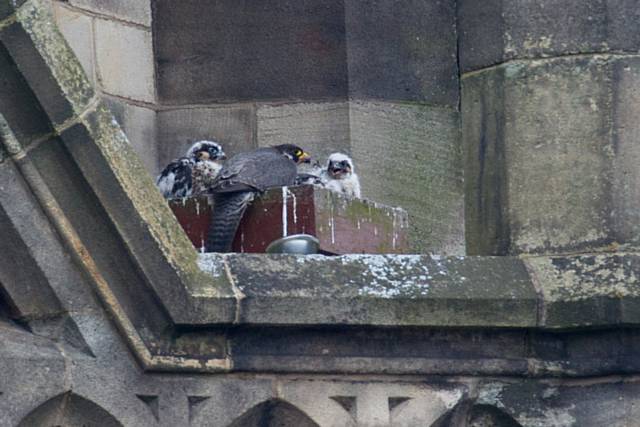
Four Peregrine Falcon chicks can be seen in a nest in the Town Hall clock tower.

The birds of prey first began nesting in the clock tower of the Grade-I Listed building six years ago, after a nesting tray was installed by the Manchester Bird Recorder. Four chicks and two adult falcons mean the box is getting a little crowded so plans are being put in place to enlarge the box for next year.

Staff at the town hall have been keeping a close eye on the progress of the four young chicks, who all seem to be progressing well and will soon be ready for flight.

Assistant Cabinet Member for Community, Culture and Tourism, Councillor Janet Emsley said: “Our town hall is a fantastic building which attracts visitors from all over the world. We’re really pleased to see such beautiful wildlife as these Peregrine Falcons nesting here again and it adds another string to the town hall’s bow.”

Richard James from The Royal Society for the Protection of Birds (RSPB) said “It’s great to see the falcons nesting on the building. They have become a popular attraction in many towns and cities and we hope they continue to be successful.”

Reaching speeds of up to 200mph during dives to catch prey, Peregrine Falcons are the fastest animals in the world. Although they are commonly found living and hunting in open countryside, they are increasingly being spotted in towns and cities where tall buildings provide plenty of nesting opportunities and pigeons to feed on.

As one of around 1,500 breeding pairs across the UK, these falcons delayed works as part of the town hall restoration when two chicks nested in the clock tower in 2012.

Friday, 6 December 2013

Rainfall to blame for decline in Arctic peregrines

news/2010_jan/Arctic_Peregrines
A peregrine sits outside her flooded nest,
unable to hatch her eggs.  University of Alberta
December 2013: Rain is proving deadly for young peregrine falcons in Canada's Arctic says scientists from the University of Alberta. The study, recently published in Oecologia, has found that an increase in the frequency of heavy rain brought on by warmer summer temperatures is posing a threat not seen in this species since before pesticides such as DDT were banned from use in Canada in 1970.

A nestbox experiment at the heart of a study co-authored by U of A researcher Alastair Franke and colleagues at the Université du Québec has provided "unequivocal evidence" that gradual changes in Arctic temperature and precipitation are responsible for a long-term decline in reproduction for the peregrine, a top predator in the Arctic.

Friday, 24 May 2013

Peregrine falcons may be removed from endangered species list


Urban roosts, DDT ban help boost numbers 
Just five decades ago, habitat loss and a deadly pesticide had all but killed off one of the Midwest’s most impressive aerial predators. 

Now, Indiana’s wildlife regulators are poised to remove the peregrine falcon from the state’s endangered species list this summer. 

John Castrale, a biologist with the Department of Natural Resources, said the recovery of the species has been “phenomenally successful,” thanks to reintroduction efforts, a ban on the pesticide that was killing the birds and the falcons’ remarkable ability to adapt to urban environments. 

Indianapolis is no stranger to the falcons. Just last week, a nesting pair, dubbed KathyQ and Will, hatched their fourth chick of the year on the 31st-story ledge of Market Tower on Monument Circle in Downtown Indianapolis. Another male, named Kinney, had nested with KathyQ for years, but died last summer. 

An Indianapolis Star blog featuring live cameras received 7.1 million views last year. The pair have Facebook fan pages, too, each with more than 1,000 “likes.” 

There’s another nest at Indianapolis Power & Light Co.’s Harding Street plant on the Southwestside; that nest also is on camera. 

Castrale said the birds have traded their traditional nesting sites — in cliffs and bluffs along riverbanks — for skyscrapers. 

“They’ve adapted to use these artificial sites, artificial cliffs,” he said of the birds’ penchant for skyscrapers. “That’s really made a difference. They’re really taking advantage of it.” 

Falcons, known for their dazzling diving aerial attacks on prey such as pigeons, can plummet at close to 200 mph to strike, stun and kill an unsuspecting bird.