As regular CFZ-watchers will know, for some time Corinna has been doing a column for Animals & Men and a regular segment on On The Track... particularly about out-of-place birds and rare vagrants. There seem to be more and more bird stories from all over the world hitting the news these days so, to make room for them all - and to give them all equal and worthy coverage - she has set up this new blog to cover all things feathery and Fortean.
Showing posts with label Dartford warbler. Show all posts

Monday, 25 February 2019

Rare bird is a heathland triumph


Monday, 28 January 2019 - Environment
SURREY Wildlife Trust’s management of Whitmoor Common, the largest area of open heathland in the Guildford area, has been awarded the highest standard for heathland management by Natural England.
The Dartford warbler, an indicator species for biodiversity, and the window-winged caddis fly are just two species to benefit from the rare lowland heathland, which is now in favourable condition.
The success of Surrey Wildlife Trust’s management at Whitmoor Common has improved the ecology of three-quarters of the 183-hectare reserve. Landscape scale scrub clearance by contractors in winter, cattle grazing, the Trust’s volunteer work, specialist conservation work and support from Whitmoor Common Association have all contributed to the ecological improvements.
Katy Fielding, Surrey Wildlife Trust liaison officer at Whitmoor Common, said: “Lowland heathland is rarer than rainforest and Britain holds 20 per cent of this resource in Europe, so we have a real responsibility to look after it.
“Our hard work building up the mosaic of habitats and micro habitats, together with the diversity in age and structure of gorse, heather and woodland is creating the optimum conditions for wildlife.’

Tuesday, 26 April 2016

Rare songbird sings on revived Devon nature reserve

By WMNHFinch  |  Posted: April 21, 2016

One of Devon's most elusive birds is singing again on some of the county's rarest and most threatened habitat.

The Dartford warbler's distinctive song is echoing across the RSPB's Aylesbeare 
Common nature reserve, weeks after the end of a major restoration project.
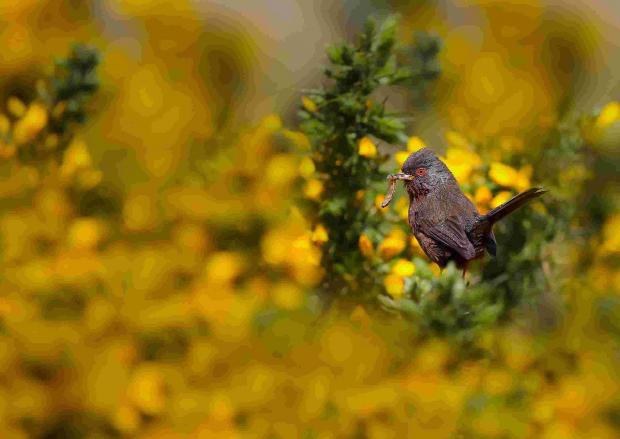
David Boult captured the bird on film this Spring

The RSPB was able to make vital improvements to one of the few remaining lowland heaths in southern England with a £14,000 grant from Tarmac through its Landfill Communities Fund.

Alan Everard, Tarmac's head of estates, south, said: "The restoration of Aylesbeare Common will help ensure this distinctive bird is saved for future generations."

RSPB Aylesbeare Common, in east Devon, is a hotspot for Dartford warblers, and for other specialised heathland species such as nightjar, silver-studded blue butterfly, Kugelann's ground beetle, grass snake, common lizard and the soprano pipistrelle bat.

The Dartford warbler is linked with the conservation of England's surviving heaths, and its liking for gorse in particular led to it once being known by the folk-name 'furze wren' in some parts of the country.


Thursday, 13 August 2015

Rare bird spotted at Winfrith Nature Reserve

Tuesday 11 August 2015 / News

A RARE bird has been spotted in Dorset. 

Conservation officer for Dorset Wildlife Trust, Hamish Murray, spotted the rare Dartford Warbler at Winfrith Nature Reserve.

This small, dark, long-tailed warbler is resident in the UK and has suffered in the past from severe winters.

Its population crashed to a few pairs in the 1960s.

Since then it has gradually recovered, increasing in both numbers and range.

It is still regarded as an Amber List species.
Share article

It will perch on top of a gorse stem to sing, but is often seen as a small flying shape bobbing between bushes.

Saturday, 6 December 2014

Dartford warbler spotted on New Forest heathland for first time in over a decade

Dartford warbler spotted on New Forest heathland for first time in over a decade

AN ICONIC New Forest bird has been recorded at heathland in New Milton for the first time in more than 10 years.

The rare Dartford warbler, which is on the IUCN Red List of Threatened Species, was spotted at Barton Common for the first time since August 2004 by local expert Keith Betton.

He told the Daily Echo: “It’s always exciting when a rare bird is recorded in a new location.

“The grazed gorse is a good habitat for the birds, and I’m hopeful that in the coming months we will record even more species.

“There are two birds present – so I am hoping they may stay around for the breeding season.”

Monday, 5 May 2014

Plea to wildlife photographers over rare bird


A series of recent incidents involving photographers encroaching into the heather at the National Trust’s Dunwich Heath, near Southwold, to obtain close-up images of Dartford warblers has prompted the trust to take action.
The species is often elusive and difficult to observe and enjoys the top level of legal protection afforded by the Wildlife and Countryside Act. It is on the act’s Schedule 1 and is highly sensitive to disturbance.

Despite it being the breeding season, trust staff say some photographers had recently been seen well away from the heath’s many paths, far too close to nest sites and even trying to lure the warblers on to the heather tops by playing recordings of the species’ song, a highly controversial practice known as tape-luring.

The trust staff have produced a leaflet for photographers and birdwatchers which urges them to adhere to a code of responsible, law-abiding behaviour.

Wednesday, 7 November 2012

'Obsessional' thieves found guilty of stealing hundreds of birds' eggs after two-year undercover operation


'Premier league' bird egg collector Marcus Betteridge fined £1,000 for disturbing rare Dartford warbler's nest

Seymour Crang also fined £1,000 for unlawful possession of wild birds' eggs

Two 'premier league' bird egg collectors have been fined for stealing hundreds of rare eggs after a two year police investigation to find the culprits. 

'Obsessive' collectors Marcus Betteridge, 52, and Seymour Crang, 49, built up a unique collection of rare eggs after stealing them from the nests of birds including lesser redpolls, tree pipits and redshanks.

Police raided their homes after a two year joint investigation with the RSPCA and National Wildlife Crime Unit and discovered hundreds of eggs, collecting equipment, photographs and diaries relating to activities at nest sites.

Five eggs of a lesser redpoll, four of a tree pipit, five linnet eggs and one of a redshank, all kept in a cotton-wool lined ice cream carton were found at the home of Crang.

Police also discovered a diary belonging to Mr Betteridge which contained hundreds of pages with detailed notes covering more than a decade of activity.

Newton Abbot Magistrates Court heard Crang and Betteridge are 'premier league' and 'obsessional' egg thieves with a 'twisted psyche'.