As regular CFZ-watchers will know, for some time Corinna has been doing a column for Animals & Men and a regular segment on On The Track... particularly about out-of-place birds and rare vagrants. There seem to be more and more bird stories from all over the world hitting the news these days so, to make room for them all - and to give them all equal and worthy coverage - she has set up this new blog to cover all things feathery and Fortean.
Showing posts with label Worcestershire. Show all posts

Monday, 23 October 2017

Museums Worcestershire: How flightless parrot reached Worcester

15th October

Sometimes referred to as an Owl Parrot due to its moon-like face, the bird is nocturnal and entirely vegetarian, feeding mainly on flowers, roots and leaves.

While our specimen is slightly faded in colour, the Kakapo is usually a bright mossy green with dappled yellow and black.

This camouflage allows the Kakapo some protection against birds who hunt above the forest using sight, but is of little use against mammals who hunt using smell. Before the arrival of humans the Kakapo was common throughout New Zealand’s forests, but became vulnerable to attack from introduced species such as rats and cats. The bird is now heavily monitored and managed on predator-free islands.

This specimen is believed to have travelled to the museum in the latter half of the 19th century, although its precise history is uncertain. Worcester had become a lively centre for natural history research and learning by this period, with the founding of the Worcestershire Natural History Society and other dedicated groups creating and promoting their own collections.


Wednesday, 29 April 2015

Unusual bird spotted at Upton Warren en route to Eastern Europe

First published 2 hours ago in Regional News by Alex Townley

AN unusual birds has dropped in on the Moors pools at the Upton Warren Nature Reserve on its way to Scandinavia or Eastern Europe to breed.
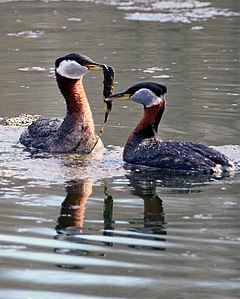
Grèbejougrisparade.jpg
A red-necked grebe has been spotted near the shallow waters of the nature reserve between Droitwich and Bromsgrove, complete with its summer breeding plumage.

John Belsey, a volunteer warden at Upton Warren, said: “A small number of red-necked grebes overwinter in the UK and they pass through on their way to and from breeding grounds in spring and autumn. This is the first time we’ve ever seen one at Upton Warren and to have one in full summer breeding plumage is absolutely fantastic.

Tuesday, 1 July 2014

Rare bird breeding success at nature reserve

A BIRD that rarely breeds in Worcestershire has successfully raised a family on a nature reserve for the first time since 1947.

A pair of shoveler ducks has successfully bred on The Moors Pools at the Christopher Cadbury Wetland Reserve, in Upton Warren, near Wychbold.

The site, consisting of both fresh and saline water pools, is owned by Worcestershire Wildlife Trust.

John Belsey, a volunteer at Upton Warren, said: “These unmistakeable birds, with their large spatula-shaped bills, are regular visitors to the county but rarely breed here.

Sunday, 11 May 2014

Residents enjoy watching chicks with bird cam

3:45pm Wednesday 7th May 2014 in News

RESIDENTS have been all of a flutter at a Worcestershire care home after a bird watching camera was set up in their court yard.

Elderly people living at Rashwood Care Home, in Wychbold, near Droitwich, have been enjoying keeping an eye on the comings and goings of the family of birds since the bird cam was installed.

Deborah Sorenson, from the care home, said the camera was similar to that of Spring Watch on BBC1.

"We are watching the camera on the library TV," she said. "When she laid the eggs we watched them hatching and now we are having great joy watching the mother feeding the birds and bringing the food to them. There are eight chicks in the nest. It's very similar to Spring Watch.

Wednesday, 23 October 2013

We must act now to save beautiful owls under threat

BARN owls in Worcestershire are under threat in what is being described as “the worst breeding season for 30 years”.

The Worcester Barn Owl Conservation Group (WBOCG) has found numbers of the popular farmland bird have decreased dramatically since 2009, with only four nests found in a recent survey, compared to the usual 13.

Bird numbers usually start to increase once the weather starts to get warmer after the winter but a report by the British Trust for Ornithology found deaths had increased by 208 per cent at the end of March this year.

Monday, 18 February 2013

Work to save woodland birds to take place in Worcestershire


Rare birds to benefit from woodland work
February 2013. Work to improve habitat and protect declining woodland birds is about to take place at two Worcestershire nature reserves.

Funded largely by a Woodland Improvement Grant, Worcestershire Wildlife Trust is about to undertake thinning and ride widening works in two woodlands.  Trench Wood (near Sale Green) and Monkwood (near Grimley) have both been the focus of previous forestry work and wildlife gains have been recorded.

Lesser spotted woodpecker.
Photo credit Pete Walkden.
James Hitchcock, conservation officer for the Trust, explained "The work we're undertaking is part of the long-term restoration of both these woodlands. Visitors to the woodlands have become used to work of this sort over the last few years. The areas we're working in and the type of work we're doing this year, however, are very much focused on trying to halt the decline of woodland birds like spotted flycatcher, marsh tit and lesser spotted woodpecker."
Marsh tit and spotted flycatcher

As we have lost woodlands and our traditional woodland management methods have faded, numbers of woodland birds have declined. Once common, birds like the marsh tit and spotted flycatcher now have red status - severe decline in numbers and whose population is globally threatened.

While there are a number of factors contributing to this decline, re-instating coppicing in woodlands can help. Coppicing involves cutting down trees almost to their base - the trees spring back to life with strong new growth, which can be cut again on a constant cycle. By managing on rotation, woodland managers can ensure there is always a range of habitat for wildlife.