As regular CFZ-watchers will know, for some time Corinna has been doing a column for Animals & Men and a regular segment on On The Track... particularly about out-of-place birds and rare vagrants. There seem to be more and more bird stories from all over the world hitting the news these days so, to make room for them all - and to give them all equal and worthy coverage - she has set up this new blog to cover all things feathery and Fortean.
Showing posts with label rare bird. Show all posts

Friday, 26 April 2019

Tennessee hunter kills bizarre albino turkey in Rutherford County - (Just had to kill it though eh?)


Mike Organ  Nashville Tennessean
Published 12:28 PM EDT Apr 13, 2019
It's being called the "turkey of a lifetime," by the Tennessee Wildlife Resources Agency.
That's how TWRA officials described a rare leucistic gobbler killed by a hunter in Rutherford County last week.
Cameron Bond of Warren County shot the unusual bird on April 6.
A rare leucistic turkey was shot by a hunter in Rutherford County.
Tennessee Wildlife Resources Agency
Leucism in birds, according to the TWRA, is a loss of pigmentation. It is a genetic abnormality.
The beard on the turkey Bond killed was dark and the back feathers still held some color. 
Bond said the turkey weighed 20 pounds. It's beard measured nine and one-half inches and its spurs were .75.
Spring turkey hunting season in Tennessee opened on March 31 and continues through May 1.

Wednesday, 27 June 2018

Rare white magpie sighting delights South Australian birdwatchers


Updated 9 Jun 2018, 10:48pm

First, there was the exciting sighting of a black kookaburra in a West Australian backyard. Now bird enthusiasts in South Australia are talking about a rare white magpie that has been spotted in the Flinders Ranges.

The bird is mainly white and a very light brown where it would normally be black. It has been spotted frequently near a creek about six kilometres north of the town of Quorn.

Quorn resident and bird enthusiast John Paynter said the magpie does not let people get too close.

"We drove around and all of a sudden it was sitting right in the middle of the road, picking a bit of carrion off the road," Mr Paynter said.

"But once he worked out we were trying to photograph it, he took off pretty quickly."

Mr Paynter keeps birds and said the white magpie would be at a higher risk of predation than other magpies in the area.

"Obviously a white magpie is a lot easier to see than a coloured one, a dual-coloured one anyway.

"I'm hopeful that it survives, but the chances of that are probably a bit slim with the colour … these things don't tend to last in the wild but hopefully it will be okay and hang out for a while."
Birds SA secretary Kate Buckley showed a photo of the bird to other members and they said that while rare, the bird was not an albino.

Sunday, 31 January 2016

Birders flock to Surrey farmland for rare Asian bird


Birders from around the continent are taking flight to an obscure patch of South Surrey farmland to see a striking little bird that belongs in Asia — the Siberian Accentor. 

By Larry Pynn, Vancouver Sun

METRO VANCOUVER -- Birders from around the continent are taking flight to a patch of south Surrey farmland to see a striking little bird that belongs in Asia — the Siberian Accentor.

“This particular bird is in an easily accessible area,” George Clulow, president of B.C. Field Ornithologists, said in an interview Friday.

“People can easily fly in, which is what they’ve been doing from all over North America. I was standing next to people from Massachusetts, California, Florida, Minnesota.”

There are only six or seven recorded sightings of the wayward bird in B.C., Clulow noted. Normally it is found in Southeast Asia and breeds across Siberia.

Clulow first spotted the Siberian Accentor with fellow birder Mandy Lu on Jan. 3 during the annual Christmas Bird Count, an event that forces birders to look in unusual and less-visited areas to help pump up their counts.

They were in an agricultural area on 160th Street when he noticed small birds flying in a blueberry field. “I turned around and saw this bird for a split second perched in a blueberry shrub,” he recalled.
“It dropped down and we couldn’t find it. It was a bird I’d never seen before — sparrow-sized but with a striking head pattern (featuring dark and rust stripes).”

That evening at home he pulled out a reference book, Rare Birds of North America, and there on the cover was a photograph of the Siberian Accentor. “That’s it. That made it easier.”

He returned three days later and after four hours had a good sighting of the bird, snapped a few photos to confirm identification and posted it on the Internet. “It just went viral from there,” he said. “It’s a rare bird.”

The bird has remained at the site ever since, with continued sightings this week. It is often seen feeding on the ground with dark-eyed juncos.

To reach the site head east on No. 10 Highway toward Cloverdale, turn right (south) on 160th Street, cross the railway tracks and look for the birders.


Tuesday, 6 May 2014

Thomasville woman spots rare woodpecker

May 1, 2014 


Written by
Merry Ann Frisby

A rare white pileated woodpecker is visiting homeowner Mary Wise in Thomasville, Georgia. On April 22, it finally posed for a portrait.

The leucistic pileated woodpecker has been mistaken for the ivory billed woodpecker, which is likely extinct.

“I was surprised and excited to see this beautiful bird return,” said Levings.

Researchers from the Cornell Lab of Ornithology say that the phenomenom — also known as “partial albinism” — is infrequent but not unknown in wild bird populations. It results from a reduction or absence of melanin, a dark pigment, in the feathers.

“It is not unusual for such birds to retain other feather pigments, such as reddish carotenoids, resulting in unusually patterned plumage such as in the recently found Pileated Woodpecker,” said the university team. “From 2000-2006, Project Feeder-Watch participants reported fewer than 1,000 leucistic birds. There were 5.5 million birds reported each season.”

Monday, 21 April 2014

National park under fire for backing plans which threaten rare bird

Exclusive By Rob Edwards Environment editor
Sunday 20 April 2014

The Cairngorms National Park Authority has been accused of endangering one of Scotland's rarest birds by backing big housing schemes and promoting tourism.

Four-fifths of the UK's dwindling population of capercaillie live in the national park, but experts have said the birds are suffering because of escalating interference from residents and visitors.

According to Dr Robert Moss, a wildlife biologist who has made a lifelong study of capercaillie, the national park is "conflicted" on the issue and ignores the advice of its own ecologists.


Moss is the lead author of a new scientific study of three woodlands in the Cairngorms area showing that capercaillie are very vulnerable to human disturbance. The birds stayed hundreds of metres away from places where people entered the woodlands, and at least 70 metres from tracks though the woods.

The study, published in the journal Wildlife Biology, said that capercaillie avoid much larger areas where dogs often stray from tracks, and in the most disturbed woods retreat to centres of trackless boggy ground for refuge.

Capercaillie populations have declined from about 20,000 in the 1970s to fewer than 2000 now, partly because of increased human disturbance.

Tuesday, 18 March 2014

Rare spoonbill the latest victim

A rare bird is the latest casualty in a wave of deaths following an avian botulism outbreak.

 Royal spoonbills A royal spoonbill was found dead at the Mangere wastewater treatment plant last week.

Several birds have been found dead at the site in recent weeks, but it's the first spoonbill to be added to the list, Lyn MacDonald, New Zealand Bird Rescue Charitable Trust manager, says.

She describes the latest find as "really heartbreaking".

"It's just terrible. The spoonbills are quite rare and it looked like we were starting to get a group establishing themselves here."

Auckland Council is aware of the avian botulism, which occurs annually in shallow, warm water and says it is a natural occurrence.

Humans can't catch the disease.

Monday, 24 February 2014

Researchers, volunteers search for rare marsh bird

BY LAUREN WALCK

lwalck@sunherald.comFebruary 17, 2014 

"Bird!" Someone shouted in the distance, signaling about 20 people to start sprinting toward the voice.
That is, as much as one can sprint in the bumpy, grassy and muddy land of the Mississippi Sandhill Crane National Wildlife Refuge.

Headlamps and flashlights bouncing, a group of researchers, refuge workers and volunteer birders were in search of the rare and elusive yellow rail on Monday night.

Kelly Morris, a graduate student at Mississippi State University, is leading a study on the bird, which flies here from Canada in the winters.

The yellow rail is a bird of conservational concern, a national watchlist by the American Bird Conservancy and National Audubon Society. It is also a focal species for the U.S. Fish and Wildlife Service's migratory bird program, which means its conservation is a priority.

Monday, 17 February 2014

A rare Northern Hawk Owl draws attention on the Palouse


By Rachel Dubrovin Published: Jan 20, 2014 at 8:37 AM PST


Bird watchers mourn rare owl after it was hit by a car.
MOSCOW, ID - Birdwatchers on the Palouse are mourning the loss of a rare bird that's been living in eastern Moscow since early December.

This is footage of the rare Northern Hawk Owl that Reporter Rachel Dubrovin shot last week near the Eastside Marketplace. Palouse Audubon Society Member, Terry Gray said he got a call Thursday afternoon from fellow bird watchers who found the owl after it was hit by a car on Mountain View Road. Gray said it's a tragic loss, but he wasn't shocked to hear it was hit.

"It's something that happens a lot I think," said Gray. "These very rare birds that come into an area that are not used to being in a place where there's a lot more danger, and they don't usually make it back to where they're initially supposed to be."


Saturday, 15 February 2014

Rare bird seen at Wealden reserve

Published on the 09 February 2014 

A rare bird has returned to a nature reserve, thanks to hard work by a wildlife charity.

The distinctive melodic song of the woodlark is now being heard at the RSPB’s Broadwater Warren reserve after a successful campaign to restore the habitat of the little heathland bird.

Other wildlife such as adders, slow worms and butterflies are also benefiting from the heathland restoration of the former conifer plantation on the reserve north of Crowborough, as part of the RSPB’s Give Nature a Home campaign. Heathland as a habitat in the UK is now rarer than the rainforest worldwide.

Like many native British birds, the woodlark, which is slightly smaller than a skylark with a shorter tail, has undergone a steep decline in numbers over the last few decades. This is mainly due to destruction and disturbance of the places where they feed and breed. It’s now on the up, thanks to projects like the one at Broadwater Warren, but there is a long way to go before numbers are stable and thriving again.


Sunday, 2 February 2014

Rare birds found at Urunga

By Alice BurnetJan. 15, 2014, 7 a.m.


URUNGA locals are inordinately proud of their seaside town, and appreciation of this gem of a location is apparently shared by the rare Beach Stone-curlew.

The Beach Stone-curlew is listed as an endangered species and while it has been observed around the North Coast of Australia, it has largely disappeared, and is now rarely spotted on ocean beaches.

In fact, the Australian population may be as few as 15 breeding pairs.

The range and distribution of the species, within NSW, is thought to have contracted as a result of urban, industrial and recreational development and activities on the coastal area.

So, to have a breeding pair of the Beach Stone-curlew at Urunga, is quite a coup.

Monday, 27 January 2014

Endangered Philippine eagle killed by falling branch

MANILA, Philippines—A rare Philippine eagle, whose species is on the brink of extinction, was killed inside a conservation group’s breeding center when a branch fell on its cage, the center said Saturday.
The 15-year-old male bird, named ‘Arakan’, was one of about 250 adult Philippine eagles remaining according to the Swiss-based International Union for the Conservation of Nature, which lists the species as “critically endangered”.

Days of non-stop rain caused the huge branch of a tree to fall on Arakan’s cage at the Philippine Eagle Foundation’s center in the southern island of Mindanao, crushing the raptor on January 18, the foundation said.

Numerous large trees are planted inside the center because the conservation group is “trying to simulate the natural environment of the eagles,” said the foundation’s communications officer Beauxy Auxtero.


Rare bird at risk as farms encroach

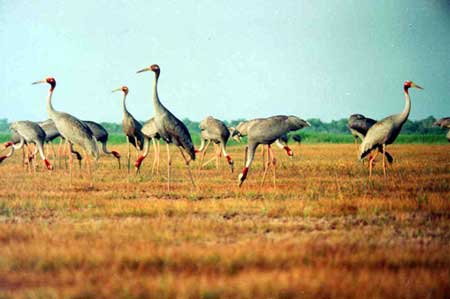
VietNamNet Bridge – The decline of the Sarus crane, the tallest flying bird in the world, is causing concern for conservationists.

Sarus cranes at Dong Thap Province's Tam Nong
Natural Conservation
 Centre. A decline in the bird's
 population has conservationists concerned about its survival.
Less than 2,000 members of the Indochinese subspecies are left in Cambodia, extreme southern Laos, Myanmar and southern Viet Nam.

Every November, the birds migrate to Tram Chim National Park in the Cuu Long (Mekong) Delta's Dong Thap Province. In 1998, about 1,100 Sarus cranes arrived in the national park.

But in recent years, that number has dwindled to approximately 200, said Nguyen Van Hung, director of the national park.

Rare Bird Spotted in Odisha for First Time

By Hemant Kumar Rout - BALASORE

Published: 18th January 2014 11:09 AM

For the first time in the State, rare species of migratory waterfowl has been spotted in Balasore district during a census by the Forest department that concluded on Friday. The rare bird, Common Merganser, was sighted at Laxmipada Chada on Subarnarekha river mouth.

Common Merganser is a migratory bird of duck family having a size of around 58 cm to 72 cm and weight of 1 kg to 2.1 kg. Normally, male birds are slightly larger than females. Like other species in the genus Mergus, it has a crest of longer head feathers, but these usually lie smoothly rounded behind the head, not normally forming an erect crest.

As many as 27 Common Merganger birds in a group were detected on Subarnarekha river mouth on Thursday. The birds which were found here were of 66 cm long. Balasore DFO Harsha Bardhan Udgata said this migratory bird usually resides in Ladakh, Mangolia, Pakistan and Tibet.

Wednesday, 22 January 2014

This phalarope must be one of the most photographed birds in the UK this week

Hove Lagoon, West Sussex: Blown off-course by storms, this small, slender, white and grey water bird has found shelter among the blue mosaic tiles
The traffic splashes along the glistening sea front at Hove. The black rain clouds move east, and the sun rises up into the sky. Light reaches around the walls surrounding the children's paddling pool, where the grey phalarope is already feeding when I arrive. Blown off-course by recent storms, this small, slender, white and grey water bird, about the size of a starling, has found shelter among the blue mosaic tiles.


Tuesday, 1 October 2013

Twitchers flock to Bolton as four rare glossy ibis spotted near Bob's Smithy Inn

WHEN it comes to famous visitors to Bolton — few could have attracted quite as much interest as the four who descended on the town over the weekend.

Long lens cameras and binoculars were out in force in an attempt to get a close-up view of four feathered friends — but these are not of the common-or-garden variety.

The rare glossy ibis birds have made a temporary home in a farmer’s field just behind the Bob’s Smithy Inn much to the delight of local twitchers and those from further afield.

Upon hearing the news — announced on the internet — the birds had landed hundreds of birders have been seen around the spot over the weekend as they attempted to catch a glimpse of the bird or, if they are lucky, get a much-prized photograph.

Bernard Hooley is one such bird enthusiast who dragged wife, Irene, along from their Kearsley home.

Apparently either used to human attention — or perhaps unfamiliar with other species — the birds appear completely at ease with all the attention and Bernard, along with his fellow watchers, has managed to get within six feet of them.

Friday, 13 September 2013

White-winged black tern at Attenborough Nature Reserve

A rare bird usually found in Central Asia and Africa has been discovered at a nature reserve in Nottinghamshire.

The white-winged black tern has attracted more than 800 birdwatchers to Attenborough since it was first spotted on Thursday.

Experts said the bird could have been blown off its migration course as it would normally spend winter in the southern hemisphere.

Centre manager Tim Sexton said the bird's visit had been amazing.

'Swallow-like'
White-winged black terns' scientific name is Chlidonias Leucopterus which means swallow-like with bright white wings

The birds have a white rump, pale grey upper wings and a broad white collar
They are known as marsh terns and have shorter tails than sea terns like the common and little species

Mr Sexton said: "It first appeared on Thursday but news didn't get to us until late so it was too dark to go out looking for it.

"An anxious night followed and at first light on Friday I arrived at the reserve and within minutes, had relocated the white-winged black tern.

"It's so rare in the UK because it breeds in the far east of Europe, Central Asia and East Africa.

"It over-winters in southern Africa, South Asia and as far away as Australia."

Wednesday, 11 September 2013

Wilson's phalarope: the rare bird creating whirl in Belfast

BY LINDA STEWART – 29 AUGUST 2013
Scores of wildlife fans have flocked to the RSPB's Belfast Harbour Reserve to capture a "once in a generation" sighting of a rare bird.

The juvenile Wilson's phalarope showed up yesterday morning, feeding on invertebrates among the other waders on the mudflats.

The rare migrant breeds and winters on the other side of the Atlantic and has only appeared in Northern Ireland a handful of times. And thanks to the power of social media, word soon spread.

"Within half-an-hour of the first text going out, it was on the internet," warden Chris Sturgeon said.

"There was one man who was down there for four hours trying to get a photo of it.

"We've had over 40 people here to see it so far – for us, on a Wednesday, that is pretty good. There are a lot of people out there who haven't heard about it, so I am expecting a lot of interest tomorrow."

The phalarope is a common wetland breeding bird on the other side of south west Canada and the north west United States and migrates to inland salt lakes near the Andes in South America to over-winter.

That's why it is so rare to see one here – although, amazingly, one did show up at Belfast Harbour Reserve two years ago and stayed for a month.

Sunday, 25 August 2013

Rare Peregrine falcon recovering after being shot in wing

Police are investigating after a rare peregrine falcon was shot in Keynsham.

The falcon, which is just a few months old, was found at the side of the road by a passer-by in Queen Charlton earlier this month.

He alerted the Independent Bird Register and it is now recovering in a specially constructed mews at the smallholding of Peter Burden who has been rehabilitating birds of prey for 40 years.

Initially Mr Burden thought the bird had been hit by a car but an X-ray revealed lead pellets in its wing.

Mr Burden, who also breeds chickens, ducks, sheep and rheas, at his home in Portishead said: “I have cared for many birds over the years but this is the first time I have known a peregrine falcon to be shot.

“The falcon suffered soft tissue damage which means it cannot fly. It is making good progress and I am taking it back to the vet next week.”

Mr Burden, 60, who is also chairman of Portishead Town Council, also reported the incident to Bristol Ornithological Club,

Club chairman Ed Drewitt had ringed the bird when it was a chick near Avonmouth on the Severn Estuary early in July and said: “This bird is just a few months old and it’s hard to believe it’s been shot.

“I’ve been studying peregrines in Bristol for 15 years and this is the first instance of one being shot in the city. It is unacceptable behaviour, and a relief the bird is still alive.

“In areas such as northern England we do encounter problems of this kind, with game hunters targeting the birds.

“Whoever shot the bird was a bad shot and fortunately the pellet went into its wing, rather than into the main body.”

He hopes the bird will make a full recovery and will be able to be released into the wild.

Peregrine falcons are a protected species and the incident has been reported to the police and the Royal Society for the Protection of Birds.

A police spokesman said: “We are investigating the incident which is an offence under the Wildlife and Countryside Act 1982,

“Anyone with information should contact Keynsham Police Station on 101.”


Sunday, 4 August 2013

Ilocos Norte to impose conservation plan on rare bird

LAOAG CITY, July 30 (PIA) -- Ilocos Norte officials are set to enforce a conservation plan for a rare bird which was spotted in two coastal villages recently. 

The rare birds, identified as spotted imperial pigeons (Ducula carola), were sighted in the villages of Davila and Dilavo in Pasuquin town by local birders. 

Governor Imee Marcos, who was alerted of the sighting, said the presence of the rare birds will help boost the province’s tourism industry. 

The provincial government has started working on a conservation plan which includes securing the birds’ congregation sites and producing instruction manuals for the public’s use. 

The plan encourages residents to avoid trapping birds and help authorities protect the birds’ natural habitat. 

Meanwhile, Dr. Petrus Calope, a bird enthusiast and conservation advocate in Ilocos Norte, said that the bird is endemic to the country but is categorized as ‘vulnerable’ in the International Union for Conservation of Nature’s Red List of Threatened Species. 


Friday, 2 August 2013

RARE BIRD OF PREY NESTS IN COUNTY FOR FIRST TIME

THE sight of wrens, voles and lizards impaled on a barbed wire fence has delighted South Tyne naturalists.

For the gory spectacle indicated that one of Europe’s most unusual birds of prey was nesting in the area for the first time.

The barbed wire gibbet was the work of the red-backed shrike, known as the butcher bird through its habit of hanging its dead prey on thorns or other spiky protuberances.

A male bird – slightly smaller than a blackbird – was seen displaying in the Coanwood area in mid-June.

It found a mate, and the pair produced four offspring which left the nest earlier this month.

Parents and fledglings can still be seen hunting in the area.

Although red backed shrikes have been known to breed in Southern England for some time, it is believed to be the first time they have nested in Northumberland.

It follows the successful nesting of a great grey shrike on Alston Moor four years ago.

Local naturalist Colin Simms said: “Red backed shrikes used to breed in Carlisle and Kendal many years ago, but I firmly believe this is the first time they have bred in Northumberland in modern times.