As regular CFZ-watchers will know, for some time Corinna has been doing a column for Animals & Men and a regular segment on On The Track... particularly about out-of-place birds and rare vagrants. There seem to be more and more bird stories from all over the world hitting the news these days so, to make room for them all - and to give them all equal and worthy coverage - she has set up this new blog to cover all things feathery and Fortean.
Showing posts with label nightingale. Show all posts

Wednesday, 1 May 2019

Bird lovers flock to Berkeley Square as nightingales return


Artists and musicians swoop to save one of UK’s most celebrated but endangered birds
Mon 29 Apr 2019 07.00 BST
Just as Vera Lynn sang, the voices of nightingales are again being heard in Berkeley Square in central London over the hum of traffic and din of construction work.
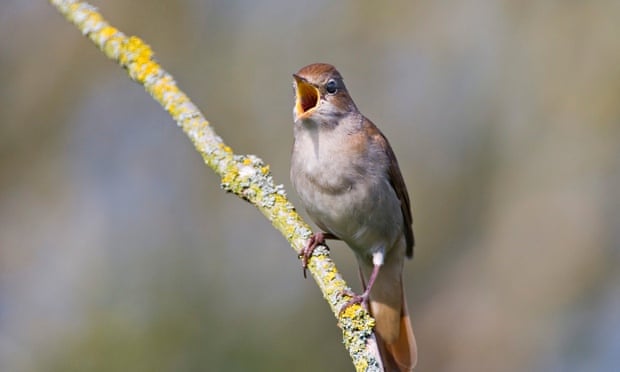
The nightingale has virtually disappeared from Britain over the past 50 years, its population plummeting by 93% to fewer than 5,500 pairs. But now a chorus of nightingale events are being arranged by artists, musicians and filmmakers to raise awareness of the plight of one of the country’s most celebrated but endangered birds.
Birdsong was played on phones on Friday as the street artist ATM spent the day painting a nightingale in a gallery on the square, and more than 750 people attended a concert on Monday, when the folk singer Sam Lee and other musicians will duet with amplified nightingale song.
Let Nature Sing, a track of pure birdsong including the nightingale, has been released by the RSPB to highlight the loss of more than 40 million birds from the UK in 50 years.
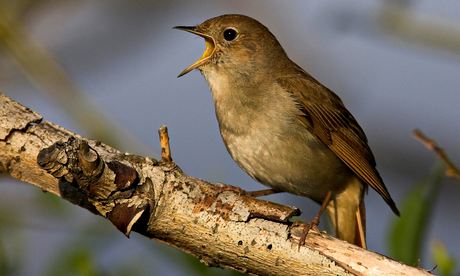
The modest-looking nightingale’s remarkable, mostly nocturnal song has inspired writers ever since it was described by Pliny the Elder several thousand years ago. Romantic poets from John Keats to Samuel Taylor Coleridge feted this unobtrusive brown bird’s astonishing musicality.

Wednesday, 26 December 2018

Kent nightingale habitat gets a welcome reprieve

Developers scale back housing building plans at Britain's best site for nightingales.


December 22, 2018 at 8:30 am


The threat to important habitat for the UK’s dwindling population of nightingales has receded somewhat with the decision by Homes England to scale back its plans for the Lodge Hill site in Kent from 2,000 houses to 500.

Aside from reducing the numbers of houses, Homes England also said that it is now only intends building outside the boundary of the protected area.

The long-running effort to save Lodge Hill, Britain’s best site for nightingales and a Site of Special Scientific Interest (SSSI) has been going on since 2014, when it was announced that 5,000 houses were to be built.

Three rounds of public campaigning took place in 2014, 2017 and 2018, led by the RSPB and Kent Wildlife Trust in partnership with several other organisations.

Lodge Hill holds up to 85 singing nightingales, out of a national population of only 5,500 in a 2012 British Trust for Ornithology survey.

Wednesday, 4 October 2017

Chattenden 'nightingale-threat' plan for 5,000 homes pulled


6 September 2017
Plans to build more than 5,000 homes on a site that is home to the rare nightingale have been withdrawn.
Proposals for the Site of Special Scientific Interest (SSSI) at Lodge Hill, Chattenden, included housing, schools, a healthcare centre and shops.
The scheme on the former Ministry of Defence (MOD) site was opposed by many residents, Natural England, the RSPB and the Wildlife Trust.
The leader of Medway Council said he was "appalled" by the decision.
The RSPB said the site was "the most important site in the country for nightingales" and development would threaten dozens of pairs of nightingales which nest on the land.
The Defence Infrastructure Organisation and the Homes and Communities Agency (HCA) have withdrawn their planning application and intend to submit revised proposals for the site.
The HCA said it was committed to going ahead with a development at Lodge Hill with a new planning application expected to be submitted in 2018.

Read more 

Wednesday, 18 February 2015

Public opinion forces UK government to hold enquiry over Nightingale site development

One of England's best Nightingale sites is under threat

The Government has heeded pleas from more than 12,400 people concerned about the future of England’s finest Nightingale site - Lodge Hill in Kent.

It has called in for a public inquiry on an application to build 5,000 homes on Lodge Hill, a Site of Special Scientific Interest in Kent.

Martin Harper, Conservation Director of the RSPB, which led a campaign in support of the site, says: “There has been public outrage and condemnation that a site of national importance for wildlife has been considered for development without public scrutiny.

“We are delighted that the Government has listened to these concerns, and has reached the only logical conclusion.”

Call in means that this case will be examined at the highest level where the full merits and values of the site and associated issues can be aired.

Tuesday, 30 December 2014

A nightingale sings – but not for much longer if housebuilding drive wipes out its haven

Campaigners fear disaster for the endangered songbirds if a plan to build 5,000 homes on a breeding site in Kent is given green light

Robin McKie, science editor

Sunday 28 December 2014 00.05 GMT

It is revered for the beauty of its song and is a beloved adornment to the British countryside. But the nightingale – hailed by Keats as a “light-winged Dryad of the trees” – is now in trouble, having suffered a catastrophic drop in numbers in recent years.

Even worse, say ornithologists, the best site in Britain for protecting the songbird – at Lodge Hill in Medway, Kent – is under threat of destruction. Its loss, they say, could deal an irreparable blow to the nightingale in this country. It could also open the floodgates to commercial exploitation of hundreds of other protected environmental sites across the country.

“Lodge Hill is the only Site of Special Scientific Interest (SSSI) in the UK that is specifically set up to protect nightingales,” said Sarah Lee, of the RSPB. “It is the most important site for the birds in the UK. Yet the local council want to build 5,000 homes there. It would absolutely destroy the site and the birds’ homes – and send a very worrying signal about the prospects of protecting other critically important sites in the UK.”

Saturday, 6 September 2014

Hoo peninsula development 'will destroy key nightingale site'

6 September 2014 Last updated at 02:54

Plans to build up to 5,000 homes on a site that is said to be key to the UK's nightingale population have been condemned by environmental campaigners.

The Wildlife Trust said the move could cause "environmental destruction on a scale not seen for more than 20 years".

It comes after Medway Council approved the proposal for Kent's Chattenden Woods and Lodge Hill on Thursday.

Developers Land Securities say the area's 84 pairs of nightingales would be re-homed nearby.

The council estimates that the development, a former Ministry of Defence training camp, would bring almost 5,000 jobs to the area and says that affordable housing would account for one in four of the new homes.

Its plans also include three new primary schools, a secondary school and new health and leisure facilities.

Monday, 19 May 2014

Nightingales broadcast on BBC again after 90-year interlude

Posted on: 18 May 2014


Ninety years to the day since the first outside broadcast of Nightingale song on the BBC, the RSPB has decided to do it again to celebrate the anniversary of the historical transmission.

The programme will also mark the plight of the threatened, long-distance migrant bird. Live from a site in north Kent, adjacent to threatened Lodge Hill – England’s most important site for the species – a team of technical experts from the RSPB will record the bird’s famous song and stream it in real time from its website this Sunday night (18 May).

Dr Andre Farrar, the RSPB’s media manager and a Nightingale enthusiast, will be taking part the recording. He said: “Nightingales have sung their way into the consciousness of our country, popping up in literature and popular culture. Yet they are in trouble, and if their decline is to be halted action needs to be taken.

Thursday, 8 May 2014

Nightingale has best birdsong because of its complex brain, research finds

Secretive bird produces more notes than other species, according to study that sheds light on human language


theguardian.com, Sunday 4 May 2014 15.26 BST

No wonder they celebrated it in a song. The common nightingale is top of the feathered crooners, according to research highlighted on International Dawn Chorus Day that suggests the bird's impressive vocal range is down to the composition of its brain.

The secretive bird, immortalised in the romantic 30s song A Nightingale Sang in Berkeley Square, produces far more notes in its birdsong than other species, according to research carried out at the University of Bath and Cornell University.

The researchers studied three males from 49 different common species of songbirds from the US, Europe and South Africa, and compared the size and shape of their brains with the length and complexity of their songs. It was found that birds with larger "higher" brain areas in relation to "lower" brain areas were able to learn dozens of different notes. Higher brain areas control more cognitive and learning functions, while lower brain areas control more motor functions.


Friday, 22 November 2013

Nightingale site gains protection

November 2013: The future of the nightingale, one of Britain’s rarest birds, looks brighter with the good news that Lodge Hill in Medway, north Kent has been declared a Site of Special Scientific Interest (SSSI) by Natural England

This site is home to more than one percent of the UK’s total population of nightingales, a bird which has declined in the UK by 46 per cent since 1995. Lodge Hill – part of which is a former military engineering school – has also been protected for its nationally-important grassland and ancient woodland.