As regular CFZ-watchers will know, for some time Corinna has been doing a column for Animals & Men and a regular segment on On The Track... particularly about out-of-place birds and rare vagrants. There seem to be more and more bird stories from all over the world hitting the news these days so, to make room for them all - and to give them all equal and worthy coverage - she has set up this new blog to cover all things feathery and Fortean.
Showing posts with label migratory birds. Show all posts

Monday, 16 September 2019

Conservation of a Central American region is critical for migrating birds

Date: September 12, 2019
Source: Oxford University Press USA

Many of North America's migratory birds are declining, but the mysteries about when and how birds migrate must to be solved to effectively protect them. A new paper in The Auk: Ornithological Advances, published by Oxford University Press, identifies a previously overlooked area that is critical for conservation: the region between southern Mexico and Guatemala where songbirds fuel up for a grueling flight across the Gulf of Mexico.

Migration is a dangerous time for birds, especially during flights over large bodies of water. Many birds migrate directly across the Gulf of Mexico, requiring over 600 miles of sustained flight. The details of how the survivors manage this feat of endurance have been murky, especially for species like warblers, whose small size prevented researchers from tracking their full migration routes until recently.

Researchers used light-weight geolocators to identify migration strategies for the vulnerable and declining Golden-winged Warbler, finding 80% of individuals spent a week in southern Mexico and Guatemala to feed and build up reserves for the flight over the Gulf of Mexico in spring migration. The importance of this stopover region was previously unknown for this species, and it needs conservation given the rapid conversion of natural habitats to pasture and farmland.

While most Golden-winged Warblers stopped in this region, not all did. Some that overwintered in northern Central America were able to make the trans-Gulf flight directly from their overwintering grounds without the stopover. "This is an important finding," says Dr. Ruth Bennett of the Smithsonian Migratory Bird Center, "because birds that migrated directly across the Gulf were able to shave a week off their total migration time. These birds may experience a selective advantage in the spring." That is because male Golden-winged Warblers race north in spring migration to establish breeding territories. Results from the study suggest the spring period requires more energy and poses a greater risk of predation and starvation, while fall migration allows for more flexibility to minimize energy costs and avoid risks.

Wednesday, 7 August 2019

More than 10 years conserving natural grasslands

By Emilia Ulloa


In the southern cone of South America lies a beautiful and unique stretch of lowlands, covered in rolling prairie grasses and rich in wildlife. These are the Pampas. Named for the Quechua word ‘pampa’ which loosely translates to ‘plains’ the pampas cover an area close to a million kilometers, extending across parts of Argentina, Uruguay, Paraguay and Brazil. 

This region serves as a habitat to around 600 native birds, and is a stopover point for thousands more migratory birds which traverse the territory along journeys that can be up to 15 thousand kilometers long. The plant-life in the area provides crucial sustenance and refuge to these migrating birds, while also serving as vital breeding areas for endemic birds such as the Saffron-cowled blackbird (Xanthopsar flavus) and the Black-and-White Monjita (Xolmis dominicanus). In addition to supporting an incredible amount of wildlife, the pampas also provides sustenance to thousands of people who live in the region. 

Despite this, the area is in danger of disappearing completely, along with all the unique wildlife it supports. The principle threats to the pampas are the intensifications of agriculture, ranching, and urban development. In fact, 95% of the pampas are private property, and are being used for the cultivation, primarily of soya, corn and wheat. These monocultures in turn leach the soil of its nutrients and leave it open to the risk of erosion.


Sunday, 21 April 2019

How birders helped pinpoint hotspots for migratory bird conservation


APRIL 15, 2019
by Richard Schuster, Amanda D. Rodewald, Joseph Bennett, Peter Arcese And Scott Wilson, The Conversation
Many bird populations are crashing, largely because they migrate such long distances and are at risk from human influence at every link in their migratory chain.
One favourite, the tiny Canada warbler, is among those that find themselves in trouble. Although this bird weighs only as much as a AAA battery, each spring it flies more than 5,500 kilometres from its winter home in South America to breed in Canada, stopping in Mexico, Texas and Michigan along the way. The Canada warbler makes this incredible journey as many as eight times over the course of its life.
Unfortunately, like many North American songbirds, the Canada warbler is at risk of extinction. Deforestation and human development projects are of the utmost concern to Canada warblers and other birds. More than one-third of North America's 1,154 bird species are suffering population declines.

Sunday, 3 March 2019

UAE could be a hotspot for bird lovers


A new Arabic app aims to celebrate the diversity of migratory birds in the Middle East
Published:  February 13, 2019 15:44By Ashley Hammond Chief Reporter
According to BirdLife International, every autumn over two billion birds channel through the Middle East from Europe and Central Asia on their way down to Africa, before migrating back again in spring.
A quarter of that number, however, are shot or trapped by hunters in the region every year, and up until recently few efforts were being made to protect them.
Now, however, a new app — the world’s first to be launched in Arabic — by conservation charity, the Ornithological Society of the Middle East, Caucasus and Central Asia (OSME), looks to change attitudes towards wildlife in the region.
Based on the book Birds of the Middle East, which was also translated into Arabic and launched at the Emirates Airline Festival of Literature in Dubai in 2017, the free to download app looks to take the fight for conservation to a wider and ever younger, tech-savvy, audience.
“Hunting is one of the big concerns so we hope to try and get people — the next generation or the generation after that — to appreciate birds for their natural beauty and incredible behaviour, rather than just being merely seen as something to be shot,” OSME chairman Rob Sheldon told the Weekend Review.

Sunday, 13 January 2019

Migratory birds make a comeback to the city


Bishwabijoy Mitra | TNN | Jan 5, 2019, 03:00 IST
This winter, Kolkata is once again waking up to the chirping of migratory birds who gave their annual visit to the city a miss for a few years before making a comeback this season. If birdwatchers are to be believed, this winter is special for two reasons — not only are several rare birds being spotted after a long gap, the overall spotting has also gone up.
Veteran birder Shubhankar Patra, who spotted a flock of 50 black-headed ibis in Rajarhat last month, said, “It was a very unusual and beautiful sight. For many years, it was difficult to spot even one black-headed ibis. So, we were totally taken by surprise on seeing a whole flock!” Birder Mitali Saha Deb was equally ecstatic on spotting a square-tailed drongo cuckoo at the Chintamani Kar Bird Sanctuary last month.

Wednesday, 12 December 2018

How will the winds of climate change affect migratory birds?

New study finds both positive and negative impacts possible

Date: December 10, 2018
Source: Cornell University

Under future climate scenarios, changing winds may make it harder for North American birds to migrate southward in the autumn, but make it easier for them to come back north in the spring. Researchers from the Cornell Lab of Ornithology came to this conclusion using data from 143 weather radar stations to estimate the altitude, density, and direction birds took during spring and autumn migrations over several years. They also extracted wind data from 28 different climate change projections in the most recent report from the Intergovernmental Panel on Climate Change (IPCC). Their findings were published today in the journal Global Change Biology.

"We combined these data to estimate how wind assistance is expected to change during this century under global climate change," explains lead author Frank La Sorte, a Cornell Lab of Ornithology scientist. "This matters for migratory birds because they use more energy flying into headwinds. But they get a nice boost from tailwinds so they can conserve energy during flight."


Friday, 20 July 2018

Licensed hunters killing birds in droves across Rahim Yar Khan


Published: July 9, 2018

RAHIM YAR KHAN: Licensed hunters are taking advantage of the seasonal migration of birds and hunting well beyond the permitted numbers. They are preying on birds such as Talair, green parrots, Lali and wild birds, locals in villages told Express News. They blamed the mafia for the activity.

Villagers said lenient wildlife laws were allowing hunting groups to take advantage of the situation and hunt native birds in excess. After profiteering from green parrots, which have virtually disappeared over the years, hunters are killing Lali, another native bird that can be seen in the open around the region.

They maintained that the hunters extend long bird traps in the fields to catch snakes and Lali, a bird whose meat is in large demand in the food and restaurant industry. They revealed the hunters usually operate in remote areas so that they can get a large catch without being noticed.

Thursday, 3 May 2018

Feather replacement or parental care? Migratory birds desert their offspring to molt


When parental care and the annual molt overlap in time, a migratory songbird often chooses single-parent desertion

Date:  April 19, 2018
Source:  American Ornithological Society Publications Office

A new study shows that when feather replacement and parental care overlap in time, migratory songbirds make a striking trade-off; they desert their offspring, leaving their mates to provide all remaining parental care.

This radical solution to conflict between parental care and the annual molt provides "a nice illustration of the complex lives that migratory songbirds lead," says Ron Mumme, the study's author and Professor of Biology at Allegheny College in northwestern Pennsylvania. "They have to negotiate conflicting demands and make difficult trade-offs and compromises, just like we do."

Migratory songbirds that breed in North America confront serious issues with time management. After spending a relatively leisurely winter and early spring luxuriating in warm tropical climates, they migrate north for a brief but highly eventful summer in North America, during which they must complete three energetically demanding and time-consuming tasks: (1) they must build nests, lay eggs, and provide for their offspring until the young reach independence, (2) they must completely replace all the feathers in their plumage as part of the annual molt, and (3) they must prepare for the fall southward migration by eating prodigiously and storing the body fat that will fuel their long-distance flights.


Monday, 12 February 2018

Migratory birds eye-localized magnetoreception for navigation


February 8, 2018, University of Southern Denmark
Migratory birds use a magnetic compass in their eye for navigation. The involved sensory mechanisms have long remained elusive, but now, researchers have revealed exactly where in the eye avian navigation is situated.

Migratory birds travel long distances when they shift between breeding and wintering grounds. Observations of migrating birds were first recorded by ancient Greeks more than 3,000 years ago, and it has long been a mystery how they find their way when embarking on thousands of kilometers long journeys.

In 2000, researchers suggested that a protein in birds' eyes helps them take information from light and process it to a travel course—an inner magnetic compass. Since then, the basic sensory mechanisms underlying this magnetoreception have remained elusive. In order to solve the riddle, a research group at University of Southern Denmark collaborated with colleagues from the University in Oldenburg, Germany.

The team conducted a series of studies and simulations that reveal the detailed position and nature of the inner compass. They studied the navigational sensory mode of European robins (Erithacus rubecula) via computer microscopy of birds' eyes. "We believe that we have strong evidence to pinpoint the right magnetoreceptor molecule in migratory birds," said Ilia Solov'yov, associate professor at the University of Southern Denmark.


Thursday, 8 February 2018

It’s official: over 91,000 migratory birds visited Khijadiya this winter


TNN | Jan 25, 2018, 04:00 IST

Rajkot: The count of migratory birds done by forest department in Khijadiya Bird Sanctuary, about 10km from Jamnagar city, has revealed that 91,261 birds of 193 species visited the sanctuary in this season. The count was done on January 20 and January 21.

During the previous count, in 2012, the bird count was around 40,000, while in last year's census only 27,400 birds of 262 species were found at Khijadiya Bird Sanctuary. However, forest officials said that the 2017 bird count was not done scientifically. Hence, the count was done this year again. According to an official release by the forest department, species like great crested grebe, black-necked stork, little grebe, rosy pelican, dalmatian pelican, large and little cormorant painted stork, flamingos, common crane, demoiselle crane, glossy eyes, etc, visited the sanctuary spread across 6 hectare between October 2017 and January 2018.


Thursday, 16 November 2017

This sanctuary in India houses some of the rarest species of migratory birds in winter


The Keetham Bird Sanctuary is the abode of hundreds of wild animals and birds throughout the year.

November 13, 2017 | UPDATED 18:56 IST

The Keetham Bird Sanctuary is one of the very few places left in North India, where the endangered Siberian Cranes come regularly to nest every year.

Spread in 2.25 sq km, the Keetham lake and its surrounding 7.97 sq km sanctuary area is the abode of hundreds of wild animals and birds throughout the year, but the months of October to February are special, as this is the time when migratory birds from far north come to spend the winters at this lake.

However, this year, the prospects of these birds arriving to the lake anytime soon appear bleak, with the weather in Agra still quite warm and the high pollution levels with increased construction activity around the sanctuary also acting as deterrents for the migratory birds. Midway into November, the lake still awaits the arrival of its annual guests and bird-watchers arriving here to see these rare birds, are getting disappointed.


Rare migratory bird spotted in Hadoti, third sighting in 3 decades


Sun,12 Nov 2017


Summary: The black-naped monarch, a migratory bird, rarely seen in Rajasthan, has been spotted for the first time in the Hadoti region, the third such sighting in the last three decades in the state, wildlife experts said. 

The Black-naped monarch is usually found across south-east China, Taiwan, the Phillipines, India and Sri Lanka, he said. The bird also known as the black-naped flycatcher, usually lives on trees and thick foliage but in the Abhera forest, it has been spotted in a scrubland, said Meena. “Previous records reveal that occasionally a single bird has been sighted in the Keoladeo National Park in Bharatpur during winter in1993-94. The bird was spotted by wildlife researcher and a programme coordinator at the Society of Conservation of Historical and Ecological Resources Hari Mohan Meena and Dr Krishnendra Singh Nama, a senior wildlife biologist at the society.


Tuesday, 13 September 2016

Devotion to rearing chicks can come at a cost for migratory birds

Date: August 30, 2016

Birds that have to work harder during breeding season will feel the effects of their exertions the following year, according to research by Oxford University scientists.

A new study published in the Journal of Animal Ecology found that migratory seabirds suffered negative repercussions when they had to spend more time rearing chicks, including decreased breeding success when they returned to the colony the following spring.

The study artificially altered the length of the chick-rearing period for pairs of Manx shearwaters, giving new insights into the consequences for birds whose reproductive phase doesn't go to plan. All parent pairs involved in the study cared for their foster chicks until they were fully reared -- often at their own expense.

Lead author Dr Annette Fayet, of the Oxford Navigation Group in the University of Oxford's Department of Zoology, said: 'The results of this study provide evidence for carry-over effects on the subsequent migratory, wintering and breeding behaviour of birds.'

Carry-over effects are the processes by which events in one breeding season may affect the outcome of the subsequent season. But the exact nature of these effects, as well as whether they affect other events in birds' annual cycles, such as migration and wintering, has been unclear.

Dr Fayet said: 'Birds that had their chick-rearing period extended in our study delayed the start of their autumn migration and spent less time at the wintering grounds, and while they were there they spent less time resting. When they returned to the colony the following spring, they started breeding later, laid smaller eggs, reared lighter chicks -- early, heavy chicks survive better -- and overall had a lower breeding success.

'This suggests that the birds were in poorer condition after working harder during the experimental breeding season and shows the negative effects on both non-breeding and breeding behaviour in the year following the experiment.'


Sunday, 3 April 2016

Judge: Sanctioned slaughter of fish-eating birds broke law

Posted: Mar 30, 2016 7:20 PM GDTUpdated: Mar 30, 2016 10:11 PM GDT
By JANET McCONNAUGHEY
Associated Press

The U.S. Fish and Wildlife Service acted improperly when it allowed tens of thousands of migratory aquatic birds to be shot each year to protect farmed and sport fish populations, a federal judge has ruled.

The agency said it lacked resources for a "hard look" at either the long-range environmental effects of or possible alternatives to its decisions about double-crested cormorants, and that just isn't a good reason, U.S. District Judge John D. Bates wrote.

Letting that stand could gut the National Environmental Protection Act, "since many an agency would frequently so argue," wrote Bates, a federal judge in Washington.

He ruled Tuesday on a pair of orders that opponents say let people kill up to 160,000 double-crested cormorants each year to protect sport fish in 24 states east of the Mississippi River and farmed fish in 13 of those states.

"The Service is reviewing and studying the decision," Fish and Wildlife spokeswoman Laury Parramore said in an email Wednesday.

The advocacy group Public Employees for Environmental Responsibility sued the government to stop the practice, which is known as "lethal removal."

Fish and Wildlife has allowed fish farmers to kill cormorants that were eating or about to eat fish in their ponds since 1998. Five years later, it said Indian tribes and state and federal wildlife agents could kill those eating or about to eat "public resources of fish." Those orders have been renewed every five years.

Read on ...

Thursday, 24 March 2016

Migratory birds disperse seeds long distances

Date:March 22, 2016
Source:Plataforma SINC

Some species of plants are capable of colonising new habitats thanks to birds that transport their seeds in their plumage or digestive tract. Until recently it was known that birds could do this over short distances, but a new study shows that they are also capable of dispersing them over more than 300 kilometres. For researchers, this function could be key in the face of climate change, allowing the survival of many species.

Birds can act as dispersers of seeds and other propagules -buds, bulbs, tubers or spores- over short distances which, in many cases, do not exceed a kilometre and a half. However, it had not been demonstrated whether or not they were capable of doing so over longer distances.

A team led by scientists at the Doñana Biological Station-CSIC (Spanish Council for Scientific Research) in Seville (Spain) confirmed this hypothesis due to the seeds found in the digestive tract of various species of birds hunted in the Canaries by Eleonora's falcons (Falco eleonorae) during their migration towards Africa.

"This mechanism of long-distance dispersion had not been confirmed until now, mainly due to the difficulty involved in sampling propagules transported by birds during their migratory flight. We were able to analyse it thanks to the hunting behaviour of Eleonora's falcons," Duarte Viana, researcher in the Doñana Biological Station and co-author of the study, explained.

Sunday, 21 February 2016

How Migratory Birds Could Save the Paris Agreement From the Supreme Court

The death of Antonin Scalia may have spared the historic agreement from a premature demise, but its constitutional underpinnings are still in jeopardy.


FEB 15, 2016

In December, nearly every country on the planet came together in Paris for a historic deal to cut carbon emissions and beat back the rising tide of climate change. Now, the Supreme Court threatens to tear it all down.

Last week, the Supreme Court barred the Obama administration from implementing any part of its Clean Power Plan, the core of the United States' carbon emissions pledge that was the centerpiece of the Paris Agreement, until lower courts can determine whether the Environmental Protection Agency actually has the legal authority to follow through on the administration's commitment in Paris. In their plea to the Court for a temporary hold, nearly 30 states argued that the slate of regulations in the administration's carbon emissions plan would be an unconstitutional abrogation of state sovereignty; the "EPA would no longer be an environmental regulator but rather the nation's central planning authority," as NBC News reports. The stay, issued by the court, indicated that a majority of justices would likely strike down Obama's plan.

But with the death of Supreme Court Justice Antonin Scalia on Saturday, the Clean Power Plan has been spared its doomed fate. As Jonathan Chait notes, Scalia's absence reduces the court to a veritable four-to-four split, meaning the conflict over the Paris Agreement's implementation at home will be decided by a Democrat-heavy D.C. Circuit panel, which will likely uphold the new EPA regulations without the risk of the court striking it down. "Modern conservative legal doctrine has moved toward a form of aggressive judicial activism, devising—or, more precisely, resurrecting—theories that allow the Court to strike down vast swaths of laws conservatives find objectionable," Chait writes. "Activist Courts require a majority. That is now gone."


Tuesday, 2 June 2015

Arctic ducks combine nutrients from wintering, breeding grounds to grow healthy eggs


Date:
May 20, 2015
Source:
Central Ornithology Publication Office
Summary:
It takes a lot of nutrients to build an egg. One of the big questions among researchers who study the eggs of migratory birds is where those nutrients come from -- does the mother make the egg directly out of what she eats during the breeding season, or does she save up nutrients consumed on her wintering grounds? The answer appears to be both for Common Eiders, large, sea-going ducks that breed in the Arctic.
Continued ...

Wednesday, 27 May 2015

Federal Program Allows Killing of Half a Million Protected Migratory Birds a Year

Wednesday, May 27, 2015

Being a bird of “conservation concern” or even the oldest bird species on the continent is not enough to avoid being slaughtered under a little-known federal program that authorizes the killing of half a million birds a year.

The Center for Investigative Reporting’s Reveal looked into the U.S. Fish and Wildlife Service’s “depredation permit” program, which allows businesses, farmers and others to kill members of more than 300 species of migratory birds each year. The body count during a recent three-year period totaled 1.6 million birds, or just over 500,000 a year.

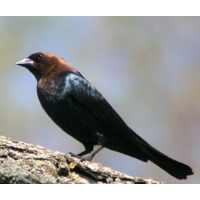
Brown-headed cowbird (photo: Wikipedia)
Two-thirds of all the birds killed were brown-headed cowbirds, red-winged blackbirds, common grackles and Canada geese. The rest of those killed included upland sandpipers, barn owls, wood ducks, lesser yellowlegs, snowy owls, roseate spoonbills, curlew sandpipers, red-throated loons, great blue herons, white and brown pelicans, cedar waxwings, robins, belted kingfishers, mourning doves, red-tailed hawks, American kestrels, turkey vultures, mallard ducks and sandhill cranes, North America’s oldest bird species.

Some of the birds “are struggling to cope with habitat loss, climate change and other threats and are classified by the government as ‘birds of conservation concern,’” according to Reveal’s Rachael Bale and Tom Knudson. “These include upland sandpipers, lesser yellowlegs, roseate spoonbills and red-throated loons, who, because of declining populations, could be on their way to the endangered species list.”

Saturday, 14 March 2015

Taitung bird habitat damaged by heavy machinery: birdwatcher

CNA 
2015-03-14 

The Jihben Wetlands in Southeastern Taiwan's Taitung, a major habitat for endangered migratory birds, has been severely damaged by excavation equipment, experienced birdwatcher Peng Ching-chien told CNA on Wednesday.

Migratory birds have deserted the area, while fish and shrimp have died in the wetlands as parts of it were drained by what appeared to be heavy machinery, Peng said, adding that he noticed the destruction during a visit to the wetlands on Feb. 22.

Earthen embankments between the wetlands and the sea have been leveled, causing drainage of some areas, said Peng, who has been engaged in birdwatching as hobby for more than 20 years.

Other birdwatchers also said that they found tracks apparently left by excavators and jeeps across the wetlands, which are recognized by BirdLife International as a vital bird habitat.

Saturday, 7 March 2015

Panama bird paradise saved from destruction

Panama Audubon Society (BirdLife in Panama) is celebrating after winning a hard-fought effort to reverse the Panama government’s 2012 decision to withdraw protected status for the Bay of Panama Important Bird and Biodiversity Area (IBA), a site of international importance for migratory birds Birdlife International have reported.

Its protected status had been pulled because of short-term economic pressure for urban and resort development, including hotels and golf courses. At the same time, regulations on mangrove cutting had also been relaxed.

The legislative bill to reinstate full protection of the Bay of Panama was signed by Panamanian President Juan Carlos Varela on February 2th 2015, World Wetlands Day. The new bill also includes recognition by law that the protected area is part of the Western Hemisphere Shorebird Reserve Network.

“Many of the people that helped us in so many ways were at the signing ceremony”, said Panama Audubon Society’s Rosabel Miró in her correspondence. “Among those fighting shoulder to shoulder with us were NGO’s, community associations, business associations, politicians, allies from government institutions - they were celebrating, hugging us and smiling with us.”

Under the new Panama government, spearheaded by President Juan Carlos Varela, the outlook for the site appears positive. “The protected area, the Bay of Panama wetlands, not only belongs to our country, but belongs to the world, so we must show that we are able to maintain it, so we can enjoy its natural wealth and future generations continue to receive its many benefits”, commented government representative Emilio Sempris, part of Panama’s National Environmental Authority (ANAM).