As regular CFZ-watchers will know, for some time Corinna has been doing a column for Animals & Men and a regular segment on On The Track... particularly about out-of-place birds and rare vagrants. There seem to be more and more bird stories from all over the world hitting the news these days so, to make room for them all - and to give them all equal and worthy coverage - she has set up this new blog to cover all things feathery and Fortean.
Showing posts with label relocation. Show all posts

Wednesday, 28 August 2019

Saving sage-grouse by relocation


Date: August 26, 2019
Source: Washington State University

Moving can be tough, but eventually most of us acclimate to new surroundings.

That's true for humans, and research from Washington State University shows it's the same for sage-grouse too.

A team of scientists successfully moved sage-grouse, a threatened bird species in Washington state, from one area of their range to another to increase their numbers and diversify their gene pool. A WSU study on the project in The Journal of Wildlife Management shows relocating the birds is a viable and productive step towards helping their population recover in the state.

"In the first year after moving sage-grouse in, they tended to move around a lot and didn't reproduce as effectively as the native population," said Kyle Ebenhoch, a researcher now working at the U.S. Geological Survey (USGS). "It took them about a year to settle in and get used to their new surroundings."

Ebenhoch, a WSU graduate student during this project, wrote the paper with WSU School of the Environment professors Daniel Thornton, Lisa Shipley, and Jeffrey Manning. Kevin White, a contract wildlife biologist with the Yakima Training Center at Joint Base Lewis-McChord, was also a member of the research team. The training center hosts a population of sage-grouse where the relocation work was done.

An adjustment period

Ebenhoch wanted to investigate how newly introduced sage-grouse would survive and reproduce in order to determine if relocating birds to the area could be a workable way of keeping the species from further decline in Washington.

It turns out, the birds can adjust, though the training center population continued to decline.

"The birds did adjust to their new surroundings, but it didn't stabilize the population," Ebenhoch said. "This can be one tool in our toolbox for helping, but we'll need more research to find other tools as well."

Friday, 15 March 2019

Crucial milestone for critically endangered bird


 Date:  March 7, 2019
Source:  University of Kent
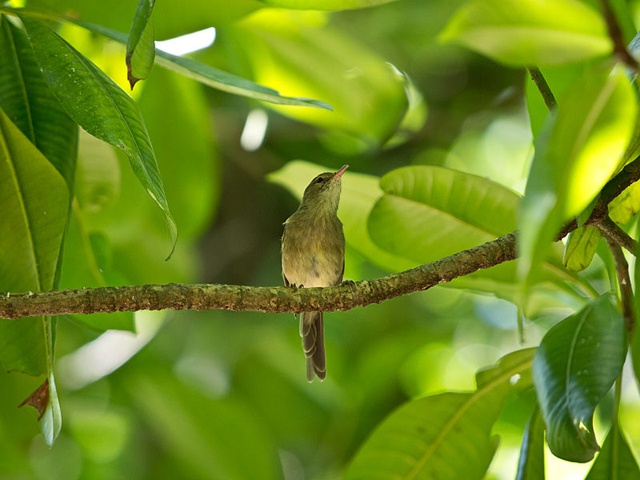
A team led by a conservation biologist from the University of Kent has successfully re-located threatened Seychelles paradise flycatchers (Terpsiphone corvina) to a different island to help prevent their extinction.
Four females and two males were caught on Denis Island and taken to Curieuse Island, where they joined 11 males and nine females who were moved there from La Digue Island at the end of last year. Four weeks after that release, the first birds had nested, with the first chick recently fledged.
The project was led by Jim Groombridge, Professor of Biodiversity Conservation and Head of Kent's School of Anthropology and Conservation (SAC). Dr Rachel Bristol, who completed her PhD at the Durrell Institute of Conservation and Ecology (DICE) in SAC managed the project in partnership with the Seychelles National Parks Authority. The project was financed by the UK Government's Darwin Initiative.
The move required the team to:
catch the birds using mist nets
delicately mark their tails so they are individually identifiable until their next moult
take blood samples
put them in transfer boxes (recycled cardboard boxes- modified to ensure air and with a branch placed inside for the birds to perch on)
transfer them by plane to Praslin, then by boat trip to Curieuse
give them rehydration and energy fluid
before releasing them from the hand
The Seychelles paradise flycatcher is currently 'Critically Endangered' on the International Union for Conservation of Nature IUCN red list of endangered species and conservationists hope that successfully establishing this additional population on Curieuse Island could mean they are down-listed to a less endangered category.


Wednesday, 2 January 2019

Aussie bird species hit by bushfires thrives after major relocation drive


SYDNEY, Dec. 8 (Xinhua) -- A small Australian bird species hit by bush fires in South Australia has surprised ecologists by quickly breeding after an unprecedented effort to relocate the birds, local media reported on Saturday.
The Mallee emu-wren is found in only two core locations in Victoria and South Australia states, but severe bush fires four years ago destroyed their southern habitat, reported the ABC news channel.
"We could never officially say they were extinct because there's so much habitat out there," local government ecologist Chris Hedger told the channel.
"But we were very confident that if there were any individuals left, it was functionally extinct and would not be able to survive in the long term."
Earlier this year, wildlife groups and authorities relocated about 80 of the birds from their Victoria habitats to a conservation park in South Australia to help boost their numbers.
A recent survey showed that the birds, known for their distinctive reddish-brown heads, sky blue chests and long tails, are thriving in their habitats with significant numbers breeding, reported the channel.
"Certainly the fact they are breeding is a good indicator of what we might expect," said Hedger.
"No one has ever moved this species, and if they have moved a similar species, it certainly wasn't in the numbers we're talking about."


Wednesday, 19 December 2018

Spanish city to relocate thousands of pigeons


09/12/2018

Authorities in Cádiz have devised plans to rehome 5,000 of the city's feral Rock Doves. Because of their associated waste the birds are deemed pests but officials didn't want to poison them, so have instead planned to capture thousands before sending them hundreds of kilometres away.

This plan has been deemed "respectful and sustainable" by city authorities and Councillor Álvaro de la Fuente told local newspaper Diario de Cádiz: "Managing the population of existing pigeons does not imply the eradication of them within the urban area." Officials from the Andalucian city claim they are seeking a 'logical balance' between humans, birds and other city-dwelling species.

Numbers of the doves have reached levels where they are now considered pests in Cádiz (Joe Wynn).

The pigeons – all 5,000 of them – will be trapped, catalogued and tested before being moved roughly 275 km away for release. The health of every bird will be checked before it is deemed fit for relocation, though what impact this will have on the environment at the as yet undisclosed release location remains uncertain. 

Once the birds have been moved, the city will print thousands of leaflets discouraging the public from feeding the remaining flocks so the population does not boom again. Similar anti-feral Rock Dove schemes have taken place in London before with a ban on seed sellers at sites such as Trafalgar Square, as well as the introduction of falconers, resulting in a reduction of dove numbers.

Friday, 16 November 2018

'Very dangerous, aggressive' magpie to be relocated


8th Nov 2018 1:00 PM | Updated: 1:33 PM
UPDATE, 2.30pm: LISMORE City Council's environmental strategies coordinator, Leonie Walsh, said she could understand people's concerns about plans to relocate an aggressive magpie.
But she said although dangerous behaviour was rare in birds, when it occurred it was important the bird was relocated.
"It's understandable people are concerned about interfering with birds and they are correct this is natural bird behaviour," she said.
"However, both Griffith University and the University of New England have done research over the years to develop ways to safely trap and relocate them; if they are relocated at least 50km away, the bird won't come back and will adapt fairly well and find a new family."
Ms Walsh said it was usually the male showing the aggressive behaviour.
"When he is removed another male will usually move straight in," she said.
"He is so pleased with the opportunity that in most cases will look after he family better than his predecessor and with less aggression."
Original story: A "VERY aggressive" magpie will be moved from Spinks Park next week after Lismore City Council received a number of complaints.
The council posted the news on its Facebook page today.
"We will be relocating a very aggressive magpie from Spinks Park next week but in the meantime please avoid this area," they wrote.
"The bird is having a go at anyone walking/cycling along the path behind the old gallery building, through the rose garden and near the kids playground.
"We are awaiting approval and will relocate the bird as soon as possible."
The post attracted a lot of comments from people who were concerned about the magpie being moved.

Wednesday, 18 April 2018

Moving rare birds to cost Enterprise Zone £500,000


4 hrs ago

Bill Jacobs  @BillJacobsLTLocal Government Reporter

DEVELOPERS of Lancashire's multi-million 'skills city' are to spend £500,000 on relocating skylarks and lapwings to a new site 35 miles away.

Finding the rare birds a new home is essential to next stage of the Enterprise Zone based at BAE Systems Samlesbury site, once condemned by government ministers as ' the worst in the country'.

In 2012 the Lancashire Enterprise Partnership, brining together councils and businesses, proposed the development aimed at boosting skills and creating 6,000 hi-tech jobs.

In 2014 government ministers Penny Mordaunt and Greg Clark told the LEP they had 'lost confidence' in the scheme, the only one of 24 in England to have attracted no new businesses or produced any new jobs.

On Thursday the Cabinet of Lancashire County Council, a key player in the LEP, will consider an update confirming leases on the land needed had been agreed with BAE Systems and authorising spending of £11.5 million on road and drainage works to prepare more of the site for occupation.


Sunday, 7 September 2014

Egg on face after bird's nest relocation goes wrong


By Shawn McAvinue
11:28 AM Friday Sep 5, 2014

Contractors were left with egg on their faces yesterday after a botched nest relocation job.

The contractors had been called in by the Dunedin City Council to remove a blackbird's nest and eggs from a Crawford St traffic light, after it was deemed a distraction for motorists.

Council contract manager Peter Hughes said Fulton Hogan was asked to relocate the nest to a nearby tree.

However, as the nest was being removed, it disintegrated and the contractor dropped the eggs, he said.

''The nest wasn't particularly well constructed and it all went west,'' Mr Hughes said.

He was unsure how many eggs were broken but said it was two or three.

When the ODT visited the site yesterday, a juvenile female blackbird was circling above the traffic lights.

Department of Conservation ranger Graeme Loh said relocating a nest was a solution for several bird species, but blackbirds were ''prone to disturbance''. A blackbird nest needed to be moved close to the original nesting location for the mother to find it.

Sunday, 10 August 2014

Back from the brink – threatened Seychelles warbler is successfully translocated to Fregate Island

Fregate Island, Seychelles | August 10, 2014, Sunday @ 11:29 - See more at:

Back from the brink – threatened Seychelles warbler is successfully translocated to Fregate Island(Seychelles News Agency) - It’s the first conservation success story of its kind in the world: the Seychelles warbler (Acrocephalus sechellensis) was one of the most threatened bird species in the world in the 1960s – down to a total population of only 26 birds, conservation experts had to move fast to avert the birds from becoming entirely extinct.
After decades of ongoing habitat rehabilitation on the last remaining island where the birds were found in the wild, the warbler’s future looks a lot brighter, thanks to efforts by local NGO Nature Seychelles, a Birdlife International partner. With the total population now in the thousands, the organisation captured 59 birds from Cousin Island and transferred them by helicopter to the private resort island of Frégate in the Seychelles in December 2011, which is now the fifth island where these birds live.

According to a new study published in Conservation Evidence this month, the birds have increased to over 80 individuals, including 42 birds hatched on Frégate, after a census was carried out on the island in June last year.

The project was funded by an $18,000 Disney Worldwide Conservation Fund grant to Nature Seychelles through the Royal Society for the Protection of Birds (BirdLife International’s UK arm), the Seychelles Warbler Research Group (a collaboration between the Universities of East Anglia and Sheffield in the UK, and the University of Groningen, Netherlands) and Frégate Island Private.

Friday, 8 November 2013

Island move gives birds better shot at survival

A hard-won battle with the weather has enabled the Department of Conservation to strengthen the population of a threatened bird species.

After weeks of waiting on the weather, DOC and the Mohua Charitable Trust were this week able to transfer 22 mohua from the Catlins to Resolution Island in Fiordland.

The birds were captured in Eastern Southland by a team of 20 catchers and flown by helicopter to Dusky Sound. The Catlins mohua will join a population already established on Resolution Island to strengthen the genetic makeup.

Mohua are one of the rarest songbirds in the country and have recently been voted by New Zealanders as bird of the year, in the Forest and Bird's annual poll.

It was hoped Resolution would become a "genetic hotspot" for mohua and other threatened birds.

About 60 mohua were transferred from Landsborough Valley in South Westland in 2011.

DOC Te Anau biodiversity ranger Hannah Edmonds said October was the ideal time to try to capture the birds because they were pairing up and seeking to establish a territory.

"They tend to stay in the one area during this time," she said.

However, it was only on Wednesday, after weeks of waiting, that conditions were perfect for the operation, she said.

Wednesday, 22 May 2013

Birdsong can change surprisingly quickly after relocation

Lost in translocation? How bird song could help save species

May 2013. Translocation - or moving animals to safer places - is a vital tool for saving species from extinction. Many factors influence the success of these new populations, including habitat quality, predators, capture and release techniques, the number and sex of individuals, and their genetic diversity. Now new research, the first of its kind, published in the British Ecological Society's Journal of Applied Ecology suggests bird song could also be important.

Ecologists from the University of Waikato and Lincoln University in New Zealand studied the North Island kōkako, an iconic bird with a haunting, organ-like song. Once widespread in the North Island, loss of habitat by deforestation and predation by rats, possums and stoats decimated the population. By 1999, fewer than 400 pairs remained, and between 2001 and 2007, several pairs were moved from Te Urewera National Park to two other reserves: Boundary Stream Mainland Island and Ngapukeriki.

Songs analysed
To find out how moving the kōkako has affected their song, the researchers made hundreds of recordings in the three populations and analysed differences in song using sonograms. They then used playback experiments to discover how birds from one population reacted to another populations' song.


Monday, 3 December 2012

Rare sandhill cranes move to new Miss. home


GAUTIER, Miss. (AP) — Dressed in white canvas bags, their faces hidden behind a double layer of heavy black plastic mesh, the biologists turned avian foster parents spoke in hushed voices.

"We don't want to spook the cranes," whispered Megan Savoie, crane project director at the Audubon Species Survival Center.

Her concern was for a quartet of 6-month-old birds destined for theMississippi Sandhill Crane National Wildlife Refuge in Gautier — not for the dozens of adult Mississippi sandhill cranes calling to each other in creaky rattles on New Orleans' west bank.

While the four juveniles raised in Louisiana were heading toward the Mississippi Gulf Coast, so were two more raised in Florida.

But before they could be moved, they had to be caught.

The 4 ½-foot-tall cranes are gray with red foreheads. Only about 150 exist — about one-third as many as whooping cranes. They were among the first animals on the U.S. endangered species list, and their 19,300-acre refuge was the first created under the Endangered Species Act of 1973.

If not for Savoie and other biologists in New Orleans, Florida and Maryland, the refuge would be lacking. More than 95 percent of the 100 birds there either were raised in captivity or are descendants of such birds, said Scott Hereford, top wildlife biologist at the refuge.

Audubon hatched eight this year. Two died within days of unknown causes and one died of West Nile virus complications shortly before it was old enough to fly. Another was eaten by a rat snake. Those snakes have become a problem for Audubon's cranes. They'll eat either chicks or eggs — even decoy eggs used to get cranes to keep laying. Several had to have dummy eggs surgically removed, Savoie said.

Snakes are just the latest challenge at the center, which has raised 150 chicks to flying age since breeding birds were moved there in 1995 from Patuxent, Md. Audubon has 40 adult birds, and the White Oak Conservation Center north of Jacksonville, Fla., has 10.