As regular CFZ-watchers will know, for some time Corinna has been doing a column for Animals & Men and a regular segment on On The Track... particularly about out-of-place birds and rare vagrants. There seem to be more and more bird stories from all over the world hitting the news these days so, to make room for them all - and to give them all equal and worthy coverage - she has set up this new blog to cover all things feathery and Fortean.
Showing posts with label Madagascar pochards. Show all posts

Friday, 4 January 2019

WORLD'S RAREST BIRDS RETURN TO WILD A DECADE AFTER THEY WERE THOUGHT TO BE EXTINCT

DEC 29, 2018 15:55 PM IST

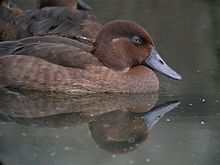
Researchers have released 21 ducks of the species called as the Madagascar pochards – the rarest birds in the world – into their new home in a rescue effort to conserve the species, BBC reported.

The release was one in a series of steps that an international team of conservationists have taken to recover the duck's numbers.

Just a decade ago, the species of diving duck was thought to have been wiped out completely. The ducks were rediscovered in a remote lake in 2006, after the last confirmed sighting of the species at Lake Alaotra in Madagascar in 1991.

The ducks were then taken under the wing of an army of conservationists and researchers from wildlife organizations and the Government of Madagascar.

Since the 1960s, Madagascar pochard numbers have come down dramatically because of many new fish species that found their way into the lakes, killing off the pochard chicks in large numbers and damaging the bird's nesting sites.

The problem was made much worse by polluted water, which forced the few remaining birds into a single, untouched lake in central Madagascar.

They were only "clinging on to existence in a place not really suited to them", said Rob Shaw, head of conservation programmes at the Wildfowl and Wetlands Trust (WWT) to BBC. "The threats that they face across the rest of Madagascar - and why they've been wiped out so extensively – are vast."

The WWT along with Durrell Wildlife Conservation Trust, The Peregrine Fund and the Government of Madagascar teamed up to rescue pochard eggs and raise the species back to healthy numbers in captivity.

Friday, 26 October 2018

Aviaries Assembled: Homes for world's rarest duck ready ahead of release


In no mean feat, our conservation team have managed to erect floating aviaries on the remote Lake Sofia. They will serve as the near-extinct bird’s temporary aquatic home.
The giant, circular aviaries – made out of Scottish salmon farming cage parts – were shipped to Madagascar last year and arrived at their destination this spring.
Peter Cranswick, Head of Planning and Advisory at WWT, said:
“We can barely believe it ourselves but there are now two floating aviaries on Lake Sofia. This is the last major task before we get the ducks involved.
“There was a lot of level two type fun – fun only in retrospect. It was challenging physically and mentally and completed with just an hour to spare before we had to depart.
“Now we’re all set for the main release in October. In the meantime, we have created a water-based funfair for the Marotolana locals.”

Tuesday, 26 August 2014

Madagascar pochard ducklings dying before they can fledge

A study of the world’s rarest bird – the Madagascar pochard – has revealed that 96 per cent of the chicks die before fledging.

Madagascar Pochard, Captive Breeding Program, Madagascar 4.jpg
The conclusion reached by researchers from the Wildfowl and Wetlands Trust (WWT) is that the last remaining population will never expand without outside help.

Just 25 pochards remain in the wild, restricted to one wetland in northeast Madagascar – a complex of lakes near Bemanevika.

The study, published in Bird Conservation International, found that the level of mortality actually increases as the chicks get older, peaking when they are between two and three weeks old.

The researchers conclude that most chicks slowly starve to death once they’re old enough to dive for food, because the water in the lakes is too deep for them.

Historically, it is unlikely that the pochards bred at Bemanevika, but they have been forced from their favoured habitats as wetlands across Madagascar have been turned over to rice and fish farming. The lake’s remoteness has allowed them to survive undisturbed.

The volcanic lakes that are the last refuge of the few remaining wild Madagascar pochards

The wetlands that had formed in volcanic craters are deep with steep sides and surveys showed that, even in the sediment, little food is available to the ducks. Researchers found that ducklings fed at the surface until they were two weeks old, which is typically when related species switch to diving for food. The elevated levels of mortality were observed after this point.

Wednesday, 24 April 2013

Adorable ducklings offer hope for the world's rarest bird (Video)

Stephen Messenger
April 19, 2013

With a wild population which stands at around 22 individuals, Madagascar Pochards are believed to be the most critically endangered bird in the world. But thanks to the recent hatching of 18 adorable young hatchlings in captivity, conservationists are hopeful that this species of duck can be brought back from the edge of extinction.
photo: Wikipedia

Although these ducks were once common throughout Madagascar, decades of habitat loss and the predation of invasive species, they were believed to have been wiped out entirely by the early 1990s. But when a small group of less than two dozen was rediscovered clinging to survival along the shores of a remote lake in 2006, biologists from the Wildfowl and Wetlands Trust (WWT) set about trying to revive their numbers.

And now, for the very first time, those endangered Madagascar Pochards have successfully bred in captivity -- producing a batch of offspring that nearly doubles their numbers in the wild.

Did I mention they're adorable?