As regular CFZ-watchers will know, for some time Corinna has been doing a column for Animals & Men and a regular segment on On The Track... particularly about out-of-place birds and rare vagrants. There seem to be more and more bird stories from all over the world hitting the news these days so, to make room for them all - and to give them all equal and worthy coverage - she has set up this new blog to cover all things feathery and Fortean.
Showing posts with label pest control. Show all posts

Thursday, 28 December 2017

Kārearea to join fighting squadron in battle against pests


ILLYA MCLELLAN/STUFF

Three karearea chicks were set up in their new home in Martinborough to help with pest control on vineyards, but also as part of a conservation effort to restore numbers.

In flight the kārearea resembles a stealth bomber.

And with rapid wing beats and a top speed of about 389kmh they are wreaking havoc on birds that blight vineyards in the premier wine producing region of Martinborough.

Three more of the native falcons have been re-homed at Palliser Estate as part of the area's fighting squadron.

At 28 days old the chicks have reached adult weight and will will grow adult feathers in the coming weeks.

At just 29-days-old the kārearea were settled into their new home at Clouston Vineyard on December 11 as part of a programme that combines pest control with conservation.

Palliser Estate employees have noticed a significant reduction in thrush, blackbird and finch numbers since the falcon programme began in 2014. They also scare seasonal birds like starlings.

Behind the initiative which has seen 10 birds released over four years are Martinborough resident and former Palliser Estate employee Jane Lenting, Wingspan National Bird of Prey Centre and Palliser Vineyards.

Just two were lost, one to predation and one to electrocution.

Lenting had heard of a similar effort in Marlborough while she was employed at Palliser and suggested they do the same.


Thursday, 31 March 2016

Predator plagues and the ongoing battle to save New Zealand's native birds

As the Department of Conservation gears up for another large pest-control operation Samantha Gee finds out if the last one worked and what the future of predator control looks like. 

A small yellow insect-eating bird with a loud melodious call is what first drew Graeme Elliott into the world of New Zealand's native birds.

Elliott, a self-confessed "nerdy little birdy kid" was raised in Christchurch and spent family holidays in Nelson where he remembers climbing Mt Arthur to look across the huge expanse of Kahurangi National Park, and wonder what was out there. 

"When I was a kid I suppose there probably was still a kakapo out there and I thought, there might be a kakapo, there might be a saddleback, there might be a kokako, they were kind of these rare and elusive creatures."

The Department of Conservation scientist says when he looks out across the second largest national park in the country now, he knows what isn't there.

Elliott paints a bleak picture of indigenous bird life in New Zealand. Without "intensive intervention" he says our native birds will continue to decline until they are extinct.

"I've always thought about the forest and the backcountry as the place where all our native animals lived and yet you realise now you go out into the Kahurangi National Park and you realise they don't live there any more, for the most part they have gone."

When he first began working with native birds in the 1980s, Elliott says there was a general acceptance that the species that were going to become extinct were already on their way out. 

Monday, 9 November 2015

'This is a rapid collapse': Catastrophe for native bird

3:00 PM Thursday Nov 5, 2015

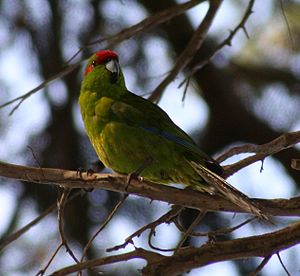
Kakariki2 cropped.jpgPoor or non-existent pest control has caused a catastrophe for one of New Zealand's beloved native bird species, conservationists say.

Dr Luis Ortiz-Catedral of Massey University said a lack of pest control in Northland was largely to blame for the disappearance of kakariki, the native red-crowned parakeet.

Last week, Forest and Bird released drone footage of decimated native Northland forests, also blaming inadequate pest control for the destruction of many native trees.

Forest and Bird said possums and other pests were running rampant in northern forests. This week, Dr Ortiz-Catedral said rats, possums, and other pests were killing off kakariki.

"This is a rapid collapse," he said.

Dr Ortiz-Catedral, a conservation biology lecturer and parakeet expert, said the kakariki had almost certainly become extinct in all areas north of Kawakawa.

"As recently as 25 years ago there were anecdotal records of kakariki scattered across Northland from Cape Reinga down to forest patches near Paparoa.


Sunday, 31 May 2015

Gelderland uses ‘neck breaker’ to kill geese at €13.50 a bird

Society May 29, 2015 

Gelderland provincial council has given a €22,000 contract to a small pest control company to kill 1,600 geese using a controversial method of breaking the birds’ necks. Despite the cost of €13.75 per bird, no-one has seen if or how the method works and the province does not plan to check up on the work or animal welfare issues, the AD reports. The contract has been awarded to a company named V&T, based in Leerdam but details about how the neck breaker will work are sketchy. The method, known as cervical dislocation, involves snapping the birds’ necks one by one. According to the local broadcaster Omroep Gelderland, the bird’s neck is placed between two blocks and then broken, resulting in a ‘stress-free and painless death’.

Read more at DutchNews.nl: Gelderland uses ‘neck breaker’ to kill geese at €13.50 a bird 

Saturday, 15 March 2014

Pest control gone wrong is suspected cause of bird deaths

11th Mar 2014 6:40 PM

A PEST control operation gone wrong is suspected to be behind the poisoning death of hundreds of wild birds in the NSW central-west.

Up to 700 birds including corellas, galahs and cockatoos have been discovered dead along the Talbaragar River near Dubbo in the past two weeks.

A spokeswoman for Wildlife group WIRES told the Herald the birds likely fell victim to a chemical used to control insects and non-native pest birds such as starlings.


Wednesday, 12 February 2014

Poisons ready in New Zealand's battle to save rare birds

Jan 29,2014
WELLINGTON, Jan. 29 (Xinhua) -- Conservation officials are preparing their largest ever pest control program, involving a widescale poison drop to kill a surge in rat and stoat numbers that threatens to wipe out many of New Zealand's native birds.

The Department of Conservation (DOC) said Wednesday that climatic conditions had prompted an unusually heavy forest flowering this summer across both islands, particularly in South Island beech trees.

DOC scientists predicted the resulting bumper seed fall would fuel rapid increases in non-native rat and stoat numbers putting vulnerable populations of rare birds, bats and other species like threatened snails at high risk in the coming spring.

DOC director-general Lou Sanson said DOC has identified South Island forest sites with high risk populations and would be closely monitoring these areas in coming months for early signs of rapidly rising predator numbers.

Tuesday, 17 December 2013

Pesky pigeons gone from Scottish Parliament

SCOTLAND’S parliament is finally free from its pigeon plague after a nine year battle with the birds.

The pesky birds have been peppering the £414m building in Edinburgh with poo since it opened in 2004.

And in 2009, concerned officials called for help from pest control firm NBC to help combat the problem.

As part of a £40,000 annual contract, birds of prey have been flown around the building twice a week in a bid to scare off the feathery fiends.

And now it appears to have worked with the no pigeons currently nesting on the site and the number of bird sightings have dropped by 50%.

Harris hawks and peregrine falcons have won the war against pigeons at Holyrood after scaring the critters away.