As regular CFZ-watchers will know, for some time Corinna has been doing a column for Animals & Men and a regular segment on On The Track... particularly about out-of-place birds and rare vagrants. There seem to be more and more bird stories from all over the world hitting the news these days so, to make room for them all - and to give them all equal and worthy coverage - she has set up this new blog to cover all things feathery and Fortean.
Showing posts with label whio. Show all posts

Sunday, 10 March 2019

Kip helping in fight to protect native birds in Mackenzie Basin


Matthew Littlewood 13:00, Feb 12 2019
DOC ranger Cody Thyne's conservation dog, Kip, is trained to find native birds in some of the most torrid terrain in the Mackenzie region.
She's cute, has an amazing sense of smell and is being used in the fight to protect the region's wildlife.
Kip the German shorthaired pointer has just received full certification as a conservation dog - certified to locate Kaki, wrybill and Whio, and is now working for the Department of Conservation (DOC) sniffing out native birds in the Mackenzie Basin.
DOC ranger Cody Thyne said it has taken about two years Kip to get to this stage.
"It takes a bit of time. You get your dog and spend quite a while teaching them the basics," he said.
Kip replaces the office's former conservation dog Jazz who died about two years ago.
"We had to jump through a number of hoops before Kip got full certification to make sure she's completely safe.
"The dogs really are an efficient tool for conservation work. Their noses can't be beaten. They are an awesome advocacy tool as people often stop me to ask what the dog is used for."
In order to be identified, the dogs wear hi-vis vests when out on patrol and always wear a muzzle when working around protected species.
Thyne said the dog is able to sniff out kaki (black stilt) nests and hidden chicks.
"She can help me find eggs.
"When you actually go into the kaki terrain along the braided rivers it all just looks the same, so quite often the dog can narrow the search down and point us to the nests.
"Using the dog is a really easy way to find the birds."
Thyne described Kip as a "very active" dog.
"The joy of it is the first time you see her point, or indicate, the bird. It takes months and months to get to that stage, but it's so rewarding when it happens.
"She's very high strung, so she needs to be kept busy." 

Sunday, 30 March 2014

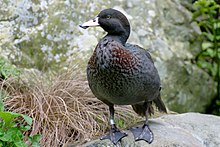
RARE BIRD SPECIES: New Zealand’s rare whio population are thriving

A survey conducted by New Zealand’s Department of Conservation (DOC) has found that the population of whio, also known as blue duck, is thriving in the mountainous rivers and streams inland of Hawke’s Bay on the North Island. This rare bird is found only in New Zealand, and is at high risk of attack from stoats and rats where they nest along fast-flowing riverbanks.
The survey was conducted in January 2014, and found a total of 18 breeding pairs along 33km of waterway bordering 6,120 hectares of the Forest Lifeforce Restoration Trust’s Maungataniwha Native Forest, compared to 10 pairs along 41km of river during a 2011 survey.


Tuesday, 26 February 2013

Rare birds get back on track


Sunday, 24 February 2013, 11:40 am
Press Release: New Zealand Government

Hon Dr Nick Smith

Minister of Conservation

24 February  2013       
Media Statement       
Rare birds get back on track

Whio (Wikipedia)
Kokako (Wikipedia)
The $1 million partnership between DOC and Air New Zealand to bring some of our most threatened birds back to our acclaimed Great Walks track network is a fantastic example of what can be achieved when business gets involved in conservation, says Minister of Conservation Dr Nick Smith.

“This is an inspiring partnership that benefits both conservation and tourism. It will create predator free zones for some of our most threatened birds while adding to the visitor experience on our most famous Great Walks,” says Dr Smith.

“This Bluegreen approach of finding environmentally responsible business partners to help fund conservation helps us do more in tight financial times. The benefits for conservation are more than just the $1 million, as Air New Zealand’s marketing muscles also helps us raise the profile of these threatened iconic birds.

“This is not just about international tourists. This is about New Zealanders being able to see birds like kiwi, whio, takahe and kokako in their natural habitat.

“Air New Zealand is showing real leadership and innovation with this initiative and I am encouraging DOC to continue exploring other partnerships that will help the conservation cause.”

http://www.scoop.co.nz/stories/PA1302/S00355/rare-birds-get-back-on-track.htm