As regular CFZ-watchers will know, for some time Corinna has been doing a column for Animals & Men and a regular segment on On The Track... particularly about out-of-place birds and rare vagrants. There seem to be more and more bird stories from all over the world hitting the news these days so, to make room for them all - and to give them all equal and worthy coverage - she has set up this new blog to cover all things feathery and Fortean.
Showing posts with label pink pigeon. Show all posts

Monday, 11 March 2019

How did the Pink Pigeon bounce back from just nine birds?


15 Feb 2019
The Pink Pigeon is no longer Endangered. But how did conservationists achieve this, and is it sustainable? Dr Vikash Tatayah, Conservation Director, Mauritian Wildlife Foundation (BirdLife Partner) reports from the field…
Last year, one of Mauritius’ best-loved birds hit a milestone that delighted the conservation world. In the 2018 Red List update, the Pink Pigeon Nesoenas mayeri was downlisted from Endangered to Vulnerable, building upon the success of 2000, when it was downlisted from Critically Endangered to Endangered. But behind the scenes of this happy news lies over 30 years of gruelling devotion, with conservationists tackling the numerous threats to the pigeon from every possible angle in their bid to bring it back from the brink.
For a while, we were worried it might go the same way as its fellow Mauritian endemic, the Dodo Raphus cucullatus. An even closer relative, the Reunion Pigeon Nesoenas duboisi, went extinct on the neighbouring Reunion Island in the late 18th century thanks to introduced cats and rats. The Pink Pigeon now holds the unenviable title of the last native pigeon in the whole Mascarene archipelago.
Predictably, it was the arrival of humans that heralded the Pink Pigeon’s decline. The species was once widely distributed across Mauritius, but by the 19th century its population had become extremely fragmented and confined to the upland forests. Humans had destroyed native vegetation to the extent that only 1.5% of the original, good-quality forest remained. They also hunted the plump bird and introduced a panoply of predators such as Black Rat Rattus rattus, Small Indian Mongoose Herpestes auropunctatus and Crab-eating Macaque Macaca fascicularis.


Thursday, 29 November 2018

Two iconic birds brought back from the brink of extinction


By: Krissy Aguilar - 
INQUIRER.net / 01:16 PM November 26, 2018
Two exceptionally rare birds have been saved from the brink of extinction, thanks to long-term conservation programs.
The International Union for Conservation of Nature’s (IUCN) Red List of Threatened Species has downlisted the risk profiles of both Northern Bald Ibis and Pink Pigeon.
Once down to just 59 pairs in the wild in 1998, the Northern Bald Ibis population is now recovering thanks to conservation action.
It has shown one of the most dramatic improvements, being downlisted to endangered from critically endangered.
Meanwhile, the Pink Pigeon’s populations are stabilizing after once having only 10 individuals in the wild in 1990.

Sunday, 24 September 2017

Reintroducing the pink pigeon and echo parakeet in Mauritius

5 Sep 2017

By Jean Hugues Gardenne and Obaka Torto

Re-introducing birds to suitable habitats where species have gone extinct is often a very important and sometimes a last resort to sustain the survival of some threatened Mauritian bird species. The Mauritian Wildlife Foundation (MWF), the BirdLife International Partner in Mauritius, has a long and successful track record of exploiting bird translocation opportunities at any given time.

In recent years, MWF has worked with other partners in the country like the National Parks and Conservation Service of the Ministry of Agro Industry and Food Security, the CIEL Group, the UNDP/GEF Small Grants Programme (SGP), HSBC, Chester Zoo (UK),and the Critical Ecosystem Partnership Fund (CEPF), to translocate several Mauritian birds, including the Pink Pigeon, Echo Parakeet, Cuckoo Shrike and Paradise Flycatcher from the Black River Gorges National Park in the south west to the east of the island, in Ferney Valley (Bambous Mountains). This strategy has helped to create new subpopulations and increased the total population of some bird species, as it contributes to their distribution, saves them from extinction and loss of genetic diversity.


Tuesday, 16 September 2014

Island expedition for Tom to save rare birds

A zoo keeper in Devon is travelling to Mauritius to help set up a breeding station for endangered birds.

Paignton Zoo’s senior bird keeper, Tom Tooley will be taking part in a two month long expedition to build a breeding station for the endangered pink pigeon of Mauritius.

Mr Tooley has worked at Paignton Zoo for 16 years and the majority of that time has been spent working with the pigeons.

Having never taken part in anything like this before, Mr Tooley said: “It’s going to be an experience.

“Bringing a chick through is satisfying, it’s rewarding. It’s not easy – you need to be patient, precise and very well organised.”

Mr Tooley will be working alongside the Mauritius Foundation for Wildlife in preparing the aviaries for the new birds.

Mr Tooley’s speciality is hand-rearing and he will be working the field and sharing his skills.

Before deforestation in Mauritius, the pink pigeon, scientifically named Nesoenas Mayeri, was thought to be very common.

Since 1840 the pink pigeon has been regarded as rare and in 1990 it was thought that only around ten pigeons were still in the wild.

The population has now grown and there are currently around 400 free living pink pigeons living in Mauritius. The pink pigeon has a reputation of being very aggressive and therefore each bird needs its own aviary.

Pigeons are considered to be clumsy birds and poor nest builders, which supplies a challenge for any aviculturist.

Thursday, 26 June 2014

Pink pigeon is identified - but colour is still a mystery


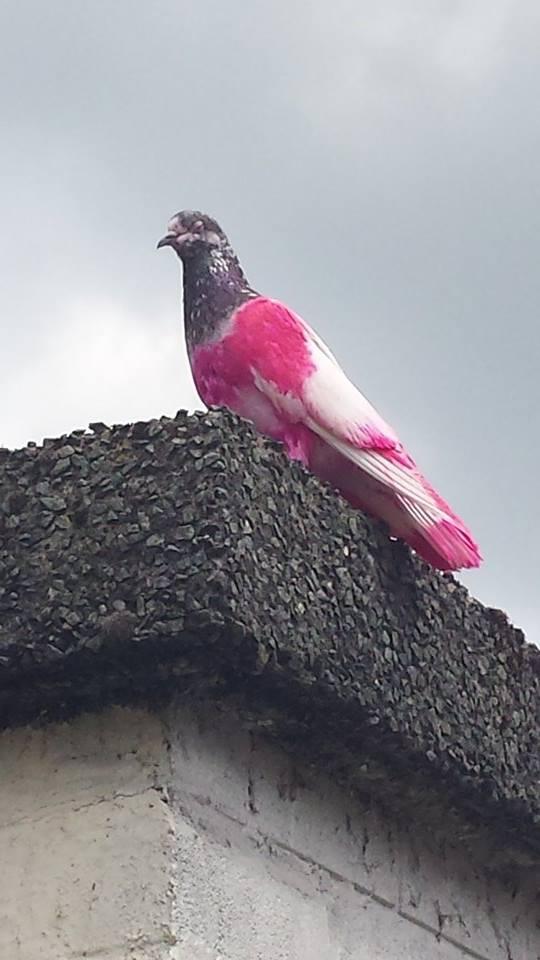
A PIGEON expert has identified a pink bird spotted in Bolton as a Tippler — but admits he has no idea why it is such as unusual colour.

Terry Dawber, secretary at the North West Homing Union, says that pigeon fanciers would call the colour red, not pink — but added the colour pattern is rare.

He added that some fanciers dye their pigeons to distinguish which are the better flyers.

And it seems the unusual bird is on the move as it has been spotted elsewhere in Breightmet.

Joanne Carney of Crossdale Road took a snap of the pigeon in her back garden last Thursday.

Local resident David Taylor captured the unusual looking bird in Tetbury Drive at about 8am on Friday.

Since the photograph featured in The Bolton News, it has baffled residents as to why it has such brightly coloured feathers — one saying it might have been dyed the colours of the St George’s flag to represent England in the World Cup.

Mr Dawber said: “Tipplers are bred for their flying endurance and ability. Looking at the photograph, the bird has got a normal coloured head of what we call a 'light print' Tippler, but the coloured sections are definitely 'pink' — or as we pigeon men would call it, red.

Monday, 23 June 2014

Mystery pink pigeon spotted on rooftops in Breightmet

6:39pm Friday 20th June 2014 in NewsBy Jeremy Culley, reporter

A MYSTERY pink pigeon has been spied in Breightmet.

The bird, which has pink and white plumage, but still has a normal grey head, was spied on a rooftop in Breightmet earlier this morning.

There is a breed of bird called a pink pigeon — called nesoenas mayeri which are native to Mauritius — but these are very rare and normally such a paler shade of pink they are almost white.

David Taylor managed to photograph the unusual bird in Tetbury Drive at about 8am on June 20 and said: "I was having breakfast this morning and saw this red and white pigeon on top of a neighbour's roof.

"When I went out it was gone but then 15 minutes later I spotted it on a neighbour's roof.

"I don't know why it's that colour, I thought someone had painted it.

Jackie Fish, who also from Tetbury Drive, thought someone had spray painted the bird in the colours of the St George flag.