As regular CFZ-watchers will know, for some time Corinna has been doing a column for Animals & Men and a regular segment on On The Track... particularly about out-of-place birds and rare vagrants. There seem to be more and more bird stories from all over the world hitting the news these days so, to make room for them all - and to give them all equal and worthy coverage - she has set up this new blog to cover all things feathery and Fortean.
Showing posts with label parasitic birds. Show all posts

Friday, 15 June 2018

Parasitic Birds and Parasitized Host Birds


1 Jun 2018

English Translation: Asia Club, a WBSJ Volunteer Group (YOKOYAMA Kazuko, KASE Tomoko)

“In a quiet lakeside forest
The cuckoo is calling for you,
‘It’s time to wake up,
cuckoo, cuckoo, cuckoo, cuckoo, cuckoo, ,,,”

Most Japanese know the above song, which is sung over the melody of the worldwide popular nursery rhyme, “Incy Wincy Spider”.  I feel refreshed whenever I hum it in the morning, as it is really suitable for this pleasant season of May.  Four species of the cuckoo family come to Japan around the middle of May from South Asia, telling us that summer has come.  I would like to show you photos of three species of them, except Hodgson’s hawk-cuckoo, which I have never succeeded in photographing yet, and also introduce “Brood parasitism”, their unique breeding habit they have in common.

Brood parasitism is a habit of a bird, which does not make its own nest, lays eggs in other bird’s nest secretly and relies on the host bird to raise the chick.  To the host, the nest owner and the tentative parents to the chick, it is nothing but an annoying event.  The cuckoo family bird chooses a nest whose owner has just started laying eggs, takes away one egg of them and lays one of her own.   This egg hatches a little earlier than the other eggs of nest owner, and moreover the chick, with eyes still unopen and no feather developed yet, puts all the host’s eggs on its back and pushes them out, so that it exclusively occupies the whole nest.  Thus the chick thrives on the food its tentative parents carry for its now-dead “tentative siblings”, until it has grown much bigger that the host parents and then leaves the nest.


Monday, 14 August 2017

Protecting the Nest from the Parasitic Pin-tailed Whydah

EMILY HEBER

The Pin-tailed Whydah, a parasitic bird, could put native Antilles and Hawaiian island species at risk.

The word “parasite” often brings to mind an image a small worm, but sometimes, parasitic species are not what you imagine. Such is the case for the Pin-tailed Whydah, which is one of only about 100 parasitic bird species in the world.

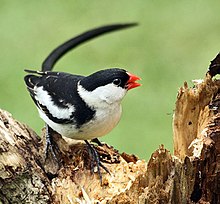
The Pin-tailed Whydah (Vidua macroura) is native to sub-Saharan Africa where it is known for its bright orange beak, black and white body, and the long tail-feathers they grow during mating season. The distinct coloration of this species has led to their introduction throughout the world via the pet trade. Although such proliferation might seem harmless, the Pin-tailed Whydah’s unique parasitism makes it dangerous to native species if it is accidentally or purposefully released into the wild.


Sunday, 28 May 2017

Neural basis for parasitic cowbird's secret password identified by researchers


Date: April 18, 2017
Source: The City University of New York

If you are raised by other species, then how do you know who you are? Although heterospecific foster parents rear brood parasitic brown-headed cowbird chicks, juvenile cowbirds readily recognize and affiliate with other cowbirds. That's because they have a secret handshake or password. Specifically, the "password" hypothesis helps explain this paradox of species recognition: Social recognition processes in brood parasites are initiated by exposure to a password: in the case of cowbirds, a specific chatter call. A new study appearing in the Journal of Experimental Biology describes the neural basis for password-based species recognition in cowbirds.

Roughly 1% of bird species are obligate brood parasites. Female obligate brood parasites shirk parental care duties by laying their eggs in the nests of other females. This breeding strategy is extremely successful for the female parasite but raises questions, particularly with respect to species recognition. For instance, how does a juvenile bird that is not raised by familial members come to recognize its own species and avoid imprinting on the host species that cared for it from the day it hatched? One possibility is that young brood parasites use a password to identify conspecifics, and learning about species-specific signals occurs only after the password is used to find conspecifics.

Researchers have now demonstrated the neural basis for password-based species recognition in an obligate brood parasite. They showed that the auditory forebrain regions in cowbirds, which respond selectively to learned vocalizations, such as songs, also respond selectively to non-learned chatter. However, if the password is not used to locate other cowbirds, the young brood parasite will mis-imprint on its host species -- a process manifested in the brain by elevated gene induction in response to the host's song.

Monday, 22 May 2017

Scientist identify key locations for spread of pin-tailed whydahs


Date: May 11, 2017
Source: The City University of New York

Pin-tailed Whydah (Vidua macroura).jpgInvasive parasites are a biological oxymoron. And yet, they are in our backyards! This study analyzes the case of a brood parasitic bird, the pin-tailed whydah (Vidua macroura) and its recent spread into the Americas!

Biodiversity hotspots -- or places with large numbers of species found nowhere else on earth -- also tend to make suitable habitats for invasive species that can, in turn, destabilize ecosystems and supplant indigenous biota. A new study in The Condor: Ornithological Applications predicts where the pin-tailed whydah, a songbird native to sub-Saharan Africa that has expanded its natural range thanks to the pet trade, may next spread in North America and Hawaii.

The pin-tailed whydah is a brood parasitic bird that lays its eggs in other bird species, typically small African finches, and has been introduced from Africa to Puerto Rico and southern California. In this study, researchers used species distribution models to predict where the whydah may continue to spread in the continental U.S., Hawaii, and the Antilles. To determine the whydah's potential distribution, they used sightings of this species reported to the Global Biodiversity Information Facility (GBIF). The investigators then identified suitable whydah habitat by finding correlations between locations where these finches have been seen and global climate data. As brood parasites, whydahs need hosts to complete their life cycle, so the researchers also used the presence of six known host species that have been co-introduced in the whydah's new range to predict suitable habitat. Their species distribution model indicated high habitat suitability in areas of high biodiversity where whydahs do not currently live, including the West Coast of the U.S., Hawaii, and most islands of the Antilles.

Thursday, 12 May 2016

New immigrant: Shiny cowbirds noted from a recording altitude of 2,800 m in Ecuador


Date: May 4, 2016
Source: Pensoft Publishers

Two juveniles of Shiny Cowbird, a parasitic bird that lays its eggs in the nests of other birds, were spotted in the Andean city of Quito, Ecuador, for the first time. This finding represents an altitudinal expansion of approximately 500 m.

Breeding populations might have been prompted by forest fragmentation and/or climate change, suggest the research team, led by Dr Verónica Crespo-Pérez, professor at Pontificia Universidad Católica del Ecuador (PUCE). Resultingly, the 'immigrants' could be threatening native birds. The study is published in the open access Biodiversity Data Journal.

"The Shiny Cowbird is native to the lowlands of South America but within the last 100 years, it has been expanding its distribution to higher altitudes and latitudes" says the lead author.
The bird had already been noted from high altitudes in Bolivia and Perú, and in some localities in the Ecuadorian Andes. Since 2000, Juan Manuel Carrión, co-author and director of the Zoo in Quito, recalls observing Shiny cowbirds near his home in a valley near Quito at 2,300 m above sea level (asl). However, one has never before been reported from an altitude as high as 2,800 m asl.

Moreover, the fact that the observed individuals were juveniles means that the species is already breeding in the city.

"Such a significant expansion of reproductive birds, of approximately 500 m, could be related to human disturbances, like forest fragmentation or climate change," adds Crespo-Pérez.


Saturday, 19 April 2014

Fear of the cuckoo mafia: In fear of retaliation, birds accept and raise brood parasites' young

Date:
April 17, 2014

Source:
Max-Planck-Gesellschaft

Summary:
If a restaurant owner fails to pay the 'protection money' demanded of him by the mob, he can expect his premises to be trashed. Warnings like these are seldom required, however, as fear of the consequences is enough to make restaurant owners pay up. Similarly, mafia-like behavior is observed in parasitic birds, which lay their eggs in other birds' nests. If the host birds throw the cuckoo's egg out, the brood parasites take their revenge by destroying the entire nest. Consequently, it is beneficial for hosts to be capable of learning and to cooperate. Previously seen only in field observations, scientists have now modeled this behavior mathematically to confirm it as an effective strategy.


Thursday, 22 August 2013

Honeyguide Birds Destroy Own Species' Eggs to Eliminate Competition


Aug. 21, 2013 — Like cuckoos, honeyguides are parasitic birds that lay their eggs in other birds' nests and dupe them into raising their young. Now scientists reveal that, unlike in cuckoos, the resemblance between honeyguide eggs and those of their bee-eater bird hosts hasn't evolved to trick hosts into accepting the imposter egg as one of their own. Rather, it appears to have evolved to trick other honeyguides who would otherwise destroy the eggs because of fierce competition for host nests.

The new research is published today, 21 August, in the journal Biology Letters.

Honeyguides are intriguingly odd birds that are best-known for their unique, mutually beneficial relationship with humans. Honeyguides love to eat beeswax. To obtain it, they guide human honey-hunters to bees' nests. In return for showing the humans the bees, the honeyguide gains access to the otherwise dangerous and impenetrable nest and its sought-after wax.

But these African birds also have a dark side. They are unusually vicious parasites whose imposter chicks stab the chicks of their host birds (often little bee-eaters) to death as soon as they hatch in order to eliminate competition for the host parents' care. The newly published research has shown that this fight for monopoly of the nest also extends to other honeyguides in a battle conducted deep underground in the nest burrows that bee-eaters dig into the roofs of Aardvark holes.