As regular CFZ-watchers will know, for some time Corinna has been doing a column for Animals & Men and a regular segment on On The Track... particularly about out-of-place birds and rare vagrants. There seem to be more and more bird stories from all over the world hitting the news these days so, to make room for them all - and to give them all equal and worthy coverage - she has set up this new blog to cover all things feathery and Fortean.
Showing posts with label Iceland. Show all posts

Monday, 29 July 2019

Puffins being hunted and brought back to the UK despite Government efforts to save the species

Helena Horton
27 JULY 2019 • 4:00PM

Puffins are being hunted 100 at a time by trophy collectors who are allowed to bring the carcasses back to the UK, despite the government’s efforts to save the species.

Campaigners and MPs are calling on Theresa Villiers, the new environment secretary, to ban the import of puffin trophies and push the international wildlife trade body to give the charismatic bird stronger protection.

Websites offer grisly hunting trips for around £3,000, offering British people the chance to go to Iceland and kill a “bag” of puffins. The hunters boast of being able to shoot up to one hundred at a time.

Read on (sub required)

Monday, 15 April 2019

Birds of a Different Feather Seen Flocking Together


Posted April 8, 2019 

Geese and swans were observed flying together in V-formation over Vík í Mýrdal in South Iceland on Thursday, RÚV reports. While it’s unusual to see two different species flocking together, according to a local ornithologist it is not unheard of.
Birna Viðarsdóttir posted the picture to a Facebook group dedicated to Icelandic bird life and it quickly garnered a great deal of attention, as well as a fair amount of skepticism – particularly since the photo was taken on April 1, April Fools’ Day. “A number of people have asked whether it’s been photoshopped,” she told RÚV, “but it wasn’t.”
Ornithologist Arnór Þórir Sigfússon says that it’s uncommon to see different kinds of birds flying together in V-formation, but it has been known to happen. Although swans and geese both migrate to Iceland from Great Britain around this time of year, Arnór Þór thinks it’s unlikely that this particular group of birds did so together the whole way, mostly because geese and swans fly at different speeds. He said he thought it more likely that the swans in Birna’s picture had joined a group of geese, rather than vice versa.

Monday, 12 November 2018

Rare Foreign Bird Sightings in Iceland

NATURE & TRAVEL November 07, 2018 09:00Updated: November 07, 2018 09:51

Photo: Kristof vt via Wikimedia Commons


A number of foreign birds that are rarely seen in Iceland have been spotted in the country of late, RÚVreports.

These unusual sightings include hawfinches in Húsavík in North Iceland, whinchats in Southeast Iceland and, along Iceland’s Southern coast, near Vík, little buntings that would have flown all the way from Northeast Europe or Asia. Other foreign winged visitors of late include lesser whitethroats, six gray herons, white-winged scoters, and even gray-cheeked thrushes, which generally nest in the Arctic, namely, in Siberia and Canada. Lastly, the colorful American robin, which nests throughout North America, has caused a particular sensation among birdwatchers on the Suðurnes peninsula.


Sunday, 20 May 2018

Puffin off the menu? Conservationists to push for ban on sale of seabird meat


BY STAFF |MAY 4 2018

Your next puffin steak in Iceland might be the last you will ever consume. The Icelandic bird conservation society Fuglavernd will request that the Ministry of Environment to institute a complete ban on the sale of the meat of seabirds like puffins and other auks, including common and thick billed murre. Many seabird populations, including the puffin, are facing significant stress due to changing climate conditions.

Erpur Snær Hansen, an ornithologist and a campaigner for the conservation of seabirds, told the Icelandic National Broadcasting Service that at the same time as puffins were facing severe stress there was far too much puffin was being sold at Reykjavík restaurants.

"What kind of moral compass do you need to have to flood the market with this meat, acting as if everything is fine and dandy, just to make a quick buck?"

Erpur added that the restaurant and tourism industries needed to pause and think about what kind of messages were being sent to foreign visitors. He also complained that it appeared like the government was not particularly interested in the issue. He pointed out that while the major seabird populations, including the puffin population, were still very large in Iceland, they were declining globally. This made it even more important for Icelanders to protect these birds.

Puffin hunting is currently banned in all parts of Iceland, except in the north. The hunting ban in the South, West and East Iceland has had positive effects on the population, he argues. "Puffin meat has gone up dramatically in price after the hunting bans were instituted, which means that the traditional consumers, locals, have cut down their consumption. But it's still sold to consumers who are willing to pay top-dollar, and that's the restaurant industry."

Source  

Thursday, 10 May 2018

Iceland's puffin in danger of extinction


Puffin numbers have gone dangerously low in recent years. mbl.is/Árni Sæberg

A new report called the 2018 State of the World's Birds Report and published by Birdlife lists 25 Icelandic birds species as endangered. 

The report, which provides a comprehensive look at the health of bird populations globally, has found that the extinction crisis has spread so far that even some well-known species are now in danger. This is reported by today's Morgunblaðið. 

Of those 25 bird species , Iceland's beloved puffin is in particular danger due to shortage of his natural food in South Iceland. Other endangered birds are the falcon, the sea eagle and the fulmar, to name a few. 


Wednesday, 3 August 2016

Six New Species of Birds Have Settled in Iceland


 July 31, 2016 12:52 Updated: August 02, 2016 08:30

Six new species of birds have settled in Iceland since the turn of the century. Being a settler is not a well-defined term, but when a bird returns for nesting for 10 years or so, it seems fairly safe to say that it settled.

The six bird species are: The barnacle goose (Branta leucopsis), the shelduck (Tadorna tadorna), the eurasian woodcock (Scolopax rusticola), the blackbird (Turdus merula), the goldcrest (Regulus regulus) and finally the red crossbil (Loxia curviriostra).

According to Yann Kolbeinsson, biologist and bird enthusiast, it is a big change for a bird to decide coming to Iceland, a far-away island. Winds can play a role, and birds on their way somewhere else may stop in Iceland and decide to settle. A warmer climate might also play a role.


Thursday, 28 January 2016

Rare bird found in Höfn, East Iceland


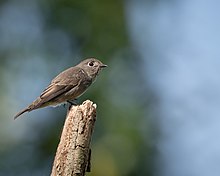
"I had no idea what kind of bird we were looking at, it was so weird," says ornithologist Brynjúlfur Brynjúlfsson at the South East Iceland Bird Watching Centre. He is the first person to have spotted a Dark-Sided Flycatcher (Muscicapa sibirica) in Western Europe. 

Muscicapa sibirica.jpgThe species, according to Wikipedia, breeds in South-East Siberia west to beyond Lake Baikai as well as in Mongolia, China, North Korea and Japan. 

Their wintering range includes India, Bangladesh, southern China, Taiwan, Sumatra, Java, Borneo and the Philippines. Vagrant birds have been previously recorded as far as Alaska and Bermuda.


Thursday, 9 July 2015

Albatross Spotted near Reykjavík


Last week a tourist on a whale-watching trip in Faxaflói, just outside Reykjavík, was attempting to photograph a humpback whale when a bird interrupted the shot.

Upon further inspection, the bird was discovered to be an albatross, and likely an Atlantic yellow-nosed albatross, a rare sight so far north.

Bird-watching enthusiast Mike King shared the photo, taken by his nephew Jared Mein, on Twitter, where it was noticed by Birding Iceland.

“Albatrosses are rarely found in the Atlantic region of the northern hemisphere. The species that live in the Atlantic are all native to the southern hemisphere, and some are known to go into the northern hemisphere of the Pacific Ocean. So this is a bird far outside of its normal territory,” ornithologist Gunnar Þór Hallgrímsson told RÚV.

Sunday, 25 January 2015

Hundreds of Dead Birds in North Iceland

BY ZOË ROBERT January 25, 2015 11:01Updated: January 25, 2015 11:15

Hundreds of dead guillemots were recently found by farmer Gunnar Óli Hákonarsson at Sandur in Aðaldalur, North Iceland. The birds, which were found on a beach east of the mouth of Skjálfandafljót river, are believed to have died from starvation due to bad weather in December. Foxes and ravens have been scavenging on the bird carcasses.

Thursday, 24 January 2013

Rare Slavonian grebe found dead in Inverness came from Iceland


"Dead duck" turns out be a scarce visitor from Iceland
January 2013. Local RSPB staff have collected a rare Slavonian grebe which was found dead in Inverness town centre. The bird is believed to have collided with an overhead wire. RSPB conservation manager Stuart Benn said, "We received a call from a traffic warden who said that he had found a dead duck in the town. His attention had been attracted by a ring that was present on the bird's leg. When we arrived we discovered that the bird was, in fact, a Slavonian grebe, a very rare breeding bird in Scotland. However when we checked the ring we found that the bird had been ringed in Iceland.

"This is an interesting discovery as it confirms that some birds from the Icelandic population spend the winter in Scottish waters and that the Moray Firth is important for these grebes as they are for many other species of marine birds."

Found in town centre
The bird was found by the River Ness near the pedestrian bridge that links Kenneth Street to the town centre. Mr Benn said, "Judging by its injuries I suspect the grebe must have flown into an overhead wire or cable. They are beautiful birds and it is very sad to see it in this state."


Tuesday, 4 December 2012

Record numbers of Whooper swans at WWT Martin Mere


Nearly 2500 whooper swans counted at Martin Mere
December 2012. A count of whooper Swans confirmed a record number of 2,480 birds at WWT Martin Mere Wetland Centre.

Whooper swans spend the summer in Iceland and winter in the UK. Approximately 7% of the population of whooper swans visit Martin Mere over the winter offering spectacular displays that we call ‘Swan Spectacular'. Everyday, the swans are fed at 10.30am and 3pm from Swan Link hide and at 10.45am and 3.30pm from Raines Observatory. The 3.30pm feed also includes a wardens talk to learn all about these amazing animals.

Probably more on the way
Centre Manager, Andy Wooldridge, said: "We usually get peak numbers of whooper swans in mid to late December so I still think numbers will continue to rise. The highest previous count was 2,100 in 2010 which also coincided with a cold snap. The recent cold weather has certainly encouraged birds which roost elsewhere to visit Martin Mere allowing us to offer a fantastic spectacle during the swan feeds."

WWT Martin Mere is open every day from 9.30am to 5pm and parking is free of charge. Situated off the A59, it is signposted from the M61, M58 and M6. The Centre is also accessible via the Southport to Manchester and the Liverpool to Preston line by train from Burscough Rail Stations.