As regular CFZ-watchers will know, for some time Corinna has been doing a column for Animals & Men and a regular segment on On The Track... particularly about out-of-place birds and rare vagrants. There seem to be more and more bird stories from all over the world hitting the news these days so, to make room for them all - and to give them all equal and worthy coverage - she has set up this new blog to cover all things feathery and Fortean.
Showing posts with label cassowary. Show all posts

Thursday, 14 May 2020

Microscopic feather features reveal fossil birds' colors and explain why cassowaries shine

MAY 13, 2020


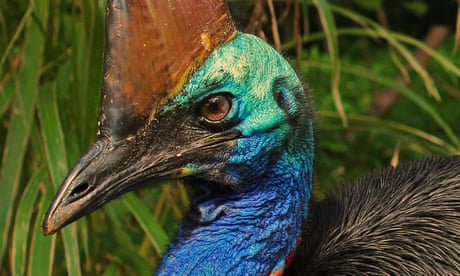
Cassowaries are big flightless birds with blue heads and dinosaur-looking feet; they look like emus that time forgot, and they're objectively terrifying. They're also, along with their ostrich and kiwi cousins, part of the bird family that split off from chickens, ducks, and songbirds 100 million years ago. In songbirds and their relatives, scientists have found that the physical make-up of feathers produce iridescent colors, but they'd never seen that mechanism in the group that cassowaries are part of—until now. In a double-whammy of a paper in Science Advances, researchers have discovered both what gives cassowary feathers their glossy black shine and what the feathers of birds that lived 52 million years ago looked like.

"A lot of times we overlook these weird flightless birds. When we're thinking about what early birds looked like, it's important to study both of these two sister lineages that would have branched from a common ancestor 80 million or so years ago," says Chad Eliason, a staff scientist at the Field Museum and the paper's first author.

"Understanding basic attributes—like how colors are generated—is something we often take for granted in living animals. Surely, we think, we must know everything there is to know? But here, we started with simple curiosity. What makes cassowaries so shiny? Chad found an underlying mechanism behind this shine that was undescribed in birds. These kinds of observations are key to understanding how color evolves and also inform how we think about extinct species," says Julia Clarke, a paleontologist at the Jackson School of Geosciences at the University of Texas at Austin and the paper's senior author. Eliason began conducting research for this paper while working with Clarke at the University of Texas as part of a larger project funded by the National Science Foundation (NSF EAR 1355292) to study how flightless birds like cassowaries have evolved their characteristic features.

In humans and other mammals, color mostly comes from pigments like melanin that are in our skin and hair. Birds' colors don't just come from pigment—some of their coloration, like the rainbow flecks on hummingbirds and the shiny, glossy black on crows, is due to the physical makeup of their feathers. The parts of their cells that produce pigment, called melanosomes, affect the feathers' color based on how light bounces off those melanosomes. Different shapes or arrays of melanosomes can create different structural colors, and so can the layers of keratin making up the birds' feathers. They can reflect a rainbow of light, and they can make the difference between dull, matte feathers and feathers with a glossy shine.

Wednesday, 8 May 2019

Large, Exotic Bird That Killed Florida Man to Be Auctioned


A large, flightless bird that fatally attacked a Florida man is among some 100 exotic animals from his estate now up for auction.
By Associated Press, Wire Service Content April 23, 2019, at 10:35 a.m.
GAINESVILLE, FLA. (AP) — A large, flightless bird that fatally attacked a Florida man is among about 100 exotic animals from his estate now up for auction.
The Gainesville Sun reports the Gulf Coast Livestock Auction will auction the cassowary that killed 75-year-old Marvin Hajos in accordance with his last wishes.
Alachua County Sheriff's officials say Hajos apparently fell April 12 and the bird attacked him. First responders rushed him to a hospital but he died.
Cassowaries are similar to emus, stand up to 6 feet (1.8 meters) tall and weigh up to 130 pounds (60 kilograms).
The animals being auctioned include two double-wattled cassowaries and five ring-tailed and ruffled lemurs.
Fish and Wildlife spokesman Robert Klepper said buyers must be licensed to legally possess the animals.

Monday, 25 February 2019

New clue in curious case of cassowary casque


200-year-old mystery surrounding iconic Australian bird
Date:  February 13, 2019
Source:  La Trobe University
A team of Australian scientists has completed research that could help solve a 200-year-old mystery surrounding an iconic Australian bird.
The La Trobe University researchers have published new evidence in Scientific Reports on the southern cassowary and its distinctive helmet -- known as a casque.
Danielle Eastick, from La Trobe's Department of Ecology, Environment and Evolution and her team have shown the cranial structure acts like a radiator or "thermal window" to help the large, flightless birds keep cool in hot weather.
"Our results are quite compelling and it's highly probable this is what the casque is actually used for," Ms Eastick said.
"It's really exciting to think we may have solved a mystery that has baffled scientists for so long."
Using a handheld thermal imaging device, Ms Eastick obtained readings from 20 captive cassowaries, from Victoria through to northern Queensland and in different weather conditions.
The images showed that the birds released minimal heat from their casque when the weather was just five degrees and the greatest levels when the mercury reached 36 degrees.
Ms Eastick explained that as a large bodied, dark feathered creature, which is native to northern Queensland and Papua New Guinea, cassowaries face a thermal challenge in high temperatures.


Sunday, 27 January 2019

Is this proof Australian wildlife is related to dinosaurs? Incredible photo of a giant claw baffles the internet - but it's not as rare as you might think


Palaeontology student shared image of cassowary claws during anatomy study 
Sarah Davis said the image shows the clear links between birds and dinosaurs 
The cassowary is native to Australia and is the country's heaviest flightless bird 
PUBLISHED: 00:52, 22 January 2019 | UPDATED: 00:59, 22 January 2019
A palaeontology PhD student has shared an amazing image of a southern cassowary, claiming it is evidence that birds and dinosaurs are related. 
Texas woman Sarah Davis, a palaeontology PhD candidate at the University of Austin, is using the bird to study 'avian anatomy, colour, and feathers as part of multiple graduate research projects' she wrote on her Twitter account. 
'Holding the claws of a male southern cassowary... Just in case any of your friends still need convincing that [bird] equals [dinosaur],' she wrote with the post. 
A palaeontology PhD candidate has shared an amazing image (pictured) of a Southern Cassowary claiming it was another piece of evidence that birds and dinosaurs are related
'I feel incredibly humble to be able to work with such a magnificent bird. Cassowaries are native to Papua New Guinea and Australia, and are fruit eaters.
'But, that doesn’t mean they don’t know how to use those impressive claws.' 
The post drew the attention of a number of social media users. 
'I remember the first time I saw a cassowary in real life and was shocked, thinking how the hell could anyone doubt where all the dinosaurs went,' one user wrote.


Thursday, 7 June 2018

Cassowary leaping high caught on film


28 MAY 2018
IVY SHIH

By hiding in camouflaged tents for months in the dense rainforest, UNSW PhD student and film-maker Dan Hunter has captured fascinating footage of Australia’s “dino-bird” – the elusive flightless cassowary.

By hiding in camouflaged tents for months in the dense rainforest, UNSW PhD student and film-maker Dan Hunter has captured fascinating footage of Australia’s “dino-bird” –  the elusive flightless cassowary.

Hunter’s latest documentary on the Southern Cassowaries of North-East Queensland reveals insights into the behaviour of these large birds, including their extraordinary feeding behaviour of leaping to great heights to pluck fruit from trees.

Called Dino Bird, the film is currently being broadcast on international wildlife channel Nat Geo Wild, after being selected by National Geographic as part of its 2018 Year of the Bird Campaign dedicated to highlighting bird conservation efforts around the globe.


Sunday, 4 March 2018

Daintree research centre to save endangered cassowaries


Peter Michael, The Courier-Mail
February 21, 2018 2:00pm

THE Daintree’s endangered cassowaries – under threat from pigs, dogs, cars and crocodiles – may be thrown the lifeline of a new research and breeding facility in the world’s oldest rainforest.

Douglas Shire Council has ordered a feasibility study into how to protect the dwindling population of the iconic flightless bird, a popular tourist drawcard, in the jungles of far north Queensland.

Every year hundreds of southern cassowaries, a throwback to the dinosaur era, are killed or injured, and baby chicks orphaned.

Today it is estimated as few as 1500 birds still survive in the wild in Australia.

“We’re firmly dedicated to protecting our cassowaries,’’ Douglas Mayor Julia Leu said.

“I think it is time we at least look at the feasibility of building one (a cassowary facility) in the Daintree Rainforest.’’

Thursday, 25 August 2016

Cassowary 'Ruthie' relocated after trying to break into elderly man's home

Bird in Queensland’s Innisfail had come to associate people with being fed, says environment department, and decision to relocate it was taken ‘reluctantly’

Australian Associated Press
Monday 22 August 201603.21 BST


Wildlife officers have relocated a young cassowary, known by locals as Ruthie, after it threatened an elderly man and tried to enter his Innisfail home.

It is the second time this month a cassowary has been relocated in north Queensland due to aggressive behaviour.

The Department of Environment and Heritage Protection said it was first alerted to potential problems with the bird in early August.

Rangers were called to the Coquette Point home last week after reports the bird was behaving aggressively and trying to break into an elderly man’s home.

 “The decision was reluctantly taken to relocate the bird after it was clear it had become accustomed to associate people with being fed,” according to the department.

The cassowary was tranquilised and relocated to a remote area of rainforest, away from human interaction.

EHP has again urged people not to feed or interact with the endangered species.


Friday, 15 April 2016

Curious cassowary 'Peanut' ventures into home, forcing owners to take cover

Australian native bird considered to be dangerous has long wandered through the backyard in Queensland’s north but until this week stayed outside


Thursday 14 April 2016 08.58 BSTLast modified on Thursday 14 April 201609.51 BST

A cassowary named Peanut has surprised a Queensland family by venturing into their home as they were preparing dinner.

Sue and Peter Leach, from Wongaling Beach in the state’s north, were forced to take cover after discovering the native bird – which can grow up to 2m tall – standing in their lounge-dining room.

“We leave all the doors open when we’re at home and I guess he was curious, but I hot-footed it out of the house and hid in the garage because although we know him he is still a wild animal,” Sue Leach told the Cairns Post.

Peanut, thought to be about three years old, has long wandered through the Leach backyard but until this week had stayed outside.

“My husband hid behind the dining room table and took some photos and he was only in there for a few minutes. He must have come in through the garage door and walked back out the front door.”

Friday, 15 August 2014

Triple E kills rare birds at Virginia Zoo

Posted on August 6, 2014 at 12:21 PM

Updated Wednesday, Aug 6 at 5:20 PM

NORFOLK -- Three 28-day-old cassowary chicks died from Eastern Equine Encephalitis at the Virginia Zooin July, officials said Wednesday. 

Two were found dead on the morning of July 17 and a third died later that afternoon despite intensive medical therapy. One of the parent birds has also died but test results have not been completed to determine a cause, zoo officials said. 

Cassowaries are flightless birds native to the tropical forests of New Guinea, north-eastern Australia and area islands.

The chicks' father, along with a young male and a young female, are still at the zoo and have been vaccinated for the disease, officials told WVEC.com.

"All of the animals that are known to be susceptible to the disease were vaccinated at the beginning of mosquito season," said spokeswoman Meg Puckett. "This includes birds of prey, cranes, tapir, and all equids. The remaining three cassowary have also now been vaccinated."

Tuesday, 1 October 2013

Staten Island Zoo's Crowdfunding Effort To Buy Unusual Birds

The Staten Island Zoo has launched an Indiegogo campaign in an effort to raise enough money for a shiny new bird: a cassowary. Two cassowaries, in fact. All they need is $20,000 or so—that's a small price to pay for... the opposite of freedom.


It's not like a cassowary can fly anyway. According to zoo curator Marc, the birds are "huge and beautiful... they're the second largest bird in the world and quite dangerous; however, their numbers are declining in the tropical forests of Australia & New Guinea. How could something so incredible and large be losing the battle to exist? Because, so few people know about them! As a zoo we have the incredible responsibility to inform the public about the status of animals in the wild. Therefore, we would like to bring a pair of cassowary to one of the most populous regions in the world: New York City. The Staten Island Zoo will be committed to exhibiting and breeding the species. With increased visitation to see the rare creature, we can secure their existence on this planet."

Since they're so rare, private breeders and other zoos are selling them for around $7,500 each, which is where your money would be going. [via DNAInfo]