As regular CFZ-watchers will know, for some time Corinna has been doing a column for Animals & Men and a regular segment on On The Track... particularly about out-of-place birds and rare vagrants. There seem to be more and more bird stories from all over the world hitting the news these days so, to make room for them all - and to give them all equal and worthy coverage - she has set up this new blog to cover all things feathery and Fortean.
Showing posts with label Wellington. Show all posts

Monday, 20 May 2019

New $12 million Te Papa exhibit showcases the scent of native birds


TUE, MAY 7
A new $12 million exhibit is set to open at Te Papa in Wellington which will feature more than 1000 items from New Zealand’s natural world.
Te Taiao Nature will showcase the scents from some of New Zealand's native birds including the Kiwi, kakapo and petrel.
Te Papa Curator Colin Miskelly says the idea behind the exhibition was to help better understand the reasons why our native birds smell the way they do.
"Part of the reason that we think that New Zealand birds are quite smelly compared with birds in other parts of the world, is that there were not ground dwelling mammals hunting by scent in New Zealand, so there was no downside to them being a bit smelly," says Mr Miskelly.

Friday, 11 January 2019

New Zealand birds: Christmas decorations tied around sparrows


Dozens of birds have been found dead or injured in New Zealand with Christmas decorations tied around their necks and wings.
Sparrows and pigeons have been reported with "decorative trinkets" tied to them in Wellington.
Some of them died of starvation as they are unable to fly and find food, according to the SPCA.
Although there have been similar incidents since 2015, there has been a spike in sightings in recent weeks.
Authorities believe the birds are being deliberately "decorated" as the tinsel and bows are tightly and carefully attached, the New Zealand Herald reported.
"Many try to pry the foreign objects off their bodies with their beaks and feet, becoming further entangled and preventing them from eating, drinking and flying. With others, the decorations are wrapped so tightly it completely cuts off their blood circulation.
"Those that do survive and arrive at our centre are always in a very bad state, and are so malnourished and distressed that we have had to humanely euthanise them," SPCA spokesperson Paige Janssen said in an email to the BBC.

Wednesday, 2 January 2019

Rare koekoeā dies in Wellington, potentially 'harassed' by tūī


Amber-Leigh Woolf15:52, Dec 20 2018
The koekoeā is a migratory species which only comes to New Zealand to breed.
A rare koekoeā, a long-tailed cuckoo, has died in Wellington after hitting a house window in Strathmore.
The rare and large bird appeared to fly in to a window after being harassed by tūī, the population of which is booming in the city.  
Te Motu Kairangi-Miramar Ecological Restoration founder Joakim Liman said a resident alerted him, after seeing tūī "screaming around", potentially scaring the koekoeā and causing it to flee. 
"This is quite a sad story," he said. 
chasing this guy and had he decided to take the window as a reflection of another bush or tree." 

Wednesday, 14 November 2018

Kiwis to be reintroduced to New Zealand capital for first time in a century


Ancient, flightless, nocturnal birds have been absent from Wellington for more than a century
Eleanor Ainge Roy in Dunedin
Tue 13 Nov 2018 02.01 GMTLast modified on Tue 13 Nov 2018 02.55 GMT
Wellington could soon have kiwis nesting beside Parliament House thanks to an ambitious conservation project that aims to reintroduce the country’s iconic national bird to the capital city within the next decade.
There are 68,000 kiwi left in New Zealand but the number of birds are declining at a rate of 2% per year. A century ago, there were millions but attacks by dogs, cats, possums, stoats and rats have led to huge population decline.
The ancient, flightless, nocturnal birds have been absent from Wellington for more than a century, but after extensive predator-trapping by the council and as part of the country’s predator-free 2050 goal, conservationists believe Wellington is ripe for a reintroduction of the shy national bird, which few New Zealanders have ever seen in the wild.
“I would love to be woken by the sound of kiwi,” said Wellington mayor Justin Lester, who has been a strong proponent of predator control in the city, which sees school children set traps on school grounds, and mountain bikers check and set traps in rural areas.
Under the program, which is being coordinated by a consortium of conservation groups, 20,000 hectares of public and private land surrounding Wellington will be targeted with intensive trapping over the next three years to begin the reintroduction of kiwi.

Thursday, 18 October 2018

Wellington's native bird population soars


9:00 pm on 24 September 2018 
Charlie Dreaver, Reporter
Wellington has seen a boom in native bird numbers and other endemic wildlife in recent years but wildlife advocates say with great fauna comes great responsibility.
Zealandia's conservation and research manager, Dr Danielle Shanahan, said the success of the sanctuary is now spreading beyond the fence.
"In Zealandia we've seen an eight-fold increase in kākā, but also beyond the fence we're seeing about double the kākā than five years ago, so we're seeing really rapid increases, and also how far they're distributed across the landscape as well," she said.
Dr Shanahan said some types of birds were declining in the sanctuary because they're doing so well in the rest of Wellington.
But, she said Wellingtonians can still do their bit to further help their survival and growth in the capital.
"For example, putting some native trees in our backyards, that provides really good food for our birds and also makes a rich environment for our invertebrates," she said.
She said there also needs to be ongoing commitment from local government, to protect the environment from degradation.
Wellingtonians have been taking that message on board.
Hannah Mackintosh lives in Newtown and she's set up a trap in the back corner of her garden.

Thursday, 25 January 2018

This Rat-Free City Park Is a Paradise of Rare Birds


Since a park in Wellington, New Zealand, fenced out rats, stoats, and other predators, rare indigenous birds have returned to the city.

Zealandia covers 550 acres in Wellington. Birds breeding in safety inside its protective fence have spread to other parts of the city.

By Emma Marris

PUBLISHED JANUARY 17, 2018
WELLINGTON, NEW ZEALAND

We make our way down a steep wooded slope, holding onto trees and bracing our feet sideways against roots. We’re off trail, but Paul Ward, an app designer and self-described “lifelong bird nerd,” knows the way.

All at once we come upon a young man, blonde and bearded, sitting alone on the ground. He’s gazing meditatively at a homemade parrot box.

The man has the hipster air of a musician or student, and he may well be both, but right now he’s a volunteer—for the Polhill Protectors, a Wellington citizens’ group working to make this urban park, called the Polhill Reserve, into a safe haven for rare native birds. Every few weeks he sits for an hour at this box to keep track of whether kaka parrots are nesting in it.

Monday, 20 November 2017

Restoration of iconic native bird causes problems in urban areas


After a century-long absence, kaka were successfully reintroduced in Wellington in 2002 - but the restoration of the iconic native bird has ruffled a few feathers.

Kaka are a delight, says Victoria ecologist Associate Professor Wayne Linklater. "They're wonderful birds to watch and listen to, and you watch kids' faces light up around them." But, just like their cousins the kea, kaka are boisterous, brainy and also potentially problematic in urban areas.

An emerging challenge in Wellington's suburbs is kaka damaging property - gouging into trees, roofs and buildings.

"Kaka are cavity nesters and, like most birds, attract in numbers where there is food," explains Wayne. "They're quite happy living in cities, where there are human-made cavities and food everywhere."

This has led to neighbours arguing about whether people should be feeding kaka, says Wayne. "Wellingtonians love feeding birds and connecting with wildlife - somewhere between 25 and 40 percent of residents at least occasionally feed birds in their backyard. It extends from throwing out some scrap food to placing large quantities in bird feeders.

"It could be that for many kaka their primary food source is people's backyards, and this is driving them to gather in particularly large numbers in some neighbourhoods."

Continued  

Friday, 27 January 2017

Killing kakas with kindness: New Zealand bird lovers threaten future of parrot


Nuts, seeds and bread left out for native birds are causing a bone disease which leaves chicks with fatal abnormalities 

Friday 20 January 2017 01.01 GMT Last modified on Friday 20 January 2017 06.14 GMT


The threatened native kaka population of New Zealand’s capital city is being killed by too much love. 

Kaka is a native New Zealand parrot and there are roughly 500 of them in Wellington, living in parks and reserves close to suburban homes, as well as in the Zealandia sanctuary.

Last year 80% of the precious kaka chicks monitored by scientists from Wellington city council died, and they have now discovered why.

Food such as nuts, seeds, crackers and pieces of bread left out by well-meaning Wellingtonians for the adult birds are causing the young chicks to develop metabolic bone disease, when their parents regurgitate the food into their mouths.

Depending on how much of the inappropriate food the birds have consumed the disease can cause them to grow up with distorted limbs, severe weakness and bone abnormalities, including beaks that do not close properly and feet pointing the wrong way.

Four Kaka chicks tested last week by the council were all found to have differing levels of metabolic bone disease, and the scientists will give the chicks another two weeks to increase their strength and leave the nest. They will then decide whether they can survive on their own, or will have to be euthanised, as two were last year.

In its worst form the disease renders the birds practically helpless and they starve to death, or shatter their bodies when they hit trees while learning to fly.

Read more 

Sunday, 19 April 2015

Curious young birds in Wellington sanctuary trip on magic mushrooms

5:00 AM Sunday Apr 19, 2015

A group of inquisitive birds were left out of their tree after eating what is believed to be magic mushrooms at a Wellington wildlife sanctuary.

Five rare little hihi - mostly juveniles - were found "sort of paralysed or spasming" on the ground in the Zealandia Sanctuary in Karori after a ranger noticed them pecking at an unidentified fungus.

Zealandia lead ranger conservation Matu Booth said the age of the birds that ate the mushrooms may go some way towards explaining their strange behaviour.

"Maybe it was a bit of a teenage 'let's try it' mentality. Perhaps one bird was down there trying it and others were encouraged to do it, too," he said.

All the birds recovered after being placed in cardboard boxes and left to come down for a few hours.

Booth said the birds were always looking for new food sources.

"But for a species to suddenly go from nectar and insect eating to apparently eating fungi, that's a bit of a strange one. One explanation may be that there were some insects on the fungi."

The hihi, or stitchbird, is one of New Zealand's rarest birds because of its carefree, friendly nature and propensity to nest in tree holes, making it an easy target for rats and other predators.

Wednesday, 24 September 2014

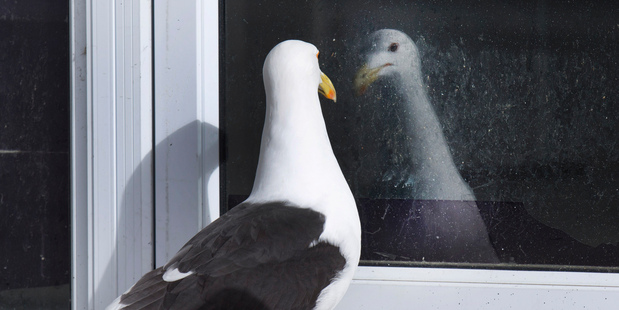
Bewildered bird falls in love with its own reflection

By Nikki Papatsoumas
3:53 PM Wednesday Sep 17, 2014

A bewildered bird has entered into a very one-sided relationship after falling in love with its own reflection.
A seagull pecking at its own reflection
 on a tinted-glass door of a disused factory 
in Waikanae on the Kapiti Coast. 
Photo / Mark Mitchell
The narcissistic seagull has taken up residence at an abandoned building on Omahi St in Waikanae on the Kapiti Coast, north of Wellington.

Carolyn Mitchell, owner of nearby business The Pantry, said the seagull has been there for the last two days, tapping at its reflection all day long.

Ms Mitchell said at first she thought the seagull might have had a mate trapped in the abandoned building.

"But then we realised no, he's actually seeing his reflection, and it is like he thinks it's a mate and he is actually trying to get food in there."

The bird had also begun to gather things to build a nest, Ms Mitchell said.

Saturday, 8 June 2013

Sirocco the Kakapo to return for a 6 week season in Wellington

Very rare chance to meet a kākāpō

He's big, handsome and one of only 124. Sirocco the kakapo, most famous for apparently mistaking Mark Carwardine as a mate (see video), is returning to Wellington to allow people to see close up just what a fantastic bird he is. 


Despite late viewing hours over 4,300 people came face-to-face with the living legend at Zealandia during his first stay in 2011. This time, Sirocco Encounters can be booked at the earlier times of 6.30pm, 7pm, 7.30pm and 8pm.

"It's a much more family-friendly schedule; we want kids to see kākāpō and learn about the issues Sirocco advocates for on behalf of Kākāpō Recovery" says Zealandia's Education and Visitor Experience Manager Brian Ireland.

Unlike the ugly fall-out from most sex tapes, Sirocco's story is one of heady success. He may not be part of the breeding program but he's making more kākāpō another way; Sirocco has turned the world's eyes on the plight of his species - our critically endangered kākāpō, or ‘parrot of the night', of which there are now only 124 left.