As regular CFZ-watchers will know, for some time Corinna has been doing a column for Animals & Men and a regular segment on On The Track... particularly about out-of-place birds and rare vagrants. There seem to be more and more bird stories from all over the world hitting the news these days so, to make room for them all - and to give them all equal and worthy coverage - she has set up this new blog to cover all things feathery and Fortean.
Showing posts with label condor. Show all posts

Wednesday, 17 July 2019

Condor chick confirmed at Zion National Park in Utah

JULY 11, 2019

by Lindsay Whitehurst

A sweeping red-rock cliff at Utah's Zion National Park is now the home of a new California condor chick as the species makes a comeback in the wild three decades after they were on the brink of extinction, biologists have confirmed.

The chick is believed to have hatched in early May on the cliffs just north of Angels Landing, park rangers said. If it survives to flying age in November, it will be the first chick to fledge at the park.

"We're hoping it does fledge, it takes off out of the nest and successfully flies off," said Eugenne Moisa with Zion National Park on Wednesday.

Birds raised in captivity were first released at Vermilion Cliffs near the Arizona-Utah line in 1996, and now more than 88 flying in the two states.

The new chick's parents are the only identified breeding pair in Zion, and are estimated to have been together two years. The female was born in 2006 at the San Diego Zoo and the male hatched in 2009 in Boise, Idaho, before being released into the wild.

Continued 

Sunday, 9 June 2019

Endangered condor may have hatched in Zion National Park


JUNE 1, 2019
There's likely a new baby condor at Zion National Park in southwest Utah.
Park rangers said Thursday that they suspect a pair of endangered California condors has hatched their first egg because of behavior changes between the birds.
They estimate the chick to be about 3 weeks old.
If the chick survives, it would be Utah's first successful hatchling. Zion spokeswoman Aly Baltrus says three chicks have been born at the park but have died before they were old enough to fly.
National Park Service records show the condors were the only breeding pair in Zion as of last year. Park rangers estimate they've been together for two years.
California condors are making a comeback in the wild three decades after nearing the brink of extinction.

Thursday, 7 April 2016

World watches rare moment of a condor egg hatching in the wild

Karina Nowysz
The Daily Buzz
April 5, 2016

Biologists from the U.S. Fish & Wildlife Service are hoping that a rare live stream of a California condor chick hatching will help raise awareness about the endangered birds.

For the first time in history, biologists set up cameras in a cliff side nest at Hopper Mountain National Wildlife Refuge in Ventura Country, California, to capture a condor egg hatch in the wild, according to a news release.

“This live cam takes the viewer right into the nest cave with the condors to watch their behavior and hear the sounds they make,” Charles Eldermire, Bird Cams manager at the Cornell Lab, said in the news release.

“We hope it will really raise awareness about these spectacular but highly endangered birds and the threats they face. We know from past experience that people form a real emotional connection to the birds they see on the cams as they witness a part of nature they’ve never seen before,” he added.

Condor are the largest land bird in North America, known for feeding on carcasses of large mammals, according to the U.S. Fish & Wildlife Service website.


Continued ...

Wednesday, 8 October 2014

In Peru's Blood Festival, It's The Condor Versus The Bull

By EDITOR

Originally published on Wed August 13, 2014 2:52 pm


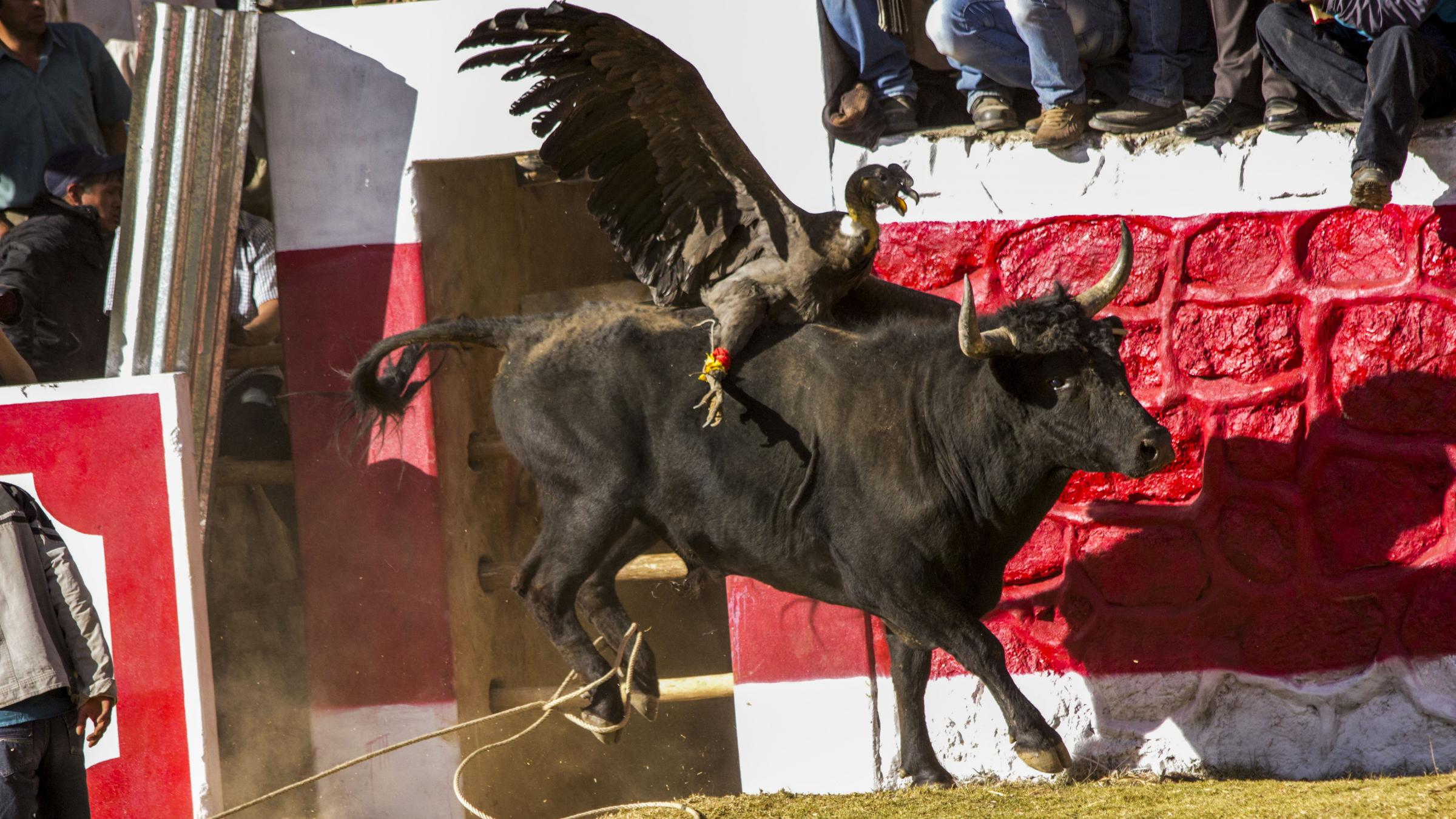
In Peru's annual Blood Festival, a condor is tied to the back of a bull and tries to gouge its eyes, while the bull attempts to shake off the giant bird. The event is popular in many parts of the country, but conservationists say this threatens a bird already at risk.

The Peruvian Blood Festival is a striking spectacle, with a giant condor strapped to the back of an enraged bull in front of a roaring crowd. For many Peruvians, it is a symbolic re-enactment of their liberation from Spanish rule. For conservationists, it is yet another threat to one of the world's largest birds.

To prepare for this annual event, known as the Yawar Fiesta, residents in the small village of Coyllurqui climb into the surrounding cliffs to trap a condor. It may then be held for weeks. But when it's time for the battle, the condor is given alcohol to drink and lashed to the back of a half-ton bull in an arena. The beast then tries to shake off the condor, while the huge bird attempts to gouge out the bull's eyes.

These Andean people believe the condor is a symbol of the Inca nation, and the bull represents the might of the Spanish conquistadors. Though they predominately identify themselves as Christians, villagers see the condor as an Andean god that has come down from the heavens to fight for their freedom.

There's a lot at stake during the battle. If any harm should come to the condor, the villagers believe it's a bad omen for the year — and the dwindling condor population suffers another setback.

Saturday, 19 April 2014

Lead continues to be a serious threat to California condor populations

Date:
April 9, 2014

Source:
Zoological Society of San Diego

Summary:
The California condor was one of the first species to be listed under the Endangered Species Preservation Act in 1966 when the population was reduced to a handful of birds. Through a massive collaborative effort, the condor population has grown to more than 400 birds, more than half of which are now free-flying in the wild. Unfortunately, there is overwhelming evidence that lead poisoning from accidental ingestion of spent ammunition is the leading cause of death in the wild population.


Sunday, 2 March 2014

ENDANGERED BIRDS: Condor comeback: First eggs spotted in breeding season for endangered bird

Posted: Feb 26, 2014 12:50 AM GSTUpdated: Feb 26, 2014 12:52 AM GST
By Christopher Francis - email

TUCSON, AZ (Tucson News Now) -

Wildlife workers are seeing the first signs of what they hope will be a successful breeding season for an endangered bird that was once extinct in the wild.
(Source: Arizona Game and Fish Department)
Earlier this month, workers found eggs in a wild flock of California condors in both Arizona and Utah. Eggs also turned up in a captive flock in Idaho.

Last year, four young condors hatched in the Arizona-Utah wild population, the most ever in one season.

According to the U.S. Fish and Wildlife Service, the California Condor is one of the rarest bird species in the world, with less than 250 living in the wild as of last year. Poaching, poisoning and destruction of their habitat nearly wiped the bird out in the 1980's until an aggressive effort began to save it.

The first egg in the wild Arizona-Utah flock was reported Feb. 11. The adults will incubate it for about two months in their nest at a remote location in Vermilion Cliffs National Monument. Biologists will continue to monitor the birds from afar to confirm when the eggs hatch and the nestlings take their first flight. They will continue to observe the young birds as they are raised by their parents for about a year.


Monday, 28 October 2013

New 'condor cam' captures rare giant bird in wild

A solar-powered "condor cam" in the hills of Big Sur, on the Central California coast, allows the public to view North America's largest birds in the wild from the comfort of home.

The San Jose Mercury News reports the live-streaming camera went online Monday.

It already has captured video of the birds feeding and preening in the wild. There are only about 430 of the massive, vulture-like birds alive in the world today.

Kelly Sorenson, executive director of Ventana Wildlife Society, says the camera is aimed at a main feeding area, and allows scientists to zoom in on each bird so they can identify them.

Like the panda-cam at the National Zoo in Washington, D.C., the condor cam uses inexpensive video technology to help the public interact with wildlife.

The camera can be found at www.ventanaws.org .


Wednesday, 23 October 2013

Dead Condor Found in Tehachapis Had Rare Upbringing

There's an update on the condor that was found dead in a water tank in the Tehachapi Mountains last Wednesday, and it's sad news: the victim was one of very few adult condors that were hatched and reared entirely in the wild.

Condor 630, a female who hatched in June 2011, was found dead by first responder crews practicing during an earthquake readiness drill near Bear Valley Springs in the Tehachapis. She was floating in a "dip tank," a water tank used to supply firefighting helicopters.

Of the 424 California condors known to exist worldwide at the end of August, only 30 adults were hatched and reared in the wild without direct human intervention. Condors are not reproducing well in the wild, and without the continual release of captive-reared birds to boost the population the species would be in even bigger trouble than it is at present.

Sunday, 16 June 2013

California town besieged by endangered birds

Residents of a small California town wish a certain endangered species would make itself scarce.

Flocks of California condors have descended upon Bear Valley Springs. Residents, who are allowed to do little to chase them away, say the huge birds peck off roof shingles, damage air conditioners and leave porches coated in droppings. And although the majestic birds, with a wingspan of nine feet, are widely admired, the gated community of about 5,200 about 80 miles north of Los Angeles has seen enough of them.

“A lot of people used to think seeing a condor was amazing,” local realtor Beth Hall told FoxNews.com. “After seeing the damage they have done, they have become less popular with people, myself included.” 

“After seeing the damage they have done, they have become less popular, among myself included.”

- Beth Hall, local realtor

Unfortunately for the residents, the birds are protected by both federal and state law, leaving them almost powerless to take action. According to the U.S. Fish and Wildlife Service, 66 of the remaining 417 condors live in Southern California.

The condors caused significant damage on the outside of a rental property of Hall's, leaving her with big repair bills. The worst of it took place on her deck after one of the birds opened and spilled a can of white paint. Other condors tracked the paint all around on the deck, Hall said.

Monday, 20 May 2013

Companies won't face charges in condor deaths

The U.S. Fish and Wildlife Service grants exceptions to a wind farm and a building project in harassing or killing the endangered birds. 

By Louis Sahagun, Los Angeles Times 

May 10, 2013, 8:10 p.m. 

Federal wildlife officials took the unprecedented step Friday of telling private companies that they will not be prosecuted for inadvertently harassing or even killing endangered California condors. 

In a decision swiftly condemned by conservationists and wildlife advocates, the U.S. Fish and Wildlife Service said operators of Terra-Gen Power's wind farm in the Tehachapi Mountains will not be prosecuted if their turbines accidentally kill a condor during the expected 30-year life span of the project. 

California condors were brought back from the brink of extinction a quarter-century ago and still cling precariously to survival. Federal law prohibits the harassment or killing of endangered species for any reason. 

Fish and Wildlife also made an exception for the 270,000-acre Tejon Ranch Co., saying that the government will not prosecute if construction of the company's controversial 5,553-acre development of luxury homes, hotels and golf courses violates the harassment ban in the endangered species law. The exception will last for 50 years. The project is expected to consume 8% of the critical condor habitat in the Tehachapis, about 60 miles north of Los Angeles. 

Fish and Wildlife Director Daniel Ashe said the decision reflects a difficult reality. The threat of prosecution jeopardized the construction of large-scale alternative energy facilities and real estate developments in the wild and windy places preferred by condors.

Wednesday, 13 February 2013

“This Is The Greatest Thing I’ve Ever Seen”: An Actual, Live Condor Gets Loose At A Hockey Game

Sean Newell

Man may think he has control over wild beasts, but that is only because the beasts allow it to be so. During the National Anthem of a Bakersfield Condors (ECHL) game a bird man attempted to bring a condor to a perch set up at center ice. Things quickly and hilariously unravelled.

First, the enormous bird freaks out and slips away from the bird man as the singer approaches the thrilling conclusion of the Anthem. Then the bird man regains control of the condor. Then the bird man busts his ass as he scoots back to center ice (you know it's going to happen before he even falls, you're going too fast, man!) and the condor is off. It eventually finds its way to the bench and hops in, scares the bejesus out of the coach and heads back for the locker room.

Sunday, 27 January 2013

Dead condor found in Zion National Park in Utah


Lead poisoning suspected
January 2013. The Peregrine Fund, a driving force behind the conservation of Californian condors, had been hopeful that a pair of condors in Zion National Park would produce the first offspring in the state for many years. 

A Peregrine Fund spokesman said "Our hopeful pairing of adult condors 299 and 343 to be the first successful Utah pair has been hampered over the past few years by us having to treat one of them for lead poisoning during breeding season. Sadly, we have now found the adult 9-year-old female (Condor 343) dead in Zion National Park in Utah. This is a major step back from Utah's first breeding."

Official necropsy results are pending to determine cause of death, but this year's trapping results show a very high rate of lead poisoning in almost all of the Utah foraging birds.

Condor population
There are just 400 Californian condors alive today, of which around 175 are in captivity. The California condor has recovered from only 22 birds left in the world in 1982 to around 400 today. The original 22 birds were captured in an effort to breed and save the species. Condors bred and raised in captivity are now periodically released at sites in California, Mexico and at the Vermilion Cliffs in Arizona.