As regular CFZ-watchers will know, for some time Corinna has been doing a column for Animals & Men and a regular segment on On The Track... particularly about out-of-place birds and rare vagrants. There seem to be more and more bird stories from all over the world hitting the news these days so, to make room for them all - and to give them all equal and worthy coverage - she has set up this new blog to cover all things feathery and Fortean.
Showing posts with label peafowl. Show all posts

Thursday, 6 December 2018

Indian peafowls' crests are tuned to frequencies also used in social displays

Peafowl crest feathers resonate with frequencies used for tail-rattling behavior

Date:November 28, 2018
Source:PLOS

Indian peafowl crests resonate efficiently and specifically to the same vibration frequencies used in peacock social displays, according to a paper published November 28, 2018 in the open-access journal PLOS ONE by Suzanne Amador Kane from Haverford College, USA, and colleagues.

Both sexes of the Indian peafowl (Pavo cristatus) grow a large crest. While many previous studies have focused on the crest as a potential visual signal, this is the first study to focus on crest feathers' potential to sense motion and vibration. The authors used seven male and eight female crests in the lab for their investigations. They microscopically analyzed the crests and confirmed the presence of filoplumes -- specialized small feathers appearing across all types of bird feathers and functioning as mechanosensors. The authors then conducted a series of experiments to determine the crests' range of responsiveness to vibration and force. They exposed the crests to simulated displays of wing-shaking, performed by males, and audio recordings of train/tail-rattling, performed by both males and females in social and sexual contexts.

Tuesday, 16 September 2014

Monk breeds peafowl at ancient pagoda

Last update 10:17 | 14/09/2014

VietNamNet Bridge – The rare bird has re-emerged in Phu Yen Province thanks to the efforts of monk Thich Nguyen Duc.

Safe haven: Caged under the shade of an ancient Bodhi tree, the peafowls now live together with other birds, safe from the threat of being stolen, shot or poisoned. 

Strange and interesting stories about the peafowl – a valuable, rare and endangered bird species – have been circulating in Tuy Hoa City, Phu Yen Province.

It was reported that a monk has been taking care of peafowls in the garden of the Ho Son Pagoda. This has compelled me to go on a trip to the pagoda to see for myself whether the stories are true.

The peafowl is included the Red Book of Viet Nam, a list of rare and endangered species of fauna and flora that are native to the country.

Research shows that the bird can be found in the Yunnan region of southern China, Myanmar, Thailand and Indochina. In Viet Nam, the noble bird can be seen in the Central Highlands, the South Central region, and in the Nam Cat Tien National Park in the southern province of Dong Nai. The State has prohibited the capture and killing of peafowl for quite some time.

The bird can also be seen in zoos in various cities of the country. But elsewhere, it seems to have disappeared. So a number of people were surprised to see a flock of peafowls and other rare birds in the Ho Son Pagoda, in the heart of Tuy Hoa City.

In a history spanning more than 300 years, Ho Son has been supervised by 17 abbots. It now serves as headquarters of the provincial Buddhist Sangha. Its location and beautiful scenery have also made it a favourite destination of Buddhist monks, intellectuals, writers and artists, who enjoy having heart-to-heart talks with monks about poetry, bonsai and birds.

The pagoda's current abbot is Thich Nguyen Duc. He is also an executive council member of the Buddhist Sangha of Viet Nam, as well as deputy chairman and secretary general of the Executive Board of the Phu Yen Buddhist Sangha.

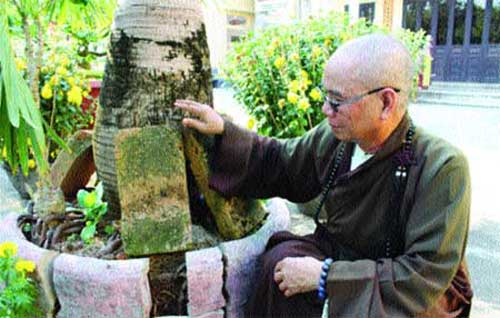
The venerable monk was also once a biology teacher. He remains a lover of nature and literature and had composed poems on meditation. His interest in nature has led him to study rare birds at risk of extinction.