As regular CFZ-watchers will know, for some time Corinna has been doing a column for Animals & Men and a regular segment on On The Track... particularly about out-of-place birds and rare vagrants. There seem to be more and more bird stories from all over the world hitting the news these days so, to make room for them all - and to give them all equal and worthy coverage - she has set up this new blog to cover all things feathery and Fortean.

Sunday, 2 March 2014

Vultures return after bird cannon removal

By Joe Beck

The bird cannon is gone, and the black vultures have returned to the Jamestown Road and Cavalier Drive neighborhood in Front Royal.

The police department's experiment with using a booming cannon to prod the unwanted birds into finding a different perch came to an end when neighbors complained about the noise.

Chief Norman Shiflett is taking some consolation that fewer vultures are being seen in the neighborhood than a few months ago.

"I don't believe there are as many vultures as there were before we put the cannon in place," Shiflett said.

The vultures arrive dependably every evening around dusk and roost in a stand of pine trees next to a long vacant house. They take to the sky in the morning in search of animal carcasses to feed on and return again in the evening.

Police rolled out the bird cannon a little over a month ago after years of complaints by neighbors upset over vulture droppings as well as the birds' smell and unsightly appearance.

Kelly Walker, a neighborhood resident, said last week she noticed about a dozen vultures back in the trees after the bird cannon disappeared.

New York Will Consider Nonlethal Ways to Reduce Swan Population

Score one for swan fans.

A proposal to eradicate mute swans in New York State by killing them met such a backlash that New York Department of Environmental Conservation announced on Friday that it would consider nonlethal means to control the invasive birds.

Swans were introduced to the United States from Europe in the 19th century, but wildlife officials say the beautiful birds destroy habitat for native waterfowl and can attack ducks, geese and even people.

A draft management plan to wipe out the state’s entire population of swans was met with a fierce outcry when it was made public in January. The environmental conservation department received 16,000 form letters in protest, and 30,000 signatures on various petitions.

Saturday, 1 March 2014

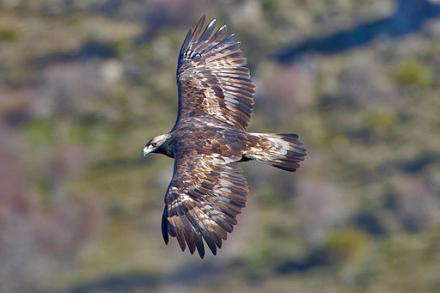
TRACKING: Researchers track Golden Eagles in New York


Wikipedia Commons
There’s a celebratory mood in the air on this cold Saturday in February, in the Catskills town of Andes. Members of the Delaware Otsego Audubon Society, with help from the Department of Environmental Conservation, had for the first time trapped a golden eagle on its winter migration from Canada.
A veterinarian and a DEC biologist measure the surprisingly calm eagle, draw blood and attach a small tracking device to its back. This female is small for a golden eagle, with a 6-foot wingspan, weighting ten pounds, and with talons that are long and black and a bit terrifying.

Tom Salo is the research coordinator for the Audubon Society. Salo says there have been many challenges trapping one - they don’t always go for the bait.

“We’ve actually, at one of our sites, had golden eagles stop eating the venison bait we put out and start killing ravens and eating live ravens, which makes it a little harder for us to trap them,” says Salo. 

Scientists find egg of bird presumed extinct

WELLINGTON: New Zealand scientists announced on Friday they had found the egg of an endangered bird that was presumed extinct for more than a century. 

Researchers found the New Zealand storm petrel egg on Little Barrier Island, off the northeast of the North Island, a year after the birds were tracked to breeding sites on the island. 

Scientists took the opportunity when the female was off the nest to check the egg, which is expected to hatch in April, and record data, Xinhua reported citing a statement issued by New Zealand's Department of Conservation (DOC) statement. 

"It was exciting to see the egg of a bird once thought to be extinct," Graeme Taylor, DOC principal science advisor, said in a statement leading the team. 


INVASIVE SPECIES: Invasive doves colonize Colorado and overshadow "good" doves

POSTED: 02/25/2014 12:01:00 AM MST11 COMMENTS
UPDATED: 02/25/2014 08:23:32 AM MST


GRAND JUNCTION — "Hwwwwwaaaaaaaahhh."

It's an annoying sound, described as a screech, a hiss or a nasally shriek. And it's being heard much more often these days from the backyards of Denver to the pasture lands around Cortez.

It is the sound of an avian interloper, the Eurasian collared dove. This bad bird has found its way northwest from the Bahamas and made itself at home across the United States.

It has invaded Colorado and, besides irritating humans with its noise, it bullies other birds. It has become so pervasive that some birders worry it might eventually muscle out other species like the common mourning dove.

"It is noisy and obnoxious," said William Kaempfer, a vice chancellor and provost at the University of Colorado and one of the state's pre-eminent birders.

The first Eurasian collared dove spotted by ornithologists in Colorado was in Rocky Ford in 1996. In the latest Audubon Christmas Bird Count, there were close to 19,000 in the state. They have now populated all 64 counties in Colorado. Fort Collins, with 3,177 collared doves, showed the highest concentration of the birds in the nation last year.


What a stink! Street drenched in bird poo after invasion by 20,000 starlings

A suburban street is being drenched in bird droppings after being invaded by a flock of 20,000 starlings

The huge swarm - called a murmuration - turns the sky black at dawn and dusk as they prepare to feed or roost for the night.

But they also shower the street in droppings.

Residents cower under umbrellas when they venture outdoors and clean their cars and windows on a daily basis.

The birds arrived in the street at the start of the year as they flew south to escape the bitterly cold winter in their native Scandinavia.

They perform spectacular acrobatic displays before returning to a Leylandii hedge at the back of the houses in Hereford to roost.

Bewick’s swans migrate but leave cygnet behind

February 2014: A Bewick’s swan cygnet appears to have abandoned by his parents at WWT Slimbridge Wetland Centre in Gloucestershire. Yesterday WWT researcher Julia Newth, who recognises the hundreds of swans in the flock by their individual face markings, saw that one family had acquired an additional youngster.

The lone cygnet has latched onto Slimbridge regulars Wooton and Stinchcombe and their four cygnets, but is spending much of its time calling in the hope of being reunited with its own parents.

Bewick’s swans migrate in large family groups and due to recent mild weather all but 10 of the Slimbridge flock have departed already.

Julia Newth said: “Occasionally, cygnets become separated from their parents during migration when there is perhaps bad weather, but it is rather more unusual to see such a separation before the journey has begun.

“We’re all waiting to see whether the parents return. If they don’t, and the cygnet leaves with its adopted family, we will call on our extensive network of swan researchers along the 2,500 mile journey to Russia to keep an eye out for them and check whether the lone cygnet manages to stay with them.”