As regular CFZ-watchers will know, for some time Corinna has been doing a column for Animals & Men and a regular segment on On The Track... particularly about out-of-place birds and rare vagrants. There seem to be more and more bird stories from all over the world hitting the news these days so, to make room for them all - and to give them all equal and worthy coverage - she has set up this new blog to cover all things feathery and Fortean.

Wednesday, 2 April 2014

Bird cam! Rare birds nest on top of council offices can be viewed live

A pair of peregrine falcons have laid an egg after returning to their nesting platform on top of County Hall.
Peregrine Falcoln
And budding ornithologists have the opportunity to see exactly what is going on in the nest, via a live web feed.

The egg, which is expected to hatch in May is in a unusual place for the fastest birds in the world, which traditionally nest on coastal cliffs.

Over the last two decades bird watchers have increasingly seen the falcons begin to move into towns and cities, where tall buildings provide perfect nesting sites.

Another factor that has tempted them to Aylesbury is the plentiful food supply in the form of flocks of feral pigeons.

Peregrines were first observed regularly in Aylesbury in the winter of 2006 and two years later a nesting platform was erected at the top of county hall. The birds first bred successfully in 2012 and have hatched young every season since.

Tuesday, 1 April 2014

THREATENED BIRD SPECIES: Texas native bird added to threatened species list

Posted: Sunday, March 30, 2014 8:51 pm

By Kaylin McDermett 
Staff Writer |


A native West Texas bird species has recently been added to the list of threatened animals because of a sharp population decrease.

Tympanuchus pallidicinctus, or more commonly known as the Prairie Chicken, was placed on the list of threatened species, which is a step below the level of an endangered species under the federal Endangered Species Act.

Calvin Richardson, with Texas Parks and Wildlife, said the bird used to be a common sight on the Great Plains, but over the past few years, both natural and man-made factors have caused a population decline.

“We’ve had three years of drought, going into the fourth year,” he said. “It’s real hard to separate man-made threats from natural ones. The chicken is so difficult because they are bothered by many man-made developments, but they are also extremely susceptible to drought even without man-made threats.”

The Prairie Chicken is found across the Great Plains in Texas, New Mexico, Colorado, Oklahoma and Kansas, according to the Texas Parks and Wildlife Department’s website.

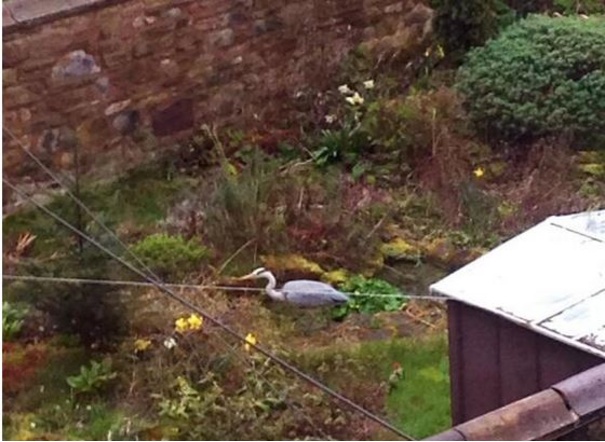
OUT OF PLACE BIRDS: California bird makes a rare stop-off in Scotland


Well, we were positively delighted to see a picture of this extremely rare bird feeding in a garden in Newington this morning. Eagle-eyed @SGalley_Recruit spotted it eyeing up the frogs. If it is a blue heron then it's quite a spot, as these birds are usually sighted in North America and Central America as well as the Caribbean and the Galápagos Islands.

I loathe pigeons! They're ugly, stupid bullies says RACHEL BILLINGTON. And they're taking over our gardens

Sightings of pigeons in gardens has increased by 743 per cent in 35 years
Robins have reduced their cheeky, inquisitive appearances by 45 per cent
According to the RSPB, there are 5,400,000 breeding pairs of wood pigeons in the UK


PUBLISHED: 01:26, 31 March 2014 | UPDATED: 01:26, 31 March 2014

Shocking news: That enchanting friend of the British gardener, the robin, is disappearing and an insalubrious monster, the pigeon, is taking over.

If you do not believe me, just look at the figures from last week’s RSPB’s Big Garden Birdwatch survey.

In the past 35 years, sightings of pigeons in our gardens has increased sevenfold, or a horrible 743 per cent, while robins have reduced their cheeky, inquisitive appearances by 45 per cent.

I suppose there’s someone who welcomes a pigeon into their garden. Probably the same person who feeds them in Trafalgar Square before retiring out of range.

But the truth is, pigeons are stupid, irritating, destructive and ugly.

The ugly part is worth pursuing because, objectively, they should be rather handsome — imagine one stuffed and put into a glass case, with its tightly packed blueish-grey feathers, its smart white collar and pink-tinged waistcoat. In life, however, they somehow end up being quite hideous.


So are a lot of humans my dear 


RISK OF EXTINCTION: Europe’s smallest bird at risk of extinction

BY TPN/ LUSA, IN NEWS · 31-03-2014 08:41:00 

The estrelinha de Santa Maria, Europe’s smallest bird, is at risk of extinction due to the deterioration and loss of its natural habitat in the Portuguese archipelago of the Azores, José Andrade Melo, of the Friends of Santa Maria Heritage Club, was reported as telling the Lusa News Agency.

The Estrelinha de Santa Maria, or to give it its scientific name ‘Regulus regulus sanctae-mariae’, survives in a few areas of the Azorean island of Santa Maria in areas of subtropical humid laurel forests.

There, the Estrelinha finds its diet of insects, worms and spiders that enables it to grow up to 9 cm in length and with a wingspan of between 12 and 14 cm.

“The fact that the bird is confined to such a small space in territorial terms, that is the island of Santa Maria, in itself, already deserves a special conservation statute with the political and scientific obligation to come up with a preservation plan,” said Andrade Melo.

Instead, the loss of forest on the island was jeopardising the survival of the species.

“It is the very National Institute of Nature Conservation and Biodiversity that slaps the estrelinha with the statute of at risk of extinction,” said the NGO coordinator.

CRUELTY TO BIRDS: Staten Island woman runs over neighbor’s hen and puts cigarette in the bird’s beak: cops

Michelle Conti, 32, told cops she drove the car toward a flock of birds belonging to her neighbors and then put the cigarette in the beak, according to a criminal complaint. "I was being a jerk. That’s not a crime,” she allegedly told cops.
NEW YORK DAILY NEWS 
Published: Thursday, March 27, 2014, 1:39 PM
Updated: Sunday, March 30, 2014, 7:22 AM


Michelle Conti told cops she ran over one of her neighbors' hens and then put a cigarette in its beak, cops said.

It was murder most fowl.

A Staten Island woman intentionally ran over a neighbor’s hen and then stuck a cigarette in its beak, cops said Thursday.

Michelle Conti, 32, was charged with criminal mischief and torturing an animal for the bizarre Sunday incident — but allegedly told cops she didn’t think she’d broken any laws.

Conti said her elderly neighbors own more than 15 hens, and the birds are making her “crazy.”

“I drove the car toward the flock of birds hitting one of the birds,” she told cops, according to a criminal complaint.

“I later came back, kicked the bird and put a cigarette in its mouth. I was being a jerk. That’s not a crime,” she insisted.

Climate change causes massive decline in Kittiwake numbers

March 2014:climate change is causing a massive decline in kittiwake numbers in northern Scotland believe scientists with the risk of some colonies disappearing completely.

The latest figures show an 87 per cent decline in kittiwakes on Orkney and Shetland since 2000. The islands were once home to thriving cliff colonies of thousands of birds – but today many of these cliffs are virtually empty in the breeding season. Research indicates that sea temperature changes are affecting the availability of their key food source – sandeels.

Paul Walton, Head of Habitats and Species for RSPB Scotland, said: “Ten years ago Marwick Head on Orkney was a thriving seabird city – but now it looks like a ghost town. And it’s not just kittiwakes, guillemots have also halved in number. A few abandoned nests remain in the breeding season on some cliffs, which are now silent and empty, instead of alive with noise and activity as they were just a few years ago.