As regular CFZ-watchers will know, for some time Corinna has been doing a column for Animals & Men and a regular segment on On The Track... particularly about out-of-place birds and rare vagrants. There seem to be more and more bird stories from all over the world hitting the news these days so, to make room for them all - and to give them all equal and worthy coverage - she has set up this new blog to cover all things feathery and Fortean.

Friday, 2 May 2014

Predators predict longevity of birds, study concludes

Date:
April 30, 2014

Source:
Max-Planck-Gesellschaft

Summary:
Aging inevitably occurs both in humans and in other animals. However, life-span varies widely across species. Researchers have now found a possible general mechanism explaining differences in longevity. They investigated life history data of nearly 1400 bird species and found that avian life span varies considerably across the entire Earth, and that much of this variation can be explained by the species' body mass and clutch size and by the local diversity of predator species. The researchers were able to confirm a key prediction of the classical evolutionary theory of aging that had been proposed more than 50 years ago.

Thursday, 1 May 2014

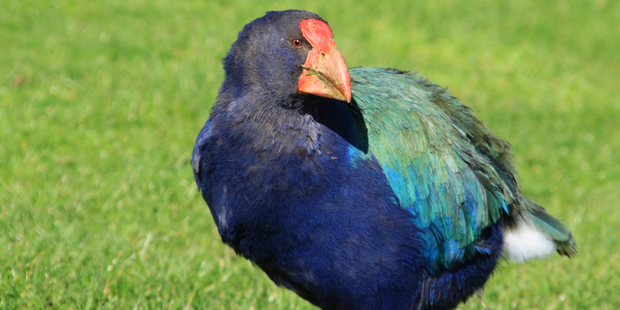
New home for takahe at Tawharanui

10:15 AM Thursday Apr 24, 2014

A new haven for takahe, one of New Zealand's most threatened native bird species, will be set up north of Auckland at Tawharanui.

The large blue-green flightless birds were thought extinct until rediscovery in 1948. Only about 260 birds are left including about 60 safe breeding pairs.

A release of takahe to the largely predator-free Tawharanui Open Sanctuary within the Tawharanui Regional Park is planned for spring 2014. The sanctuary is already home to kiwi, saddlebacks, kakariki, bellbirds, robins and kaka.

"Welcoming a treasured species like takahe to Tawharanui is a sign of maturity for the open sanctuary and and a measure of success for this community-focused park," Auckland Council spokeswoman Christine Fletcher said.

"Takahe are a significant taonga for Maori and we look forward to working with iwi on this project."

The project is a partnership between the council, Tawharanui Open Sanctuary Society, Mitre 10 MEGA Warkworth and the Department of Conservation.


A new stretch of takahe-proof fence will need to be built before the birds are released.

While major sponsor Mitre 10 will make it possible to build the fence, the open sanctuary society is also appealing for donations to reach its $30,000 fundraising target to house and care for the birds.

RSPCA express horror after Red Kite is shot in Wellingborough

Written byLAWRENCE JOHN


The RSPCA is appealing for information after a rare bird of the prey – a Red Kite – was shot in Wellingborough.

The bird suffered from a badly injured wing in the incident and was taken to East Winch Wildlife Centre in Norfolk.

The Red Kite, which is afforded the highest degree of legal protection under the Wildlife and Countryside Act, was x-rayed and it was found to be peppered with pellets from a shotgun from the incident around April 4.

Sadly, the bird was so badly injured it had to be put to sleep.

Centre manager Alison Charles said: “We are all quite horrified that someone has taken a pot shot at such a beautiful bird. We do not get many in this area.

“It is even more frustrating because it is well known that the Red Kite was saved from extinction in the UK and has now been successfully reintroduced to England and Scotland – but it is still a protected species because of its historical decline.


Herald & News: Lack Of Bird Refuges Plan Spurs Lawsuit

The Klamath Falls Herald and News | April 24, 2014 8 p.m. | Updated: April 25, 2014 1:21 p.m.

CONTRIBUTED BY:


LACEY JARRELLH&N Staff Reporter

Three conservation groups filed a lawsuit Thursday against the federal wildlife agency tasked with developing new management tools for Klamath Basin wildlife refuges.

According to a news release, the three groups — the Audubon Society of Portland, Oregon Wild and WaterWatch of Oregon — filed the suit to compel the U.S. Fish and Wildlife Service to release a Comprehensive Conservation Plan (CCP) for the Klamath Basin National Wildlife Refuge Complex. The Klamath Basin CCP is 18 months past deadline.

The plan is long overdue in area of such “extraordinary ecological importance,” said Jim McCarthy, communications director and Southern Oregon program manager for WaterWatch of Oregon.

“The fact we don’t have a plan for these refuges 18 months out is just not right,” McCarthy said.

The National Wildlife Refuge System Improvement Act of 1997 requires the USFWS to develop and implement a plan for each unit within the national wildlife refuge system, according to the release.

Saving birds from Audubon Society?

By Bill Gregware 

"Climate change is the single greatest threat to both birds and people," says David Yarnold, CEO/President of the Audubon Society, adding, "We need to deploy renewable energy resources aggressively ... if we are to meet the challenge of our lifetime."

This is nothing new; the society has been an outspoken advocate for a decade or more of renewable energy of any type, without consideration for costs or benefits. The true believers have been led by the pied pipers of renewables down a path of unintended consequences that have resulted in the death of billions of birds. Apparently, they believe the bird deaths are not in vain, because the results justify the means. By sacrificing billions of birds now, we are saving many more (and the entire human species as well) in the long run.

The three main types of renewable energy that have been pushed so hard by various political administrations and Audubon are biofuels, wind and solar. 


Why Do Barn Owls Divorce?

Posted by Jennifer S. Holland in Weird & Wild on April 29, 2014

Love is a fickle thing—even in barn owls. These normally monogamous birds sometimes call it quits and move on to new partners—nearly a quarter of the time, in fact, says a new study published April 28 in the Journal of Evolutionary Biology. Among people in the U.S., the divorce rate is about 40 percent.

And while these “divorces” may mean sacrificing quality for quantity, both sexes can benefit from the split.

On a faithful note, barn owls tend to divorce only when breeding isn’t going well—for example, if there are only a few eggs laid or not many surviving chicks. When a pair is making a lot of babies, the birds remain quite loyal—and that chick-making relationship only gets better with time because the two mate more often, potentially maximizing the size of the family long-term.

Sometimes, It’s Splitsville 
Amélie N. Dreiss and Alexandre Roulin, of the University of Lausanne, Switzerland, studied a population of free-living barn owls in western Switzerland for 24 years, observing how the pairs bonded and how many babies they had.

Barn owls are productive parents, often laying two broods per year with up to 11 (an average of six) eggs per brood.

Urban river pollutants suppress wild bird development

Date:
April 28, 2014

Source:
Cardiff University

Summary:
Hormone disrupting pollutants are affecting the health and development of wild birds nesting along the urban rivers of South Wales, new research shows. Findings reveal that chicks of the Eurasian Dipper -- a river bird that feeds exclusively on insects and fish in upland streams -- are underweight compared to their rural counterparts. Also of concern is that birds nesting in urban rivers have altered hormone levels, and are hatching fewer female chicks than those nesting along rural rivers, which could have negative implications for the population’s breeding and survival.